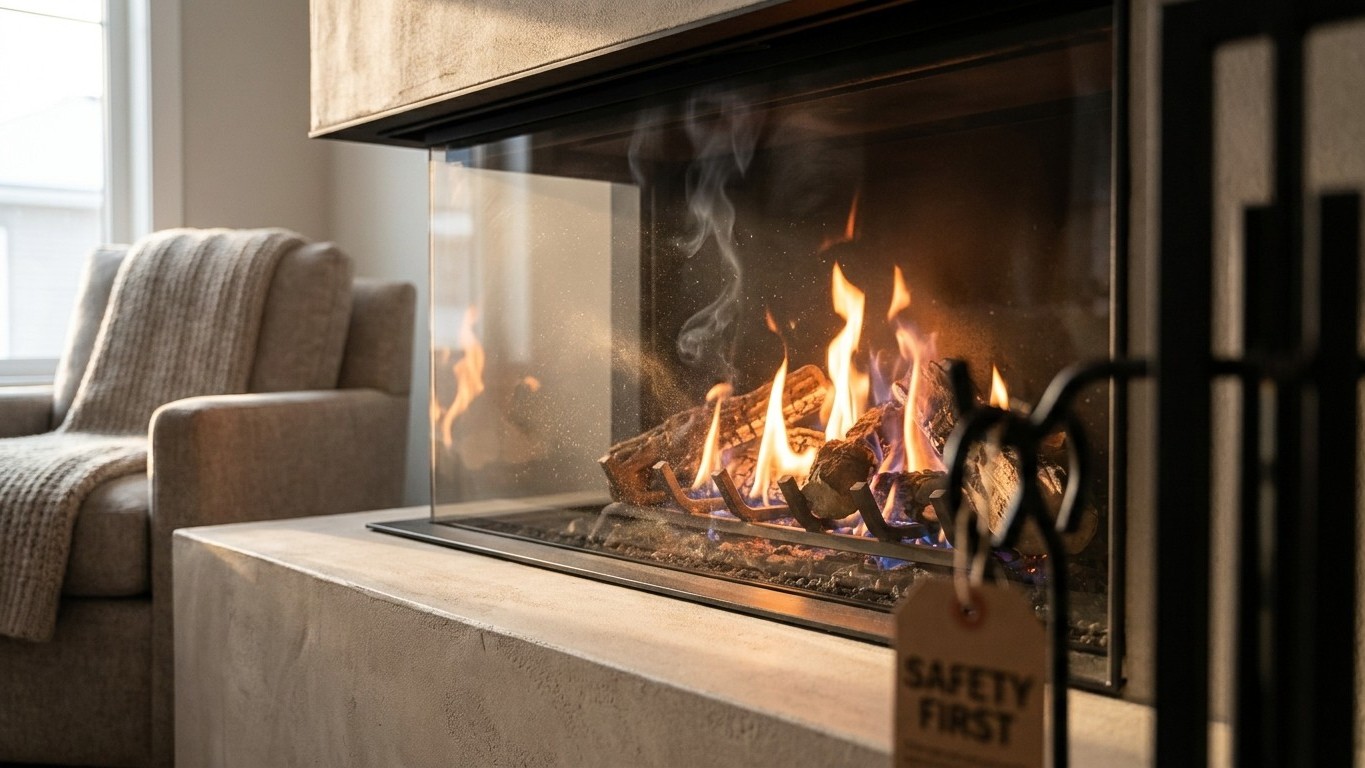

A gas fireplace smell usually comes down to dust and manufacturing residue burning off the burner and heat exchanger during the first fire of the season, and it fades within an hour or so. That’s the ordinary case. The one exception overrides everything else: if the smell resembles rotten eggs or sulfur, that’s not dust. That’s the odorant added to natural gas and propane specifically so leaks get noticed, and it means stopping what you’re doing, leaving the house, and calling from outside. Everything below sorts the harmless from the urgent.
The smell that means stop

Natural gas and propane have no smell of their own. Utility companies and propane suppliers add a sulfur-based compound to both fuels for exactly one reason: so a leak announces itself before it becomes dangerous. That rotten-egg or sulfur smell around a gas fireplace, a gas line, or a propane tank is not a maintenance quirk. It’s a deliberate warning system, and it works only if the person who smells it acts immediately instead of trying to figure out where it’s coming from.
If that smell shows up, don’t flip a light switch, don’t strike a match, don’t turn the fireplace on or off, and don’t go looking for the source with a flashlight. Any spark, including the small one inside a wall switch, can be enough in a gas-saturated space. Leave the house. If you can do it safely on the way out, prop a door open behind you, but don’t stop to investigate anything. Get everyone, including pets, outside and away from the building.
Once outside, call the gas utility’s emergency line or 911 from a neighbor’s phone or a cell phone. Don’t go back inside to grab a phone you left behind. Utilities treat these calls as a priority and will typically dispatch someone to check the line, the meter, and the appliance before anyone is allowed to return.
This response applies whether the smell is faint or overwhelming. A weak whiff of sulfur is not a lesser event that can wait until morning. Gas concentrations don’t announce themselves in a straight line, and a smell that seems mild one minute can be sitting on top of a leak that’s still building. Trust the smell, not a guess about how serious it “probably” is.
It’s worth being clear about what this is not. The smell described here is sharp, sulfurous, and unmistakable once you’ve encountered it, distinct from the dusty, faintly smoky smell of a fireplace’s first burn of the season, which is covered next. If there’s any doubt which one you’re smelling, treat it as the gas leak until a professional says otherwise. Only a gas utility technician or fire department representative should clear a home for re-entry after a suspected leak, and no one should try to relight a pilot light or restart an appliance until that clearance happens.
The first fire of the season
Most gas fireplace odor complaints trace back to something far less alarming: dust. Over months of not running, household dust settles on the burner, the heat exchanger, and the surrounding metal surfaces inside the firebox. The first time the appliance fires up for the season, that dust burns off, and it produces a faint, dry, slightly smoky smell along with a bit of visible haze near the unit. This is normal combustion of accumulated household particles, not a sign of a mechanical problem.
That burn-off smell should clear within the first hour of operation. Cracking a nearby window during that first burn helps move the smell out faster and is a reasonable habit at the start of every heating season, whether the unit is new or has been in service for years.
New appliances smell different, and longer
A brand-new gas fireplace carries its own version of this same idea, just with different sources. Manufacturing oils, protective coatings, and the paint used on interior metal components need to cure under heat, and that curing process releases a noticeably chemical smell the first several times the unit runs, not just the first time. This is standard for new gas appliances of many kinds, from ranges to space heaters, and it isn’t unique to fireplaces.
Where the timeline differs is duration. A new unit’s break-in smell can take a few uses rather than a single hour to fully dissipate, since the coatings need repeated heat cycles to finish curing. Good ventilation during those early burns, the same open-window approach used for dust burn-off, speeds the process along.
What separates a normal burn-off from a problem is whether it fades. Dust smell that clears inside an hour, or new-unit smell that fades over the first handful of uses, fits the pattern of ordinary curing and doesn’t call for a service visit. A smell that lingers well past that window, that gets stronger instead of weaker, or that shows up again after the appliance has already been running trouble-free for a season, is a different situation and points toward the observations covered next.
The smells that mean something else
Between “it’s just dust burning off” and “call the utility right now” sits a middle ground: smells that aren’t dangerous in the moment but aren’t routine either, and that are worth reporting to a qualified technician rather than diagnosing at home. Each one points in a different direction, and none of them should be assumed away just because the fireplace still seems to run fine.
- A sharp chemical smell that doesn’t fade — unlike the curing-oil smell of a brand-new unit, a chemical odor that persists well past the expected break-in period, or that shows up on an appliance that’s been running for years, is worth flagging to a technician rather than waiting out.
- A sooty smell on a vented appliance — vented units are designed to send combustion byproducts outside, so a sooty smell inside the room suggests something about that venting path or the combustion process itself isn’t working as designed, and it’s a reasonable prompt for an inspection.
- A damp or sour smell from a flue that’s gone unused — chimneys and flues that sit idle for long stretches, especially over summer, can pick up moisture, debris, or even animal activity, and a musty or sour smell when the appliance first runs is worth reporting before a full heating season gets underway.
- A burning-plastic smell — distinct from the smell of gas or dust, this points toward wiring or an electrical component rather than the combustion side of the appliance, and it’s the kind of detail worth describing precisely to whoever services the unit.
The point of listing these isn’t to hand out a home diagnosis for each one. It’s to give homeowners the vocabulary to describe what they’re smelling accurately when they call for service, since “it smells weird” gets a technician a lot less far than “sooty smell, vented unit, started last week.” Precise reporting shortens the visit and often the wait for parts.
Vent-free appliances and the smell question
Everything above assumes a smell is a departure from normal operation. Vent-free appliances complicate that assumption, because for them, some odor is part of how the appliance is designed to work, not a sign that something’s off.
A vented appliance sends its combustion products outdoors through a flue or a direct-vent terminal. A vent-free appliance has no such path. It releases its combustion products, including water vapor, directly into the room, and depends on the room’s ordinary ventilation to handle what’s released. That single design difference is why vent-free units are more likely than vented ones to produce a noticeable, ongoing smell, and why occupants who are sensitive to odors tend to notice vent-free appliances more than vented ones over time.
What keeps a vent-free unit safe
According to the U.S. Consumer Product Safety Commission, currently manufactured unvented gas-fired room heaters are required by the industry’s voluntary standard to carry an oxygen depletion sensor, which shuts off the gas supply before carbon monoxide can reach a life-threatening level. That requirement traces back to an unusual regulatory history: the CPSC had a mandatory federal standard in place, but revoked it in 1984, by which point 95 to 100 percent of manufacturers had already complied. The safeguard that protects vent-free heaters today comes from that voluntary industry standard, not from an ongoing federal mandate.
The CPSC also notes what that sensor is protecting against. An unvented heater has no outside vent to carry combustion products away and depends on ordinary room ventilation instead. Inadequate airflow, a maladjusted burner, or both together with the normal drop in room oxygen as fuel burns, can let carbon monoxide accumulate to fatal levels. Carbon monoxide itself is colorless and odorless, so a working CO alarm is the only detection method a household actually has for it. An electric appliance, by contrast, burns nothing and produces none.
None of this means every vent-free fireplace is a safety problem, and none of it means every smell from one is routine either. It means the smell question for vent-free appliances is partly a design question rather than purely a maintenance one. For anyone deciding between the two appliance types, that distinction, along with how each handles moisture, ventilation, and long-term indoor air quality, belongs earlier in the buying decision. Our guide on vented vs. vent-free gas fireplaces covers that comparison directly, and our page on carbon monoxide alarms for gas fireplaces covers what a household actually needs to have in place regardless of which type is installed.
Common questions
Is it normal for a gas fireplace to smell when first turned on?
Yes, a faint, dusty smell during the first burn of the season is normal and comes from household dust burning off the burner and heat exchanger. It should clear within about an hour, and opening a nearby window during that first burn helps it clear faster.
How long should a new gas fireplace smell last?
New units carry manufacturing oils and paint that need to cure under heat, and that produces a chemical smell over the first several uses rather than a single burn. If the smell hasn’t faded after multiple uses, it’s worth mentioning to whoever installed the unit.
What does a rotten-egg smell near a gas fireplace mean?
It means a possible gas leak. That sulfur smell is a compound added deliberately to naturally odorless gas so leaks get noticed. Leave the house immediately without operating any switches or searching for the source, and call the gas utility or 911 from outside.
Do vent-free gas fireplaces always smell?
Not always, but they’re more prone to it than vented units because they release combustion products and water vapor directly into the room instead of sending them outside through a flue. Occupants sensitive to odors tend to notice this more than those with a vented appliance.