
a Gas Fireplace that won’t light almost always comes down to one of four things: the gas is shut off somewhere between the meter and the appliance, the wall switch or remote has dead batteries, the pilot has gone out, or the thermocouple/thermopile that proves the pilot flame is dirty or misaligned. Work through those in order before assuming the worst. If you smell gas at any point, stop and get out.
Check in this order

Before touching anything, know what kind of appliance you have. A vented fireplace sends combustion products outdoors through a flue or a direct-vent terminal. A vent-free appliance releases them, along with water vapor, directly into the room. That distinction matters for every step that follows, because vent-free units carry a safety sensor that can shut down the flame for reasons that have nothing to do with a broken part.
With that in mind, work through the checks from simplest to most involved:
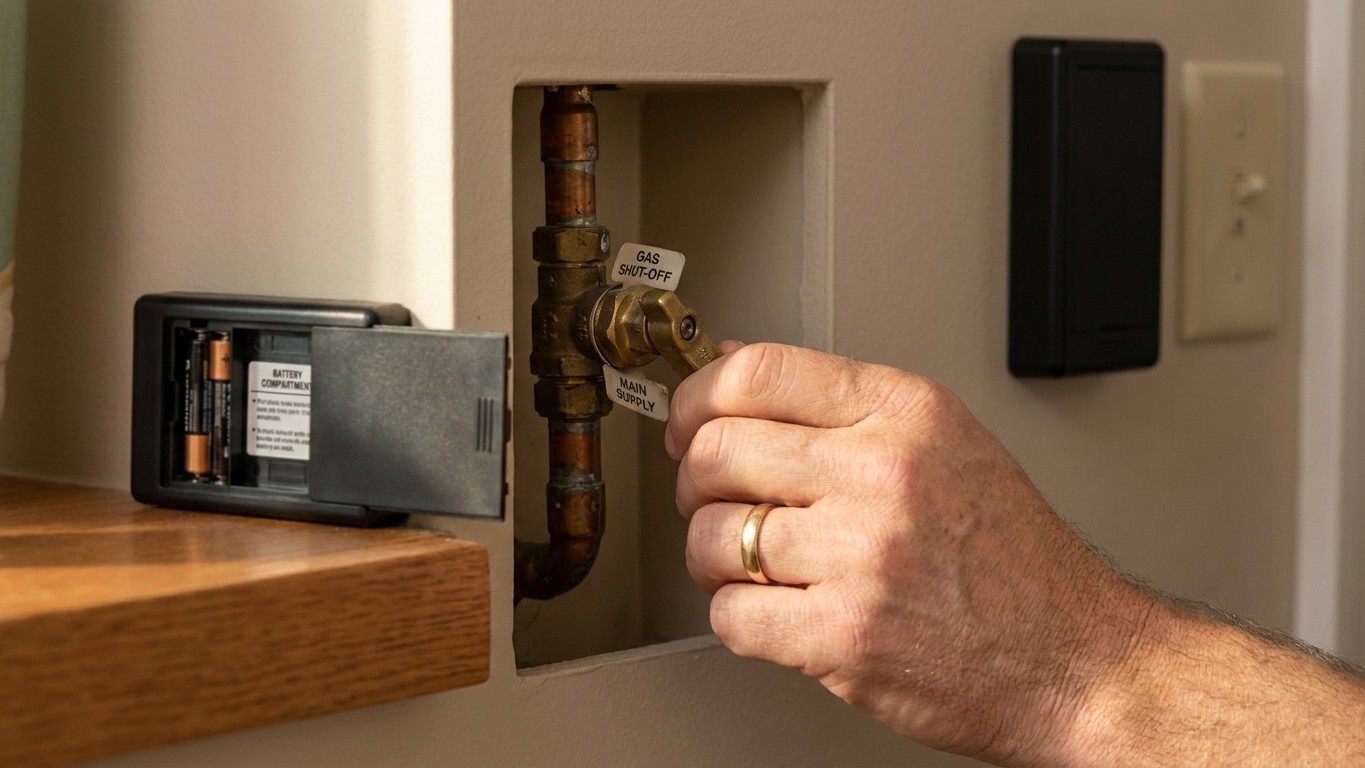
- Gas valve at the appliance. Look for a small lever or knob, usually behind an access panel or in a nearby closet. It should be parallel to the pipe when open, perpendicular when closed.
- Gas valve at the meter. If the appliance valve is open and nothing changes, check the shutoff valve at the meter itself. It’s sometimes closed after storms, gas work in the neighborhood, or a missed payment.
- Wall switch or remote, and its batteries. Many gas fireplaces run their ignition system off a battery pack, separate from house power. Dead AA or AAA batteries in the receiver or the remote are one of the most common reasons for a fireplace that simply does nothing when you press the button.
- The pilot, if the unit has a standing one. Some fireplaces keep a small flame burning at all times. If that flame is out, the main burner has no way to ignite.
- The thermocouple or thermopile. This is the small sensor near the pilot flame that proves it’s actually burning. If it’s coated in soot or bent out of position, the appliance will refuse to stay lit, or refuse to light at all.
Here’s where the line has to be drawn clearly. Turning a valve, swapping batteries, and relighting a standing pilot with the manufacturer’s printed instructions are all things a homeowner can reasonably do. Anything past that, opening the gas valve body, adjusting the gas train, cleaning or replacing a thermocouple, or investigating a suspected leak, is work for a licensed technician. Gas fireplaces aren’t the place to improvise with pliers and a flashlight.
Standing pilot or electronic ignition
This is the fork in the road that decides which of the remaining troubleshooting steps actually apply to your fireplace. An appliance with a standing pilot keeps a small flame burning around the clock, whether the main burner is running or not. That flame is monitored by a thermocouple or thermopile, a sensor that generates a tiny electrical signal only when it senses heat from the pilot. No flame, no signal, no gas flow to the main burner. This is the older, simpler design, still common in many Freestanding stoves and older fireplace inserts.
An appliance with electronic ignition works differently. There’s no flame burning between uses. Instead, a spark igniter (sometimes called intermittent pilot ignition) or a direct electronic ignition system lights the burner on demand, when you press the remote or flip the switch. These systems need a power source, usually batteries, sometimes a direct electrical hookup, and a control module that manages the spark and the gas valve together.
How to tell which one you have
Open the glass front or lower access panel and look inside. If you see a small flame burning continuously near the burner, even when the fireplace is “off,” you have a standing pilot. If the space is dark and silent until you activate the fireplace, and you hear a clicking or see a spark when you do, you have electronic ignition.
The two systems fail differently, which is exactly why the diagnosis has to start here. A standing pilot problem is almost always about the flame itself, whether it’s lit, whether it stays lit, and whether the sensor can prove it. An electronic ignition problem is more often about power, a dead battery, a tripped circuit, or a control board issue. If your fireplace has a pilot that won’t stay lit or won’t light at all, the pilot light troubleshooting guide walks through that specific failure in more detail.
Why a dirty sensor puts the fire out
This explains the single most common symptom homeowners report: the pilot lights fine, stays lit as long as you hold the button down, and dies the moment you let go. That’s not a coincidence, and it’s not user error. It’s the sensor doing exactly what it’s designed to do.
A thermocouple, or the larger thermopile used on some models, generates a small electrical voltage from the heat of the pilot flame itself. That voltage is what holds the gas valve’s safety circuit open. Holding the igniter button down bypasses that circuit temporarily, giving the pilot flame time to heat the sensor and build up enough voltage on its own. Release the button too soon, before the sensor has generated enough signal, and the valve snaps shut, cutting gas to the pilot and killing the flame.
Over months and years, soot, corrosion, or a sensor tip that’s drifted slightly out of the flame’s path can all reduce the voltage the thermocouple produces. Even if the pilot lights and burns, the sensor isn’t reading enough heat to convince the valve it’s safe to stay open. The result looks exactly like a bad pilot, but the flame itself is fine, the sensor’s proof of it isn’t reaching the valve.
A wear part, not a warranty claim
Thermocouples and thermopiles are considered wear parts. They degrade with normal use and are one of the more common, and comparatively inexpensive, repairs on a gas appliance. That said, replacing one means working directly on the gas valve and burner assembly, which is squarely technician territory on any gas-fired fireplace. A cleaning with fine sandpaper or an alignment tweak might buy a homeowner some time on some standing-pilot models per the manufacturer’s manual, but diagnosing weak millivoltage and swapping the part correctly calls for a meter and training most households don’t have on hand.
The one check that stops everything
Every step above assumes there’s no gas smell. If there is, none of it applies. Stop troubleshooting immediately. Don’t flip switches, don’t strike a match, don’t even trust the wall thermostat. Leave the house and call the gas utility or emergency services from a phone outside, or from a neighbor’s home. This is not a step to fold into a troubleshooting checklist; it overrides the checklist entirely.
Safety around gas fireplaces goes beyond leaks, though. Appliances that are vent-free release their combustion byproducts and water vapor straight into the living space rather than outdoors. Because of that, currently manufactured unvented gas-fired room heaters are required, under the industry’s voluntary standard, to carry an oxygen depletion sensor (ODS) that shuts off the gas supply before carbon monoxide can build to a life-threatening level, according to the U.S. Consumer Product Safety Commission. It’s worth knowing this came from an industry standard, not a federal mandate; the CPSC actually revoked its own mandatory requirement back in 1984, by which point 95 to 100 percent of manufacturers had already fallen in line voluntarily.
The reason this matters for a fireplace that “won’t light” is that an ODS tripping can look identical to a faulty pilot or dead thermocouple. Because an unvented heater has no outside vent and depends entirely on ordinary room ventilation, poor airflow, a blocked vent grille, or a burner that’s out of adjustment, combined with the normal drop in room oxygen as fuel burns, can trigger the sensor and shut the gas off as designed. That’s not a malfunction to force past; it’s the safety system doing its job, and it usually means the room needs better ventilation or the appliance needs a professional look, not a repeat attempt to relight.
Carbon monoxide itself is colorless and odorless, so a working CO alarm is the only real detection a household has against it. An electric appliance, by contrast, burns nothing and produces none, which is worth remembering when weighing a Gas Fireplace against other heating options for a room.
Common questions
Why does my gas fireplace click but not light?
Clicking usually means the igniter is sparking, but the spark isn’t reaching gas, or there’s no gas reaching the burner at all. Check that the gas valve is open at both the appliance and the meter, and confirm the pilot (if the unit has one) is actually lit before the main burner tries to ignite.
Can I relight the pilot myself?
On a standing-pilot appliance, yes, following the lighting instructions printed on the appliance or in the owner’s manual is normal homeowner maintenance. Anything involving the gas valve body, the burner orifice, or a suspected leak is technician work.
How often do thermocouples need to be replaced?
There’s no fixed schedule; it depends on use and how much soot builds up in the burner area. When a pilot repeatedly won’t hold once the button is released, a worn or dirty thermocouple is one of the first things a technician will check.
Is it normal for a vent-free fireplace to shut off on its own?
It can be, if the oxygen depletion sensor detects reduced room oxygen or poor ventilation and cuts the gas supply as it’s designed to. Repeated shutoffs are a sign the room needs better airflow or the appliance needs servicing, not a reason to keep forcing a relight.