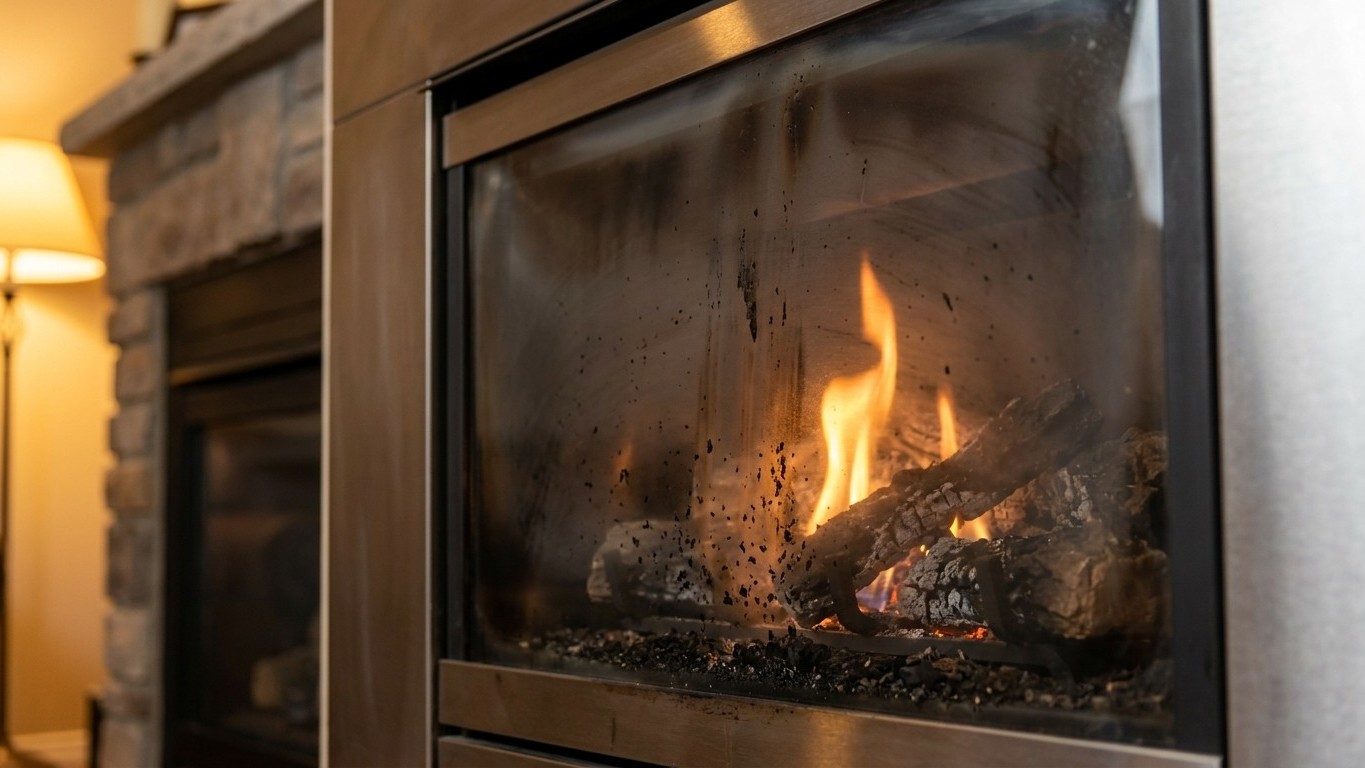

Soot on a Gas Fireplace means combustion is going wrong somewhere. On a correctly burning gas appliance, soot should be minimal to nonexistent. Black flakes on the logs, a smoky film on the glass, or dark streaks around the surround are a signal that the flame is starved of air, disturbed by moved logs, or burning against a maladjusted burner. On a vented unit, the same imbalance that produces soot can also produce carbon monoxide, so this isn’t a cosmetic problem to wipe away and forget.
A gas appliance should not soot

Wood fires soot. That’s part of how wood burns, and anyone who’s cleaned a woodstove glass knows it. Gas is different. Natural gas and propane burn with a controlled, mostly complete combustion when the appliance is set up right, which is why gas fireplace glass typically stays close to clear for long stretches between cleanings. When soot shows up, something in that combustion process has broken down.
The first thing to understand is what kind of appliance you’re dealing with, because the risk profile changes with it. A vented gas fireplace sends its combustion byproducts outdoors through a flue. A direct-vent unit pulls combustion air from outside and pushes exhaust out through a sealed wall terminal, so the room’s air supply is never part of the equation. A vent-free appliance does neither: it releases everything it produces, including water vapor, directly into the room, and depends entirely on the room’s ordinary ventilation to stay safe. Soot means something different depending on which of these three you have, but in every case it’s a sign the flame isn’t burning the way it’s supposed to.
Here’s why this matters more than a dirty-looking glass panel suggests. According to the U.S. Consumer Product Safety Commission, an unvented appliance has no outside vent for its combustion products and depends on ordinary room ventilation; inadequate airflow or a maladjusted burner can let fatal levels of carbon monoxide accumulate. Soot and carbon monoxide often come from the same root cause, an oxygen-starved or disrupted flame. You can’t smell or see carbon monoxide building up, which is exactly why a sooting appliance deserves the same urgency as a gas leak, not a cleaning schedule.
Currently manufactured unvented gas room heaters carry an oxygen depletion sensor under the industry’s voluntary standard, according to the CPSC, designed to shut off the gas before carbon monoxide reaches a life-threatening level in the room. That’s a voluntary industry standard, not a federal mandate, since the CPSC revoked its own mandatory rule back in 1984, by which point the CPSC notes that 95 to 100 percent of manufacturers had already complied anyway. Older units, or units without that sensor, don’t have that backstop. Either way, a sensor is a fail-safe, not a substitute for figuring out why the flame is producing soot in the first place.
The usual causes
Soot doesn’t show up randomly. It traces back to a handful of specific, identifiable problems, and most of them are mechanical rather than mysterious.
- Logs moved out of position. Ceramic or refractory logs in a gas fireplace are set in a precise arrangement designed by the manufacturer. If a log shifts, even slightly, from vacuuming, handling, or just settling over time, it can block part of the burner or redirect the flame against a cool surface, causing incomplete combustion and soot.
- A blocked or restricted vent. Debris, nesting material, or a damaged termination cap can restrict airflow in and out of a vented or direct-vent system. Restricted venting changes the air-to-fuel ratio at the burner, which is one of the more common triggers for sooting and is closely tied to overall venting health.
- A burner needing adjustment. Burner orifices and air shutters are calibrated for a specific flame pattern. Dust buildup, a partially clogged orifice, or a shutter that’s drifted out of adjustment over years of use can throw that pattern off, producing a lazy, yellow-tipped flame instead of the tight blue flame that burns clean. This is exactly the kind of issue caught during regular maintenance rather than after the fact.
- A vent-free appliance in an under-ventilated room. Because vent-free units draw combustion air from the room itself, a tightly sealed space, a closed door, or a room that’s been weatherized without accounting for the appliance can starve the flame of oxygen even when the appliance itself is functioning normally.
- The wrong fuel for the orifice. Natural gas and propane burn at different pressures and require differently sized orifices. An appliance converted from one fuel to the other without the correct conversion kit, or one where the wrong orifice was installed during setup, will burn inefficiently and soot as a result.
Any one of these can act alone, but they also compound. A slightly shifted log combined with a partly restricted vent, for instance, is a more serious combination than either problem on its own.
What to do before the next fire
Soot is a stop sign, not a cleaning reminder. The sequence that follows matters as much as the individual steps.
Stop using the appliance. Don’t run another cycle “to see if it clears up,” and don’t try to troubleshoot the burner yourself if you’re not trained on it. A gas appliance that’s producing visible soot is telling you the combustion is already off, and running it again only repeats whatever caused the problem the first time.
Resist the urge to clean the glass or vacuum out the logs before anyone qualified has looked at it. It feels productive, but soot patterns, where they’re heaviest, what color they are, how they’re distributed across the logs and glass, are diagnostic information. A technician reading that pattern can often pinpoint the cause faster with the evidence intact than after it’s been wiped away.
Check that your carbon monoxide alarm is working. Carbon monoxide is colorless and odorless, and an alarm is the only detection method a household actually has against it. If you don’t have one near the appliance, or if you’re not sure the one you have is functioning, that’s worth resolving immediately and separately from the fireplace issue itself.
Have the appliance inspected by a professional before lighting it again. The U.S. Fire Administration puts it directly: “Maintain heating equipment and chimneys by having them cleaned and inspected each year by a professional.” That’s an annual baseline for any heating appliance, and a sooting gas fireplace is a clear sign that this particular unit needs that visit now, not at the end of the season. A qualified technician can check the burner adjustment, inspect the venting for blockages, confirm the log placement matches the manufacturer’s layout, and verify the fuel type matches the orifice, covering all five of the usual causes in a single visit.
One more thing worth remembering while you wait for that visit: if you ever smell gas anywhere near the appliance, that outranks everything else on this page. Leave the house and call from outside. Soot is a slower-moving warning sign; a gas odor is not.
Common questions
Is soot on a gas fireplace glass dangerous by itself?
Soot on the glass is a symptom rather than a hazard in itself, but it points to incomplete combustion. On a vented appliance, that same incomplete combustion can produce carbon monoxide, which is why the soot should prompt an inspection rather than just a wipe-down.
Can I clean the soot off and keep using the fireplace?
Cleaning it off doesn’t fix whatever caused it. The soot will likely return, and in the meantime you’d be running an appliance with an unresolved combustion problem. Have it inspected first.
Does soot mean my vent-free fireplace is unsafe for my room?
It can mean the room isn’t providing enough air for the appliance to burn cleanly. Since a vent-free unit depends entirely on room ventilation according to the CPSC, soot is one of the signs that airflow, or the burner adjustment, needs a professional look.
How often should a gas fireplace be inspected even without visible soot?
The U.S. Fire Administration recommends yearly, professional cleaning and inspection of heating equipment and chimneys, regardless of whether you’ve noticed a problem. Soot simply moves that timeline up.