
A heat pump that blows warm or weak air in cooling mode is almost always something ordinary: the Thermostat still set to heat, a clogged filter, a frozen or dirt-caked outdoor coil, or the compressor sitting out a mandatory delay after a power blip. The one heat-pump-specific failure is a reversing valve stuck in heating position. Work through the cheap, common causes first. The valve is the rare exception, not the first guess.
In summer it is an air conditioner

Strip away the branding and a heat pump in cooling mode is a central air conditioner. Same compressor, same refrigerant loop, same indoor coil pulling heat and moisture out of the house air, same outdoor coil dumping that heat outside. If the system won’t cool, the diagnostic path is identical to any central AC complaint: airflow, refrigerant charge, electrical control, and the Thermostat‘s instructions to the equipment. Every guide on this site written for central air conditioners applies here without modification. There’s no separate heat-pump physics for the cooling half of the job.
That’s worth saying plainly because homeowners sometimes treat a heat pump as a mystery box that needs its own rulebook. It doesn’t. The refrigeration cycle running your heat pump in July is the same cycle running your neighbor’s straight AC unit. If their outdoor unit iced over from a dirty coil, and yours does too, the cause and the fix are the same conversation.
The one piece that isn’t shared
What a heat pump has that a straight air conditioner doesn’t is the reversing valve, a solenoid-controlled component that swaps the direction of refrigerant flow so the same hardware can heat in winter and cool in summer. In cooling mode, the valve routes hot refrigerant gas to the outdoor coil, where it releases heat to the outside air. Flip a switch on the valve and that flow reverses, which is exactly how the system heats your house in January using the same compressor and the same coils.
That valve is the only thing genuinely unique to a heat pump’s summer operation. Everything upstream and downstream of it, the blower, the filter, the ductwork, the thermostat wiring, the refrigerant charge, behaves exactly as it would in any central air system. Rule out the ordinary causes before you start wondering about the valve.
The checks, in order
Work through these from least to most involved. Most no-cool calls resolve in the first three steps.
- Thermostat mode and setpoint. Confirm the system is actually set to COOL, not just fan-on or heat left over from a program schedule, and that the setpoint is several degrees below the room’s current temperature. A programmable thermostat that reverted after a power outage is a common, embarrassing culprit.
- The air filter. ENERGY STAR advises homeowners to “inspect, clean, or change air filters once a month in your central air conditioner, furnace, and/or heat pump.” A saturated filter starves the indoor coil of airflow, and the coil can ice over, which shuts cooling down entirely even though the compressor keeps running.
- Blocked returns and closed registers. Furniture pushed against a return grille, or several supply registers closed to “push air” to one room, restrict the same airflow the filter check protects. ENERGY STAR notes that “airflow problems can reduce your system’s efficiency by up to 15 percent,” and a severe blockage does far more than trim efficiency, it can stall cooling output.
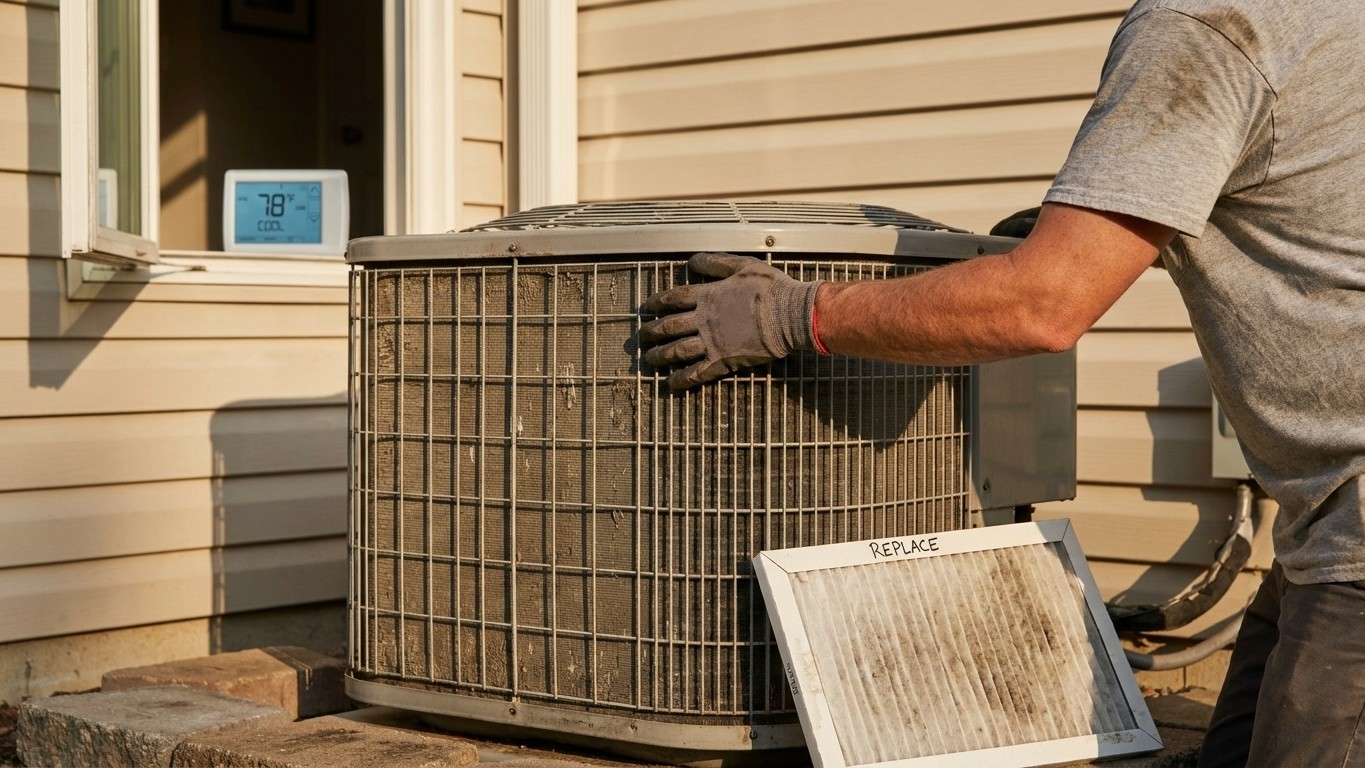
- The outdoor coil. Walk outside and look at the unit. Grass clippings, cottonwood fluff, mulch, or a fence built too close can smother the coil’s ability to reject heat. A coil that can’t dump heat outside can’t pull heat out of your house either.
- The anti-short-cycle delay. If the system was shut off, at the breaker or by a thermostat toggle, and switched back on immediately, most compressors enforce a built-in delay of several minutes before restarting to protect the motor. A unit that seems dead for a few minutes after a restart is often just waiting out that timer, not broken.
The site’s central air conditioner troubleshooting guides go deeper on each of these checks, including how to tell a genuinely frozen coil from one that’s simply cold to the touch, and they apply here without adjustment, since the cooling hardware is identical.
The fault that only a heat pump has
Here’s the symptom that points somewhere a straight air conditioner can never point: the system runs, the outdoor unit runs, the compressor is clearly working, and warm air comes out of the vents while the thermostat is set to COOL. That combination, a working system delivering the wrong temperature of air, is the signature of a reversing valve that never switched over to cooling mode. Everything downstream of the valve is doing its job faithfully. The valve just told it to do the wrong job.
Before assuming it’s the valve, check the two things that mimic this exact symptom for free. First, confirm the thermostat is genuinely set to COOL and not stuck in an “auto changeover” mode that hasn’t decided to switch yet, some thermostats delay changeover by design to avoid rapid mode-flipping near a setpoint. Second, if the thermostat or wiring was recently replaced or serviced, a reversed or mismatched wire at the O/B terminal, the terminal that tells the valve which direction to route refrigerant, produces identical symptoms without any hardware failure at all. That’s a wiring problem, not a valve problem, and it’s a much simpler fix.
If the mode is correct, the wiring checks out, and the vents are still delivering warm air with the compressor and outdoor fan clearly operating, the valve itself is the remaining suspect. This is not homeowner territory. The reversing valve sits in a sealed refrigerant circuit under system pressure, and diagnosing whether it’s a stuck valve, a failed solenoid coil, or a control-board signal problem requires gauges, electrical testing, and refrigerant-handling certification. Call a licensed HVAC technician for this one rather than opening anything with a wrench.
And on a ducted system, the delivery
Everything above assumes the equipment itself is the question. But a heat pump that’s cooling the air correctly can still leave a house feeling warm if the delivery system, the ductwork, is losing that cold air before it reaches the rooms. This section applies only to a ducted heat pump, the kind connected to a network of supply and return ducts running through walls, attics, or crawl spaces. A ductless mini-split has no ducts at all, so none of this applies if that’s what’s installed in the house; skip straight to the mini-split guide on this site instead.
For ducted systems, the numbers are larger than most homeowners expect. ENERGY STAR states that “in a typical house, however, about 20 to 30 percent of the air that moves through the duct system is lost due to leaks, holes, and poorly connected ducts.” That’s a substantial share of conditioned air escaping into an attic or crawl space instead of reaching a living room, and it shows up not as a system that won’t cool, but as one that runs constantly while certain rooms never quite feel comfortable.
Leaky ducts and a malfunctioning heat pump can look similar from inside the house, both produce weak or inconsistent cooling, so it’s worth distinguishing them before calling a technician out for the wrong problem. If the air coming directly out of a nearby vent feels appropriately cold but a room still won’t cool down, the duct run to that room is the more likely suspect. If the air at every vent feels warm or barely cool, the equipment itself, following the checks above, is the place to keep looking. The site’s duct guide covers how to spot and seal common leak points, and the mini-split guide covers the ductless side of this same silo for houses without any ducts to inspect.
Common questions
Is it normal for a heat pump’s outdoor unit to feel warm to the touch in summer?
Yes. In cooling mode the outdoor coil is releasing heat pulled from inside the house, so warm metal and a stream of warm exhaust air from the outdoor fan are expected, not a sign of trouble.
Should I hear the system click when it switches between heating and cooling?
A single audible click when the reversing valve engages is normal and expected. Repeated clicking, or clicking without any change in the air temperature at the vents, is worth mentioning to a technician.
Can a dirty outdoor coil really stop cooling completely, not just reduce it?
Yes, in severe cases. A heavily blocked coil can’t reject enough heat to keep the refrigerant cycle working, which can trip a high-pressure safety switch and shut the compressor down entirely rather than just running less efficiently.
Does a frosted or frozen outdoor unit always mean the reversing valve is stuck?
No. Frost on the outdoor coil in cooling mode more often points to low airflow or low refrigerant charge than to the valve. A valve stuck in heating mode produces warm vent air, not typically frost on the outdoor unit.