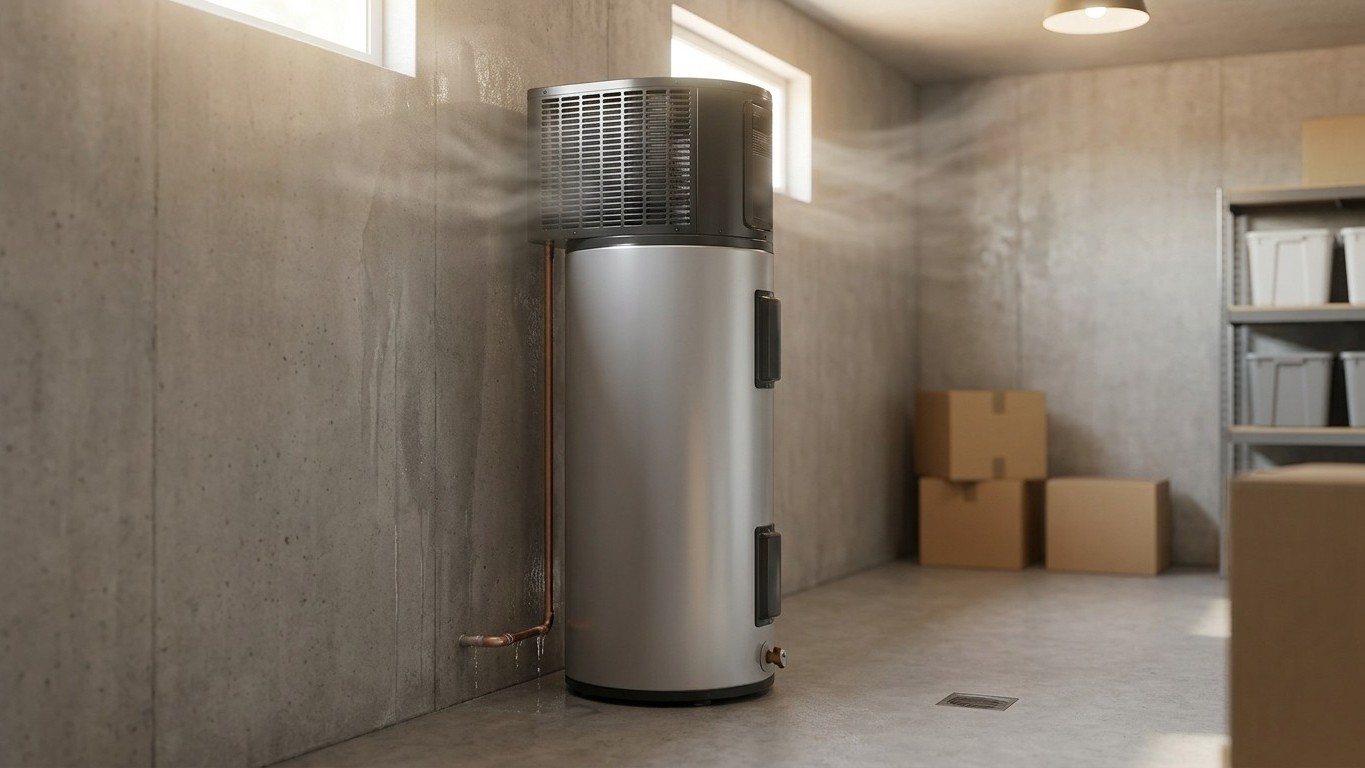

A heat pump water heater doesn’t burn anything, and it doesn’t run a simple electric element around the clock either. It pulls warmth out of the air in the room where it sits and moves that warmth into the water inside its tank. The compressor, the refrigerant, the whole cycle: it’s the same equipment found in a heating and cooling heat pump, just aimed at a tank of water instead of a living room.
The same idea, pointed at a tank
Picture a kitchen refrigerator. It doesn’t create cold; it moves heat out of the box and dumps it into the kitchen air, which is why the space behind a fridge runs warm. A heat pump water heater runs that same process in reverse: it moves heat out of the room’s air and dumps it into the tank. The water gets hotter. The room, in exchange, gives something up.
That exchange is the part people don’t expect. Because the unit extracts heat from the surrounding air, the room it sits in gets cooler as it runs. It also gets drier, since pulling heat out of air through a coil condenses moisture out of that air, the same way a dehumidifier does.
The second consequence follows directly from the first: the unit needs air to work with. It can’t manufacture heat from nothing, so it draws a steady volume of room air across its coil, extracts what warmth it can, and exhausts cooler, drier air back into the space. Box it into a tight closet with a door that stays shut, and it runs out of material to work with. The manufacturer’s specification sheet states the air volume the unit is designed around, and that number is the one to check before installation, not a guess based on the room’s square footage.
None of this makes the unit unusual or faulty; it’s simply the mechanism doing what it’s built to do. A homeowner feeling a cool draft nearby, or noticing the air feels less humid than the rest of the basement, is watching the trick work exactly as designed. Understanding that upfront changes how a person reads every other detail about installation and daily operation, because most of what raises alarm turns out to be the ordinary signature of the technology rather than a sign that something has gone wrong.
What the mechanism does not answer is how much colder the room gets, how much water it dries out of the air, or how that shifts across seasons. Those depend on the specific model, the size of the space, and how the household uses hot water. The unit’s own documentation is where those particulars live, not a rule of thumb.
Where it can go, and where it cannot
The placement question comes down to one thing: does the space around the unit hold enough air volume for it to draw from, and can that space tolerate getting cooler and drier while the unit runs. Everything else, wiring, drainage, clearance to walls, follows from settling that question first.
A large, unfinished basement is usually the best fit in a typical house. There’s air volume to spare, and the drying effect is often welcome, since basements tend to run damp on their own. A small utility closet is close to the opposite case: little air volume, a door that closes, and no path for replacement air unless the closet is ducted to another space or outdoors. A garage in a cold-winter climate sits in its own middle ground: there may be plenty of air volume, but that air runs cold for months, giving the unit less heat to work with than a heated basement would. A finished living space raises a different problem: the cooling effect competes with the room’s own heating, and the unit’s noise is harder to ignore near a couch than behind a furnace.
| Location | Air volume | What to expect |
|---|---|---|
| Large unfinished basement | Usually generous | Cooling and drying are often welcome in a damp space |
| Small closet | Usually insufficient without ducting | Unit can starve for air unless ducted to another space |
| Garage, cold climate | Often ample | Source air itself runs cold for much of the year |
| Living space | Varies | Noise and unwanted cooling compete with room comfort |
This brief carries no minimum room volume figure, since that number comes from the specific unit, not a general rule across brands and models. Manufacturers publish a minimum air volume requirement for each model, sometimes with an option to duct in additional air if the space falls short on its own. That figure belongs on the pre-purchase checklist, and it’s worth confirming before the unit arrives, since retrofitting ductwork into an installed system costs far more than measuring a room ahead of time.
None of this is a debate about whether one location is universally correct. A cramped closet might duct in air from an adjoining mechanical room and work fine; a spacious garage in a mild climate might outperform a basement with poor ventilation. The specification sheet, matched against the actual room, is what settles it.
The modes, and the one that defeats the purpose
Most of these units offer more than one way to run, and the choice matters more than it looks. The primary mode is heat-pump only: the compressor and coil do all the work. A hybrid mode blends that with backup resistance heating elements, the kind found in a conventional electric water heater, switching those elements on when demand outpaces what the heat pump alone can deliver quickly. A third mode, resistance-only, shuts the heat pump function off entirely and relies solely on the electric elements.
That third mode is where the appliance quietly stops being what it was bought to be. Run in resistance-only mode, the unit behaves like an ordinary electric water heater with an unused heat pump bolted to the side of it. This switch happens more often than it should, usually because a household runs the tank dry once, gets frustrated, and flips the unit to resistance-only to guarantee hot water shows up faster next time. The setting sticks. Nobody switches it back.
The fix takes a little planning rather than a single switch-flip after a bad morning:
- Give the tank time to recover between heavy draws. These units generally take longer to reheat a full tank than a straight electric resistance unit, so back-to-back showers can catch it short.
- Match the tank size to the household’s actual draw pattern, rather than the smallest unit that fits the space, to avoid running dry in the first place.
- Use hybrid mode instead of resistance-only when demand is genuinely unpredictable. Hybrid mode keeps the heat pump doing most of the work while calling on resistance elements only when needed, preserving most of the benefit of the technology.
- If the unit supports scheduling, set it to anticipate known high-demand periods rather than reacting to them after the fact.
None of this is about squeezing out a specific efficiency number, since that depends on the model, climate, and household habits, and this brief carries no such figure. It’s simply about not paying for a heat pump and then running the appliance as if it weren’t one.
Noise, and the water it makes
Two things surprise new owners more than anything else about daily operation, and neither one means the unit is broken.
The first is sound. A heat pump water heater runs a compressor and a fan, the same components that make a refrigerator or window air conditioner audible from across a room. It isn’t silent, and it isn’t meant to be. That’s a minor detail in a basement far from where people sit or sleep, but a bigger detail in a small mechanical closet backed up against a bedroom wall. Anyone sensitive to background noise, or installing one near a home office or bedroom, is better off weighing that ahead of time.
The second is water, specifically condensate. Because the unit pulls heat out of room air, it cools that air below the point where moisture condenses out as liquid, the same way an air conditioner’s coil drips water on a hot day. That condensate has to go somewhere, either down a drain line near the unit or, where gravity drainage isn’t possible, up and out through a small condensate pump. A condensate pump is a small motor sitting near an appliance that’s already full of water, and like any small motor, it will eventually wear out and fail. That’s not a defect specific to any one unit; it’s the ordinary lifespan of a mechanical pump doing a wet job, worth knowing about before the day it stops moving water where it’s supposed to go.
One clarification worth making plainly: the U.S. ENERGY STAR efficiency criteria that apply to air-source heat pumps used for heating and cooling a house don’t apply to this appliance at all. Those criteria (split systems that aren’t ducted must reach at least 8.5 HSPF2 and 15.2 SEER2; ducted split systems and single-package equipment need at least 8.1 HSPF2 and 15.2 SEER2) are written for space conditioning equipment. A heat pump water heater is certified against a separate set of criteria built around water heating, so a homeowner comparing a whole-house heat pump against a water heater shouldn’t expect the same numbers to show up on both labels.
Common questions
Does a heat pump water heater work in a cold garage?
It can, but the air it draws from is the same cold air filling the garage, and there’s less heat in cold air to extract. Whether that matters enough to affect performance depends on the model and the climate; the manufacturer’s specification is the place to check.
Why does the room around my unit feel cooler and damper than before?
That’s the mechanism working as intended, not a malfunction. The unit extracts heat from the surrounding air to warm the tank, and that process also condenses moisture out of the air.
Can I install one in a small utility closet?
Only if the closet holds enough air volume for the unit, or is ducted to bring in air from elsewhere. A small enclosed closet with a door that stays shut can starve the unit of the air it needs, so this is worth confirming against the manufacturer’s minimum air volume figure before installation.
Is it normal for the unit to make noise?
Yes. It runs a compressor and a fan, similar to what’s audible from a refrigerator or window air conditioner, and that noise is part of normal operation. It matters most in an installation placed close to a bedroom, office, or other quiet living space.