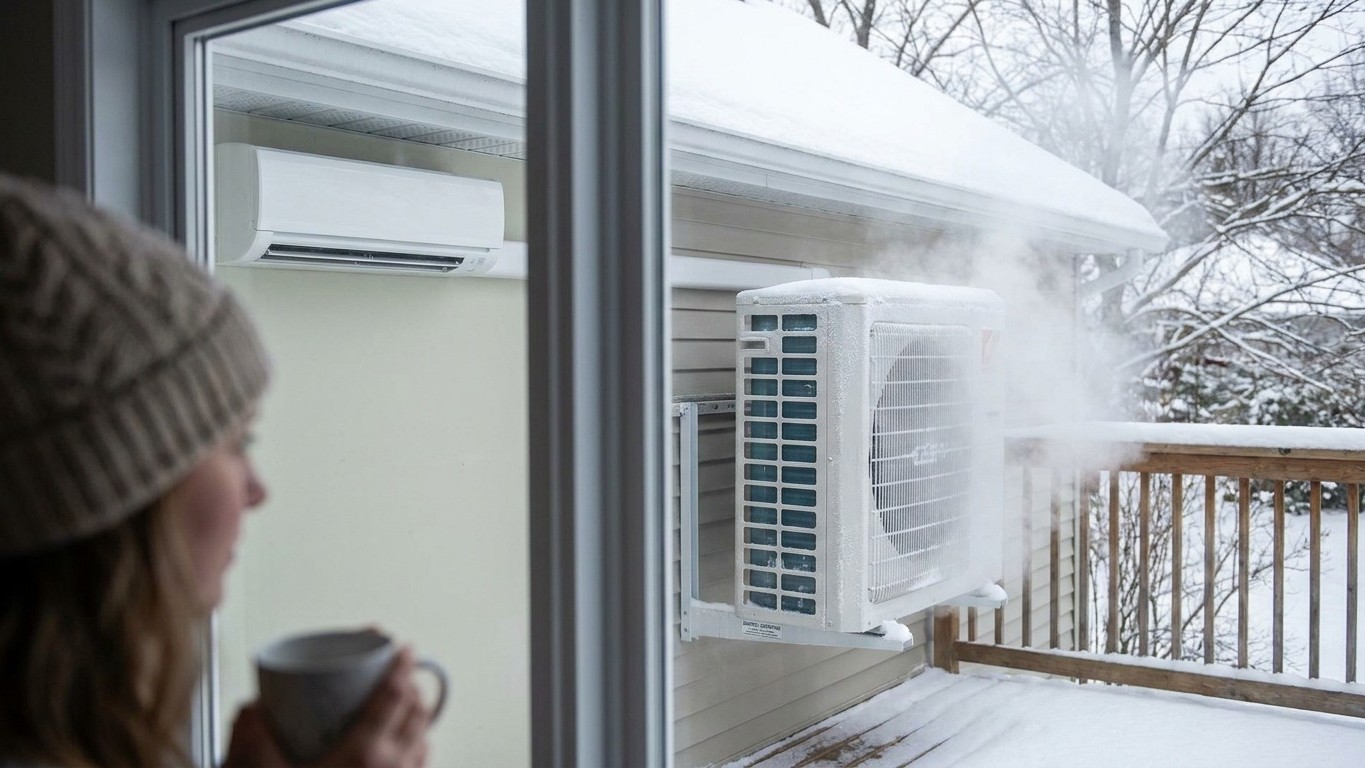

A Mini-Split that won’t heat is almost never broken. Most calls trace back to four things: a defrost cycle running its course, a setting left over from cooling season, airflow blocked indoors or out, or genuinely cold air outside asking more of the unit than it can deliver. One more thing worth knowing upfront: a ductless system has no ductwork at all. There’s an outdoor unit, one or more indoor heads, and a line set between them carrying refrigerant, power, and a condensate drain. Nothing about ducts applies here.
What is normal, and looks alarming

Three behaviors generate the bulk of “my mini split won’t heat” searches, and none of them mean anything is wrong.
The first is a blast of cool air right when the system kicks on. That’s the indoor coil warming up before it can push heat into the room. It lasts a few minutes, then the air temperature climbs. If someone’s standing right under the head expecting instant warmth, this reads as a failure. It isn’t.
The second is stranger looking: the indoor fan stops completely, the outdoor unit starts steaming, and nothing seems to be happening for several minutes. That’s a defrost cycle. The system briefly reverses itself to melt ice off the outdoor coil, and the indoor fan shuts off so it doesn’t blow cold air into the room while that’s happening. Steam rising off the outdoor unit during this window is just meltwater flashing off a warm coil into cold air. It looks dramatic. It’s routine.
The third is a layer of frost across the outdoor unit’s coil on a damp, cold day. Cold air holds little moisture, but what moisture is there condenses and freezes on the coil as the unit pulls heat from the outdoor air. The system is built to shed that frost on its own through the defrost cycles described above. Frost forming isn’t the problem; frost that never clears is.
The test that tells you which one you’re looking at
Time it. A normal defrost cycle resumes heating on its own within about ten to fifteen minutes. The indoor fan comes back on, warm air returns, and the outdoor unit goes back to its regular hum. If ten or fifteen minutes pass and the system is still sitting there, fan off, no warm air, that’s when it stops being normal and starts being worth a service call.
The most useful thing to do in that window is nothing. Resetting breakers or repeatedly cycling the remote mid-defrost just restarts a process that was already going to finish on its own. For a fuller walkthrough of how and why defrost cycles run, the heat-pump defrost cycle guide covers the mechanics in more depth.
The settings that stop it heating
Before assuming a fault, a handful of settings account for a large share of “not heating” complaints, and every one of them is free to check.
- Mode set to HEAT specifically, not AUTO and not COOL. Some remotes default back to the last mode used, and after a system’s been in cooling mode all summer, it can still be sitting there in October.
- The setpoint actually above the current room temperature. It sounds obvious, but a setpoint bumped down by a few degrees during a warm afternoon, then forgotten, will sit there doing nothing that evening.
- The remote’s batteries. A weak battery can send a command that appears to register on the remote’s display but never reaches the indoor head.
- A timer or weekly schedule left running from summer. Programmable schedules are convenient until they quietly turn the system off, or switch it to a mode nobody intended, at a time nobody’s watching.
- The vane position.
That last one is the point most people skip past, and it changes how a room feels more than almost anything else on this list. The louvers that direct airflow out of the indoor head should point downward for heating and upward for cooling. Warm air is lighter than the air around it and rises on its own, so if the vane is still angled up from summer, the warm air leaves the unit and heads straight for the ceiling instead of the floor where people actually are. The room can measure warm at the thermostat sensor near the ceiling while feeling cold everywhere a person sits. It’s not a malfunction. It’s a vane pointed the wrong direction for the season.
Airflow, indoors and out
Once settings check out, airflow is the next place to look, and it matters more than most owners assume. The U.S. Department of Energy’s ENERGY STAR program puts a number on it directly: “Airflow problems can reduce your system’s efficiency by up to 15 percent.” That’s not a minor dip. It’s the difference between a room that heats evenly and one that never quite gets there.
Indoors, the culprit is almost always the screens. Ductless heads pull room air through a washable filter before conditioning it, and a filter clogged with dust, pet hair, or lint starves the coil of the airflow it needs. The unit keeps running, keeps drawing power, and keeps underperforming.
Outdoors, winter adds its own set of problems. A unit boxed in by a fence, stacked firewood, or shrubs doesn’t have room to draw in outside air. Snow piled against or on top of the unit does the same thing from a different angle. And a base drain that’s frozen shut stops meltwater from a defrost cycle from leaving the unit, so it refreezes right back onto the coil it was supposed to drain away from, building up ice instead of shedding it.
What to check, and what to leave alone
- Indoors, pull the filter screens and check them against a bright light. If dust blocks the light, they need cleaning.
- Outdoors, walk around the unit and confirm there’s clear space on all sides, not buried under snowfall or hemmed in by anything stacked nearby.
- Check that the base and the area directly beneath the unit are clear, since that’s where a blocked drain shows up first as pooling or ice.
- Look at the coil fins themselves for a light, even frost that comes and goes with defrost cycles, versus a thick, unmoving buildup that never clears.
Clearing snow away from around an outdoor unit is a reasonable homeowner job, same as shoveling a walkway. Chipping ice directly off the coil is not. The fins are thin aluminum, spaced close together, and they bend or tear easily under anything harder than the airflow they’re built for. Damage there is the kind of thing that turns a $0 fix into a service call, so if the coil itself is iced over rather than just frosted, that’s a job for someone with the right tools, not a screwdriver and some patience.
What the machine cannot do
Here’s where a lot of expectations run into physics. A mini-split heat pump doesn’t create heat the way a furnace or an electric baseboard does. It moves heat that’s already present in the outdoor air, compresses it, and delivers it indoors. That works even in air that feels freezing, because there’s still heat energy in it down to very low temperatures. But the colder that outdoor air gets, the less heat there is available to move, and the harder the system has to work to extract the same amount.
The practical result is that heating capacity falls as the outdoor temperature falls. A unit that keeps a house comfortably warm on a mild winter day may fall behind on the coldest night of the year, not because anything failed, but because it’s being asked to move more heat than the outdoor air has to give at that temperature. Every unit has a point below which it simply can’t keep pace with the heat a house is losing, and that point is different for every model. There’s no single number that applies across the board here. The specification sheet for the specific unit installed is the only place that answers it accurately, and it’s worth pulling up before assuming a system is malfunctioning on an unusually cold night.
This is also why a lot of homes lean on a second heat source for the coldest stretches of the year, whether that’s an existing furnace, a space heater in one room, or simply accepting a few degrees of drop on the worst nights. Homes in colder climates increasingly get systems sized and rated specifically for low outdoor temperatures, built with capacity in mind for exactly this kind of weather. Either approach solves the same problem: matching the heat source to what the coldest days actually demand, rather than expecting one unit to do everything year-round.
Common questions
Why does my mini split blow cold air before it warms up?
The indoor coil needs a few minutes to reach operating temperature after the system starts. Air passing over it during that window feels cool. It’s normal and resolves once the coil catches up, usually within a few minutes of startup.
Is it normal for the outdoor unit to be covered in frost?
Yes, on cold, damp days. The system is designed to melt that frost off periodically through defrost cycles. A thin, changing layer of frost is expected. A thick layer that never clears over several hours is not.
Should I check my furnace filter if my mini split isn’t heating?
No. A furnace filter belongs to a ducted central system, not a ductless mini-split. A mini-split has its own washable filter screens inside the indoor head, and that’s the only filter relevant here.
How long should I wait before calling for service?
If the system pauses with the fan off and resumes heating within about ten to fifteen minutes, that’s a normal defrost cycle. If more time passes with no fan, no warm air, and no change, that’s the point to call for service rather than keep waiting.