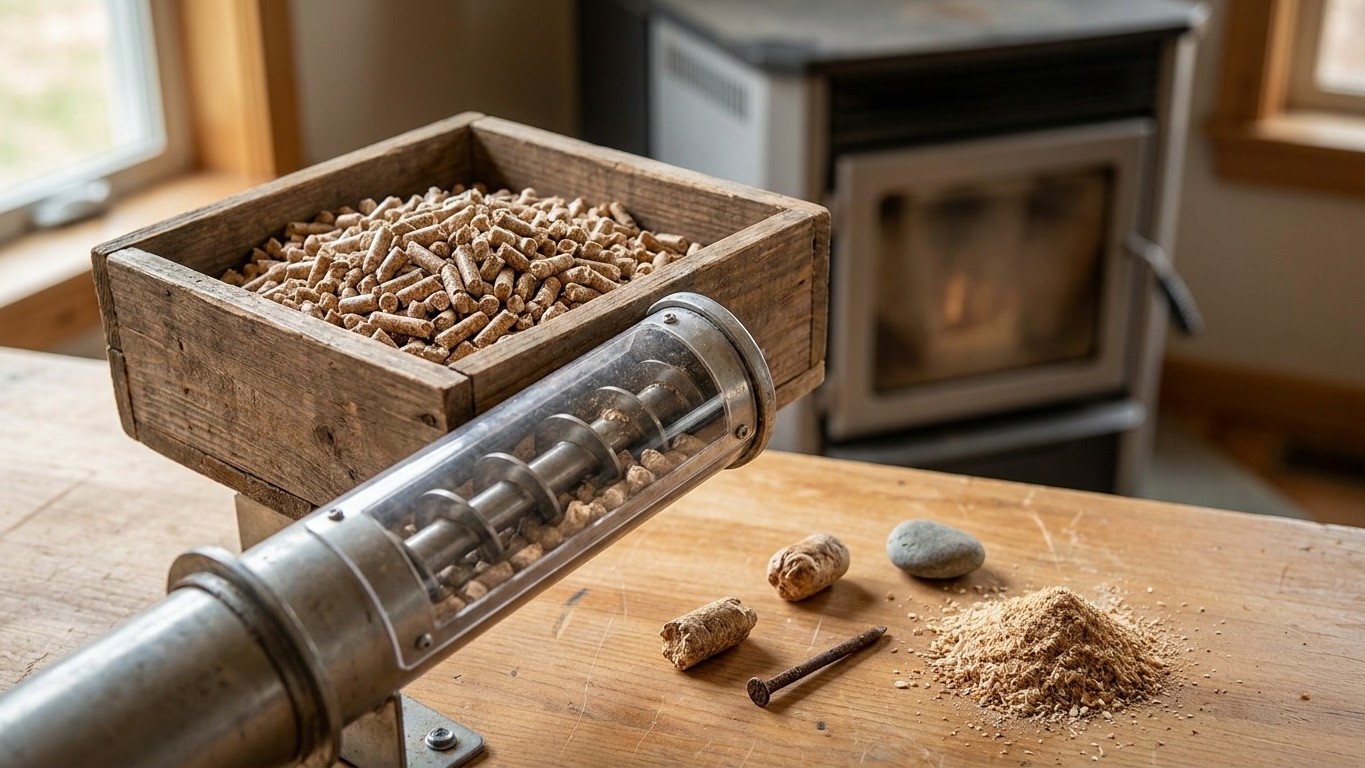

An auger jam happens when something inside that feed tube refuses to turn, or turns without moving fuel. Most of the time the fix is simple and safe for an owner to do: cut power, clear the obstruction by hand, restart. But there’s a line where “simple fix” turns into “call the dealer,” and knowing where that line sits matters more than knowing how to clear the jam itself.
What a jam actually is

The auger is a motorized screw turning inside a tube, built to a tolerance that matches whole wood pellets moving from hopper to burn pot. That’s the whole design: “The pellets are poured into a hopper, which automatically feeds into the stove.” A jam is anything that doesn’t match that tolerance. An oversized or misshapen pellet can wedge sideways. A stray nail, a pebble, or a chip of wood that made it through the bagging process at the mill can lodge between the screw flight and the tube wall. And fines, the sawdust-like powder that collects at the bottom of a pellet bag, can pack down over time into something closer to cement than fuel, especially in a hopper that sits half-full through a humid spell.
The symptom tells you roughly what you’re dealing with, though not exactly. In one version, you hear the auger motor running, maybe a faint grinding, but no pellets drop into the burn pot. The fire dies down for lack of fuel while the stove insists everything is normal. In the other version, the motor itself stalls or hums under load and the control board reads it as a fault, shutting the unit down entirely. That second scenario is usually a harder jam: something rigid enough to stop the screw rather than just block a few pellets from passing.
Why the motor doesn’t just push through
It’s tempting to assume a stronger motor would solve the problem, but that’s backwards. Auger motors are deliberately built with a weak point, often a shear pin or a plastic coupling, that’s designed to break before the motor burns out or the auger tube bends. A jammed auger that keeps getting power for more than a few seconds can shear that pin, which converts a five-minute nuisance into a repair that needs the auger housing opened up. That’s part of why stoves shut down fast when the feed system stalls: it’s protecting a part that’s more expensive to fix than pull a plug.
Because the stove is a powered appliance start to finish, a jam is never purely a fuel-flow problem in isolation. “Pellet stoves need an electrical supply to work because they use motorized components to feed the fire and blow out hot air.” That’s worth remembering before opening anything: an auger jam isn’t a mechanical curiosity you can poke at with the unit humming along. It’s a live electrical appliance with a stuck motor, and the first move is always the same one, regardless of what’s causing the jam underneath.
Clearing it, and where to stop
Power off first, always, at the wall or the breaker, not just the stove’s own switch. Let the unit cool if it’s been running. Then open the hopper and empty what’s left, ideally into a bucket rather than back into the bag, since you’re about to be looking for whatever caused the problem in the first place.
With the hopper empty, look and reach. A stray nail or pebble is usually visible sitting near the auger opening at the hopper floor, and it can be lifted out by hand. Clumped fines are less obvious: they show up as a gray, almost cemented mass stuck to the auger tube opening or coating the first few inches of the screw. A shop vacuum with a narrow nozzle clears loose fines effectively and is genuinely the right tool here, better than trying to scrape or blow. This part, cut the power, empty the hopper, remove visible debris, vacuum the fines, is squarely the owner’s job and doesn’t require any tool beyond a vacuum and maybe a flashlight.
The line you shouldn’t cross
Once the jam isn’t sitting in plain sight at the hopper floor, the situation changes. If clearing the visible debris and vacuuming doesn’t free the auger, and the motor still stalls or won’t turn on restart, the obstruction is deeper in the tube or the motor coupling itself has failed. At that point, opening the auger housing, unbolting the feed motor, or replacing a sheared pin are jobs that call for a technician, not because the tools are exotic but because the appliance is still a powered heating unit with an electrical motor and, in many models, a hot burn pot nearby. Taking a feed system apart on a unit that’s still wired in is how people get hurt or turn a $40 pin into a $300 service call. If the simple steps don’t clear it, that’s the signal to stop and call the dealer or a certified technician rather than reaching for a wrench.
This same caution extends to anything else that requires disassembly, not just the auger. General upkeep, the kind that keeps a stove running well season to season, follows a similar owner/technician split: “Pellet stoves need to be regularly cleaned to ensure that the stove runs efficiently and safely. Additionally, you should have your stove professionally cleaned at least once a year.” The U.S. Fire Administration echoes that same yearly-professional standard for the whole heating system, not just pellet stoves specifically: “Maintain heating equipment and chimneys by having them cleaned and inspected each year by a professional.” An auger jam that resists a quick at-home clearing is really just one more item on that annual list, arriving ahead of schedule.
Preventing the next one
Most auger jams trace back to what went into the hopper in the first place, which means prevention is mostly a fuel question rather than a mechanical one. The U.S. EPA puts it plainly: “Pellets can differ significantly in how well they’re made and how well they burn. Lower quality pellets may provide less heat and create a fine dust. Higher quality pellets tend to burn cleaner and produce less ash.” That fine dust is exactly the material that packs into fines clumps at the bottom of a hopper, and it’s also the residue that coats an auger tube over a season of use.
Two habits go a long way. First, don’t tip the last dusty inch of a bag straight into the hopper. That bottom layer is where fines concentrate, along with whatever fragments broke off pellets during shipping and handling. Screening it out, or setting it aside for kindling rather than hopper fuel, keeps the densest fines out of the feed tube entirely. Second, run the hopper down close to empty before any long shutdown, whether that’s an end-of-season shutoff or a stretch of mild weather where the stove won’t run for a week or two. Pellets sitting in a hopper for weeks pick up ambient humidity, especially in a garage or basement installation, and humid pellets are far more likely to swell, soften, or shed fines than pellets burned within days of bagging.
Where the bigger numbers live
None of this changes the basic math of what a stove is built to do. “EPA-certified pellet stoves usually fall into the 70-83% efficiency range, while heating capacities range from 8,000-90,000 Btu per hour.” A jammed auger doesn’t just interrupt heat output for an afternoon, it does so on a unit that was already operating well inside that efficiency band, which is why owners tend to notice the drop in warmth quickly rather than gradually. And with “EPA currently certifies over 90 different pellet stoves,” auger design, hopper capacity, and shear-pin placement vary enough between models that a dealer or the owner’s manual, not a general guide, is the right source for model-specific feed rates or hopper size. For how much a given stove should be burning through in fuel, or what a repair typically runs, the more reliable read is the appliance’s own label, the installer’s paperwork, or a call to the local dealer, rather than any general rule of thumb.
Storage plays its part too, and clearance rules apply whether the stove is running normally or sitting mid-repair with the hopper open: “Keep anything that can burn at least 3 feet from all heat sources including fireplaces, wood stoves, radiators, space heaters or candles.” That 3-foot rule is easy to forget around a fuel bag or a bucket of cleared-out fines sitting near the stove while you sort out a jam, but it applies exactly the same as it would to a stack of firewood.
Common questions
Can a pellet stove run at all with a jammed auger?
Briefly, sometimes. If pellets already in the burn pot are still lit, the fire can continue for a short while even after the feed stops, but it will die down as fuel runs out and won’t restart on its own. Most control boards will flag a feed fault and shut the unit down rather than let it run on fumes.
Is a jam the same as an auger motor failure?
No. A jam is a physical obstruction in the tube; a motor failure means the motor itself has burned out or its coupling has failed even with a clear path. Clearing debris and vacuuming fines addresses a jam. A motor that still won’t turn after the tube is confirmed clear points toward the motor or its shear pin, which is technician territory.
Do all pellet brands jam auger systems equally?
The EPA’s language on quality differences (more dust and less consistent burn from lower-quality pellets) suggests fuel quality matters more than any single brand name, but no source here names specific brands or rates them against each other. Judging a bag by how much fine dust settles at the bottom before you even open it is a reasonable, practical gauge.
Should I try clearing a jam myself if I’m not confident with tools?
The hopper-emptying and vacuuming steps don’t require mechanical skill, just power cut first and a flashlight. But if that doesn’t free the auger, stop there. Anything involving the auger housing, the motor mount, or a shear pin replacement is worth a technician’s visit rather than a guess.