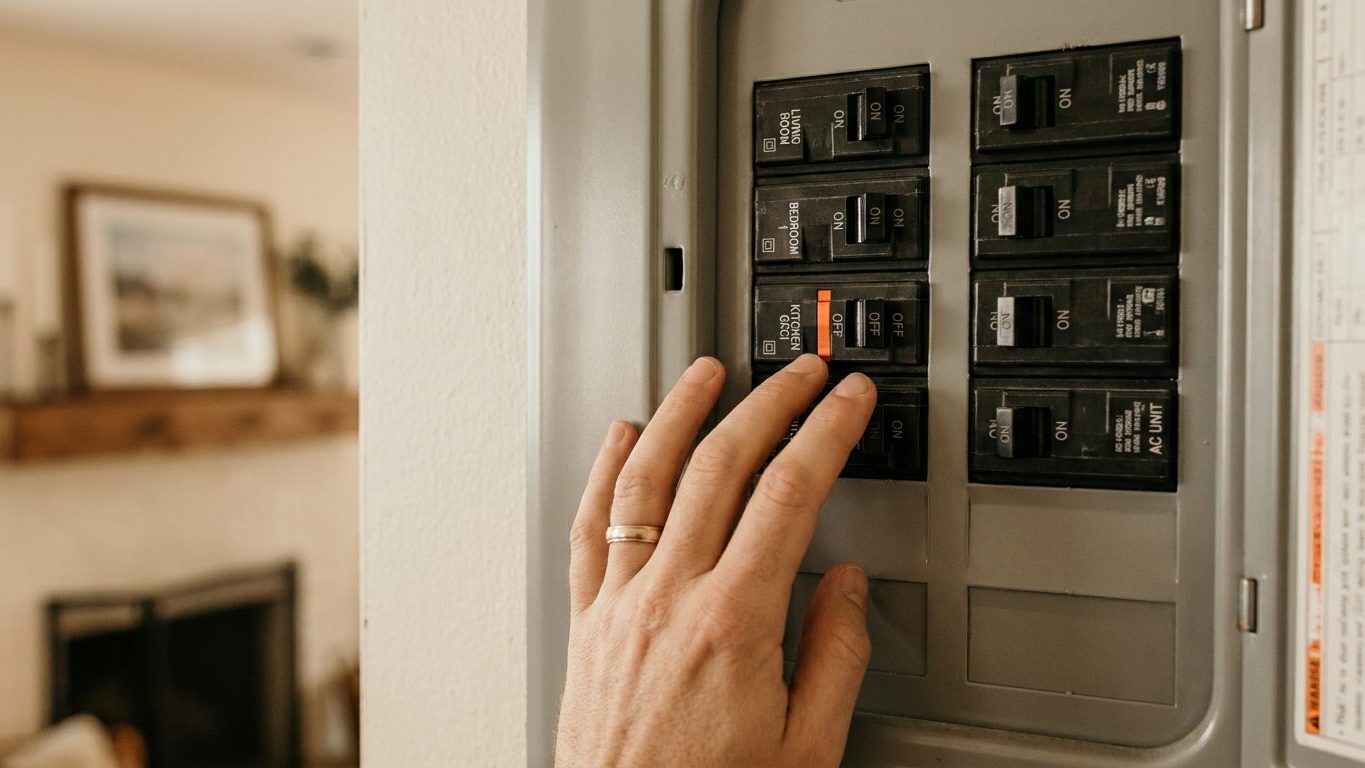

A room air conditioner that keeps tripping the breaker is telling you, plainly, that something is pulling more power than that circuit or outlet is built to deliver, or that a fault has developed somewhere in the path. The fix is never to reset it and hope. It’s to note exactly when the trip happens, stop overloading whatever’s shared with it, and if it happens more than once or twice, call an electrician instead of guessing further.
A breaker that trips is doing its job
The instinct, when a breaker trips, is to treat it as an inconvenience. Flip it back, get the cool air running again, move on with the afternoon. That instinct is the wrong one. A breaker exists to interrupt a circuit before something downstream gets damaged or starts a fire. When it trips, it isn’t malfunctioning. It’s reporting a condition: the current flowing through it has exceeded what it’s designed to pass, or a fault has sent current somewhere it shouldn’t go. Resetting it without finding out why answers nothing. It just delays the next trip, and possibly the next problem.
No single number tells you how much current a given circuit is supposed to carry. Those numbers vary by the circuit, the wiring, and the panel, and guessing at them from an article is worse than not guessing at all. What actually helps a homeowner, before an electrician ever gets involved, is paying attention to the pattern of when the trip happens. Timing is the one piece of evidence you can gather yourself, and it’s the piece that tells an electrician where to start looking instead of having them open a panel blind.
Does it trip the instant you switch the unit on? Does it hold for a few minutes and then let go? Does it only happen on the hottest days, or only when the toaster or a hair dryer is running somewhere else in the house? Or does it seem to happen at random, with no pattern you can find? Each of those is a different story, and each points toward a different kind of problem. None of them are things you diagnose by staring at the unit. But all of them are things you can notice, write down, and hand off.
Treat the reset button on the panel as a record-keeping tool for one use, not a repair. The first trip is information. The second trip, on the same circuit, in the same conditions, is a pattern. Somewhere around the second or third trip, the conversation should shift from “let me try that again” to “who do I call.”
When it trips tells you what it is
Room air conditioners draw a heavy jolt of current the instant their compressor starts, then settle into a steadier draw once running. A circuit that trips right away is reacting differently than one that trips twenty minutes into a hot afternoon, and the difference matters more than most people assume.
| When it trips | What that timing generally points toward |
|---|---|
| The moment it’s switched on | A startup surge, the brief spike a compressor pulls to get going, landing on a circuit that’s already close to its limit |
| A few minutes after it starts running | A thermal fault developing inside the unit as it warms up and continues drawing current |
| Only on the hottest afternoons | A shared circuit reaching its limit as the unit runs longer and harder to keep up with the heat |
| Only when something else is running | A shared circuit at its limit, with the air conditioner and another appliance both drawing from the same source at once |
| At random, with no pattern | A genuine fault in the unit itself, in the outlet, or in the wiring feeding it |
None of these categories are a repair instruction. They’re a description of what an electrician will want to hear first, because it narrows where the actual problem lives before any panel gets opened or any outlet gets pulled apart. A trip that happens only when the microwave or a space heater is also on is a very different situation from one that happens whether anything else is running or not. The first suggests the circuit is being asked to do two jobs at once. The second suggests the air conditioner, or its immediate outlet, has developed a problem independent of anything else in the house.
The hottest-afternoon pattern deserves its own note, because it’s the one people are most likely to shrug off as normal. It isn’t. A circuit that only fails when the load runs longest and hardest is a circuit already living near its limit even on a mild day, just not tripping yet. Heat doesn’t create the problem so much as it exposes one that was already there.
Whichever pattern you’re seeing, resist the temptation to guess at the specific part inside the unit that’s failing. That’s not something to diagnose from outside a sealed case, and this brief isn’t going to pretend otherwise. Notice the pattern, write it down, and let a qualified person take it from there.
The extension cord question
People ask this one constantly, so here’s the straight answer: no, don’t run a room air conditioner off an extension cord. A room air conditioner is a large, continuous electrical load, running for hours at a stretch on hot days, and an extension cord is not a substitute for reaching a proper outlet. It’s a workaround, and workarounds on a load this size don’t age well.
The tell is heat. A cord, a plug, or an outlet that feels warm to the touch while the unit is running is not a minor curiosity. It’s a sign that the connection is under more strain than it’s built to handle, and that strain doesn’t resolve itself by continuing to run the unit through it. Heat at a connection point is the physical signature of resistance where there shouldn’t be resistance, and it gets worse with time and use, not better.
The fact that a cord has “worked fine” for a week, or a season, or even a couple of summers, isn’t evidence that it’s safe. It’s evidence that it hasn’t failed yet. Those are different things, and the gap between them is exactly where problems tend to show up, usually on the hottest day of the year, when the unit is working its hardest and the wiring is under its heaviest load.
The fix isn’t a better cord or a heavier-duty extension. It’s placing the unit where it can plug directly into an outlet suited to that kind of continuous draw, or having an electrician install one where the unit needs to sit. If the room’s layout means the only outlet is nowhere near a sensible spot for the air conditioner, that’s a conversation to have with an electrician, not a reason to bridge the gap with a cord and hope it holds.
This is one of two points in this topic worth stating plainly and moving on from: a room air conditioner belongs on an outlet built to carry it, not on a cord reaching across a room.
What to do, and who to call
Once a breaker has tripped, the sequence that actually gets you somewhere is short and doesn’t require any tools:
- Note exactly when it trips, at startup, a few minutes in, only on hot afternoons, only with something else running, or seemingly at random.
- Unplug everything else on that circuit and run the air conditioner alone to see whether the trip still happens, which tells you whether sharing the circuit is part of the problem.
- Check whether the unit itself has a reset control, separate from the breaker, and use it once if so.
- Stop resetting the breaker after the second trip. A pattern by then is established, and keeping the unit running by working around the breaker isn’t a strategy.
- Call an electrician and give them the observation you’ve gathered, when it trips and what happens when the circuit is used alone, rather than a guess at the cause.
A breaker that trips more than once under the same conditions, or a plug and outlet that feel warm while the unit runs, are both reasons to stop using that circuit until someone qualified has looked at it. That’s the second safety point worth stating without dramatizing it: warmth at a connection and repeated tripping are both signals to stop, not signals to push through.
What you hand an electrician matters more than most homeowners expect. “It keeps tripping” tells them almost nothing. “It trips within a minute of startup, every time, even with nothing else running on that circuit” tells them where to start testing. The five minutes spent noting the pattern before you call is often the difference between one visit and several.
Common questions
Is it safe to keep resetting the breaker if the air conditioner still runs afterward?
Running again isn’t the same as running safely. A breaker that trips repeatedly is reporting a real condition each time, and resetting it without addressing that condition just delays the next trip while the underlying issue continues.
Could the air conditioner itself be broken rather than the wiring?
Yes, that’s one of the possibilities a random or unpredictable trip pattern points toward. But it’s not something to diagnose from outside the unit’s case, since that requires opening equipment safely and testing it properly.
Does a bigger air conditioner trip breakers more often?
An oversized unit is a defect in itself, not a safety margin, and it can run in short, hard cycles that stress a circuit more than a properly sized unit would. Sizing the unit correctly for the room is part of avoiding this problem in the first place.
Should I try a different outlet in the same room before calling an electrician?
Only if that outlet is on a separate circuit from the one that’s tripping, and only as a way to gather information, not as a permanent fix. If you don’t know which outlets share a circuit, that’s exactly the kind of detail an electrician can confirm quickly.