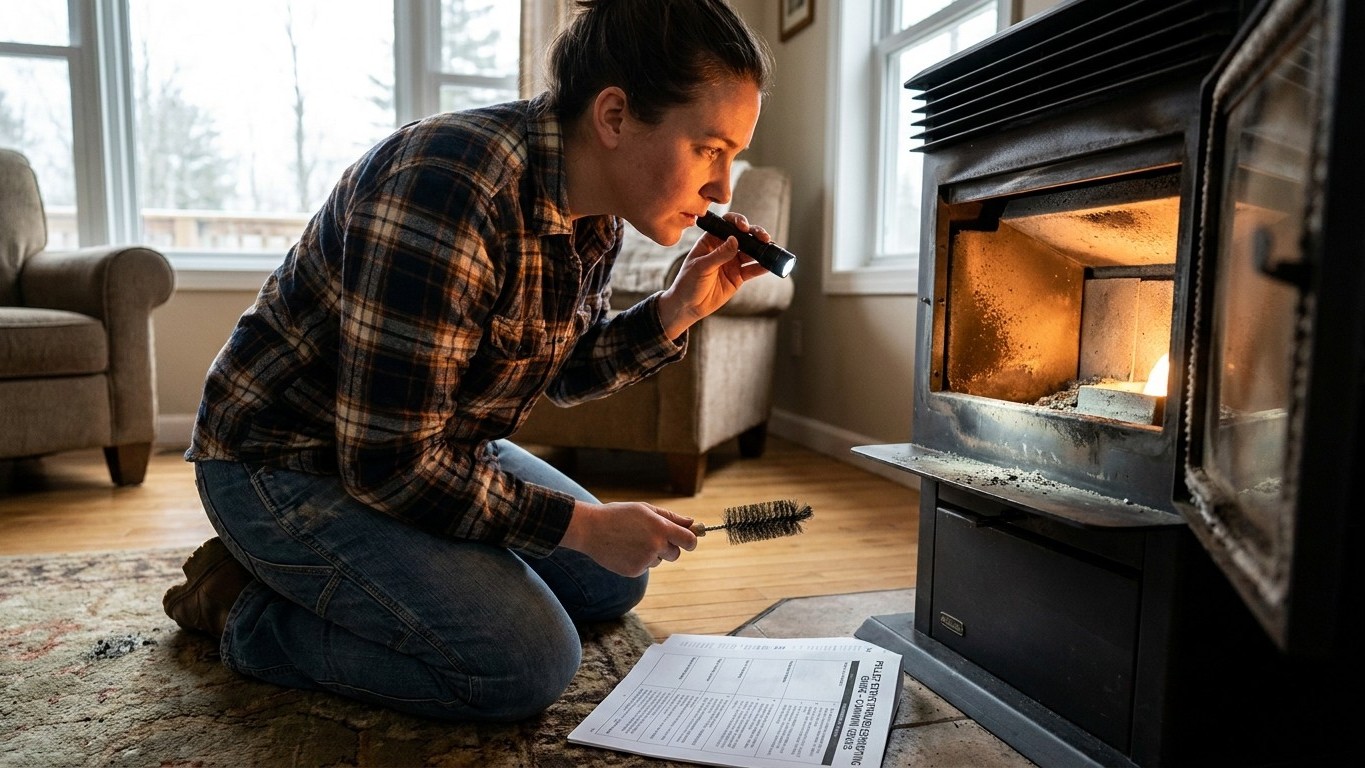

A pellet stove that shuts down mid-cycle is almost always doing exactly what it was built to do: stopping itself before something goes wrong. The fix is rarely a new part. Most shutdowns trace back to one of four things you can check yourself in under ten minutes: fuel flow, ash buildup, a sealed door, or a blocked vent terminal outside. Only after ruling those out does the problem point to a sensor or control board that needs a technician.
The shutdown is usually the stove being right

A pellet stove isn’t a simple firebox with a hopper bolted on. It’s a small combustion appliance running on a loop of sensors that constantly prove two things: that air is moving through the firepot the way it should, and that the temperature inside stays within a safe band. When either of those checks fails, the control board doesn’t guess. It shuts the auger off, kills the blower, and stops the fire before it can smolder, backdraft, or overheat a component. That’s not a malfunction. That’s the safety system working as designed.
This is worth sitting with for a second, because it changes how you approach troubleshooting. The instinct is to ask “why did my stove die.” The more useful question is “what did it fail to prove.” A vacuum switch that can’t sense draft will shut the unit down even if the fire itself looks fine. A high-limit sensor that reads an overheated heat exchanger will do the same, even if the flame is small and calm. The stove isn’t broken in either case. Something upstream of the sensor, ash, a blocked vent, a loose door seal, is preventing the sensor from confirming safe conditions.
Why electrical supply matters here
None of this works without power. As the U.S. Environmental Protection Agency puts it, “Pellet stoves need an electrical supply to work because they use motorized components to feed the fire and blow out hot air.” That includes the auger motor, the combustion blower, the convection fan, and the control board running the safety logic itself. A brief power flicker, a tripped breaker, or a loose plug can trigger the exact same shutdown symptoms as a dirty burn pot, which is why checking the obvious electrical basics first saves a lot of guesswork later.
It also helps to know the range these appliances are designed to operate in. The EPA notes that “EPA-certified pellet stoves usually fall into the 70-83% efficiency range, while heating capacities range from 8,000-90,000 Btu per hour,” and that the agency “currently certifies over 90 different pellet stoves.” That’s a wide spread of hardware, but the safety architecture, sensors that prove draft and temperature before allowing the fire to continue, is common across nearly all of them. Whatever model sits in your living room, the shutdown logic works the same way.
The order to check
Work through these steps in order. Each one is cheaper and faster to check than the next, and most shutdowns get solved before you reach the bottom of the list.
- Confirm fuel is actually arriving. The EPA describes the basic mechanism plainly: “The pellets are poured into a hopper, which automatically feeds into the stove.” If the hopper is full but the firepot is starving, the auger path is jammed, bridged with sawdust, or the auger motor itself has stopped turning. Fuel quality plays a role too. The EPA warns that “pellets can differ significantly in how well they’re made and how well they burn. Lower quality pellets may provide less heat and create a fine dust. Higher quality pellets tend to burn cleaner and produce less ash.” A bag of inconsistent pellets can clog feed paths that clean fuel would pass through without issue. For a full breakdown of feed problems, see our auger troubleshooting guide.
- Check the burn pot and heat exchanger for ash. A firepot caked with clinkers restricts airflow at exactly the spot the draft sensor is watching. A heat exchanger packed with fly ash traps heat where the high-limit sensor can read it. Both conditions mimic a “broken” stove while actually being routine buildup. Our cleaning schedule guide covers how often this needs attention between the seasonal servicing.
- Verify the door and ash pan are fully sealed. A door gasket that’s worn thin, or an ash pan not seated flush, lets in outside air the stove wasn’t designed to draw. That extra, unmetered air throws off the draft reading the vacuum switch depends on.
- Check the vent terminal outside. Wasp nests, leaves, and snow accumulation are common culprits, and they’re invisible from inside the house. This is also where basic clearance rules matter: the U.S. Fire Administration advises to “keep anything that can burn at least 3 feet from all heat sources including fireplaces, wood stoves, radiators, space heaters or candles,” a rule that applies as much to the exterior vent area as the stove itself. Our venting guide walks through terminal placement and clearance in more detail.
- Only then, look at the sensors. If fuel, ash, seals, and venting are all clear and the stove still shuts down, the vacuum switch, high-limit sensor, or control board itself is the likely cause, and that’s where owner troubleshooting ends.
What belongs to a technician
Four components sit past the line of reasonable DIY work, and trying to test or replace them without training risks both the appliance and the person doing the work.
The vacuum or pressure switch is a small, sealed component that measures the pressure differential created by draft. It’s calibrated to a specific range, and testing it correctly requires a manometer and knowledge of what reading the specific stove model expects. A technician can confirm in minutes whether the switch itself has failed or whether it’s accurately reporting a real draft problem elsewhere in the system.
The high-limit sensor (sometimes called a thermodisc or ECO switch) trips when the stove body reads hotter than it should, often as a downstream symptom of the ash buildup covered above. But a sensor that’s degraded or miscalibrated will trip on a stove that’s actually running at a normal temperature, and distinguishing “real overheat” from “faulty sensor” isn’t something a multimeter and a guess should decide.
The control board ties every sensor and motor together and makes the shutdown decision. Boards can develop intermittent faults that only show up during specific conditions, which is exactly the kind of diagnosis that benefits from a technician’s diagnostic tools and experience with that model line.
The exhaust blower pulls combustion gases out through the vent and is directly tied to the draft reading the vacuum switch monitors. A blower running slow, due to a failing motor or accumulated grease and dust on the wheel, can create a draft signal weak enough to trigger shutdowns even though the vent itself is clear.
This is also where annual maintenance earns its keep. The EPA states plainly that owners “should have your stove professionally cleaned at least once a year,” and the U.S. Fire Administration advises to “maintain heating equipment and chimneys by having them cleaned and inspected each year by a professional.” A once-a-year visit catches the early wear on these four components before they turn into mid-winter shutdown loops, and it’s the difference between a stove that runs reliably for a decade and one that nickel-and-dimes its owner with service calls every few months.
Common questions
Why does my pellet stove shut down after running fine for an hour?
This pattern usually points to ash accumulation rather than a sudden fault. As the burn pot or heat exchanger gradually fills with ash over the course of a burn cycle, draft or heat readings drift out of range, and the safety sensors respond exactly as they’re supposed to. Check the burn pot first.
Can bad weather cause a pellet stove to shut down?
Yes. Strong or gusty wind at the vent terminal can disrupt the draft pressure the vacuum switch is reading, even with a perfectly clean stove. If shutdowns line up with windy days, the vent terminal and its surrounding clearance are worth checking before assuming a component has failed.
Is it safe to keep restarting the stove after it shuts down?
Restarting once, after checking fuel, ash, and door seals, is reasonable. Restarting repeatedly without addressing the cause risks masking a real safety fault, since the shutdown exists specifically to prevent unsafe combustion.
Does pellet quality really affect shutdown frequency?
It can. Lower-quality pellets produce more fine dust and ash, which accelerates the buildup that trips draft and heat sensors. Switching fuel quality won’t fix a mechanical fault, but it can reduce how often ash-related shutdowns happen between cleanings.