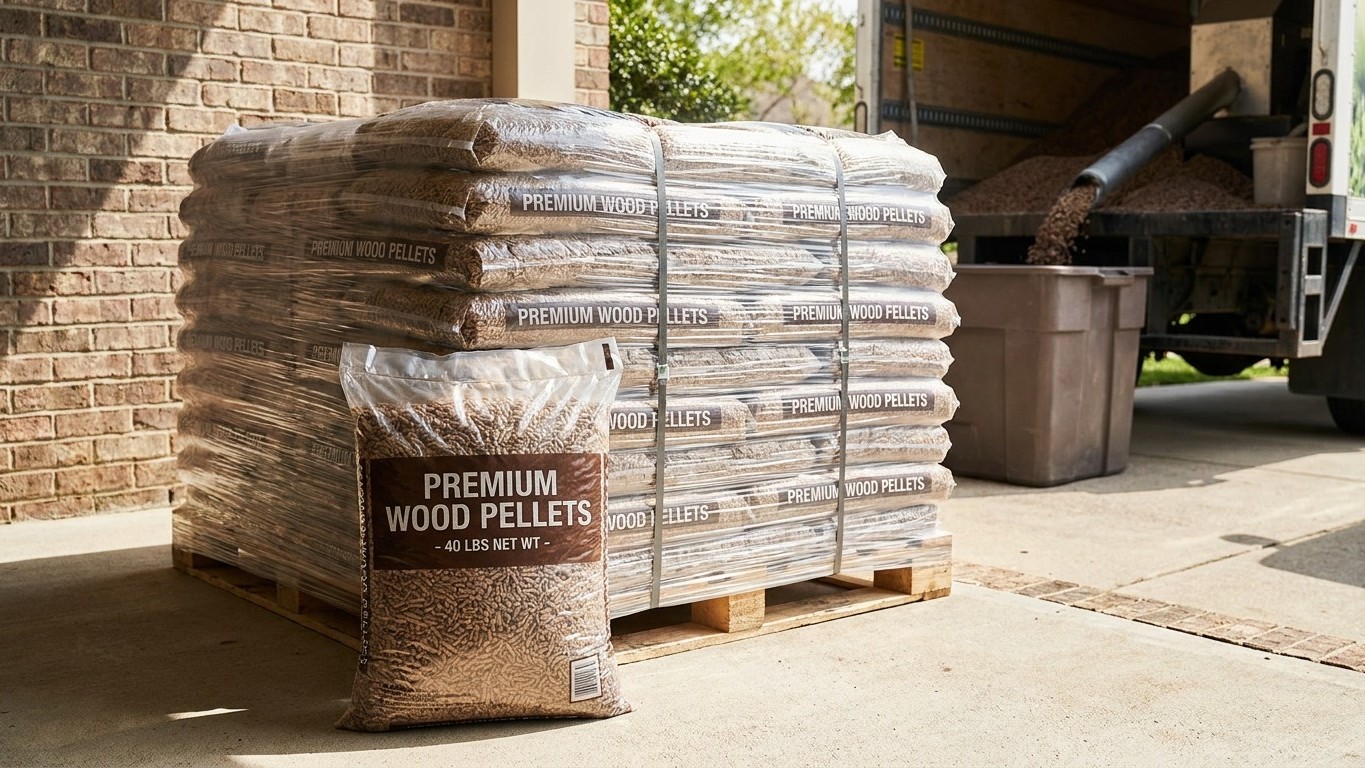

Buy pellets by the ton whenever you’re comparing prices, even if what actually lands on your porch is a stack of bags. A 40-pound bag works for testing a new fuel or topping off mid-winter. A pallet, usually a full ton banded together, covers a season for most households. The dollar figure that means anything is the price per ton, because that’s the only number every dealer and every big-box store is quoting the same way, whether they hand you loose bags or shrink-wrap the whole load.
How pellets are sold

Three units show up in pellet buying, and they’re not competing options so much as different slices of the same product. The bag is the retail unit: 40 pounds, sold individually at hardware stores, feed stores, and home centers. The pallet is the bulk unit: a stack of bags, typically 50 of them, banded and shrink-wrapped, usually adding up to one ton. The ton itself isn’t a package at all. It’s the weight measurement that lets you compare a dealer’s bulk delivery to a big-box store’s shelf price, no matter how the pellets are bundled when they arrive.
This is where first-time buyers get tripped up. A hardware store rings up pellets by the bag. A fuel dealer or farm supply outlet quotes by the pallet, sometimes with delivery included. A bulk supplier serving larger operations may talk in loose tons, delivered by truck rather than stacked on pallets at all. None of these are wrong ways to sell pellets. They’re just different points of entry into the same market, aimed at different buyers: the homeowner grabbing a few bags on a Tuesday errand, the household stocking up for the whole season, or the larger user who burns through fuel fast enough that pallet wrap is just extra cost.
Why the quoted unit changes by seller
A big-box store sells single bags because its customers are impulse buyers or people topping off a supply they already have at home. A dedicated pellet dealer or a farm and feed store leans toward pallets because that’s the unit their trucks and forklifts are built around, and it’s the unit that makes sense for a homeowner filling a garage or shed before winter. Bulk suppliers who serve larger commercial accounts skip the packaging almost entirely.
None of that changes what you should do as a buyer. Take whatever price is quoted, whether it’s per bag, per pallet, or per ton, and convert it to a per-ton figure before comparing. That’s the only apples-to-apples number in this market, and it’s the one that will actually tell you whether the pallet at the farm store beats the case of bags at the hardware store this particular week.
When to buy, and why it matters
Pellets are a seasonal product sold to a market that mostly shops in a panic. Availability and pricing both track the calendar: pellets are easiest to find and typically cheapest in the stretch before heating season really gets going, when dealers are moving inventory and shelves are still full. Once a cold snap hits a region, that changes fast. A hard freeze across a multi-state area can empty local shelves within days, because everyone who let their supply run low is suddenly shopping at once, and trucks can’t restock every store overnight.
That’s the real argument for buying ahead rather than reactively. A household that waits until the first serious cold spell to buy is competing with every other household in the region doing the exact same thing, at the exact same moment, for a limited regional supply. Buying in late summer or early fall sidesteps that entirely. You’re shopping when demand is low, trucks are running full routes, and no one else is panic-buying pallets three at a time.
What buying ahead actually requires
The catch is that buying early means storing early, and pellets are not forgiving about how they’re stored. They’re compressed sawdust held together by natural lignin, and moisture undoes that compression fast, turning a tight pellet back into loose, useless sawdust. That means a dry space, off a damp concrete floor, away from anywhere rain or snowmelt could reach the bags, for however many months separate your purchase from the day you actually burn them.
It also means having the space at all. A single pallet takes up real square footage in a garage, shed, or basement, and stacking bags directly on bare concrete invites moisture wicking up from below even in a covered space. If you’re planning to buy a season’s worth ahead of time, work out the storage question before the purchase, not after the delivery truck is already idling in your driveway. Our guide to storing wood pellets covers what a dry, stable storage setup actually looks like, pallet by pallet.
Judging what you are buying
Not all pellets perform the same way once they hit the firebox, and the U.S. EPA is blunt about it: “Pellets can differ significantly in how well they’re made and how well they burn. Lower quality pellets may provide less heat and create a fine dust. Higher quality pellets tend to burn cleaner and produce less ash.” That single sentence is worth more to a buyer than any brand name on a bag, because it tells you exactly what to watch for once you get fuel home and load the hopper.
The practical move is to resist buying a full pallet of a fuel you haven’t burned before. Buy a single bag first. Run it through a few burn cycles and pay attention to two things: how much fine dust settles at the bottom of the bag before you even light the stove, and how much ash builds up in the firebox afterward. Dusty pellets crumble easily and tend to leave more residue behind; well-made pellets hold their shape and burn down cleaner.
Keeping a record instead of guessing
Memory is unreliable over a five- or six-month heating season, especially once you’ve cycled through pellets from two or three different sources. A short note, even just a line in your phone after each bag or pallet, on how much ash and dust a particular batch produced, turns a vague impression into an actual record. That record is what tells you, next fall, whether to go back to the same supplier or look elsewhere.
Once you find fuel that burns clean and leaves manageable ash, stick with it. Switching suppliers to chase a slightly lower price on a pallet can cost more in cleaning time and lost heat output than it saves at checkout. For a deeper look at what separates a well-made pellet from a dusty one, see our dedicated pellet quality guide.
Common questions
Is it cheaper to buy pellets by the pallet than by the bag?
Pricing varies by region, season, and seller, so there’s no fixed rule. The only reliable way to know is to convert every quote, whether it’s per bag, per pallet, or per bulk ton, into a price per ton and compare those figures directly.
How much fuel does a pellet stove actually use in a season?
That depends on your specific stove, its heating capacity, and your local climate, all of which vary too much for a single rule of thumb. The EPA notes that “EPA-certified pellet stoves usually fall into the 70-83% efficiency range, while heating capacities range from 8,000-90,000 Btu per hour,” so the appliance label and your own past heating bills are better guides than any general estimate.
Can I mix pellets from different bags or suppliers in the same load?
There’s no safety issue with mixing pellets from different sources in the hopper. The reason to avoid it is purely about tracking quality: if a load burns dirty or leaves excess ash, mixed sources make it impossible to tell which batch caused the problem.
Do pellet stoves need anything besides fuel to run?
Yes. As the EPA points out, “Pellet stoves need an electrical supply to work because they use motorized components to feed the fire and blow out hot air,” and “the pellets are poured into a hopper, which automatically feeds into the stove.” Beyond fuel and power, the U.S. Fire Administration also recommends you “maintain heating equipment and chimneys by having them cleaned and inspected each year by a professional,” and keep flammable items “at least 3 feet from all heat sources including fireplaces, wood stoves, radiators, space heaters or candles.”