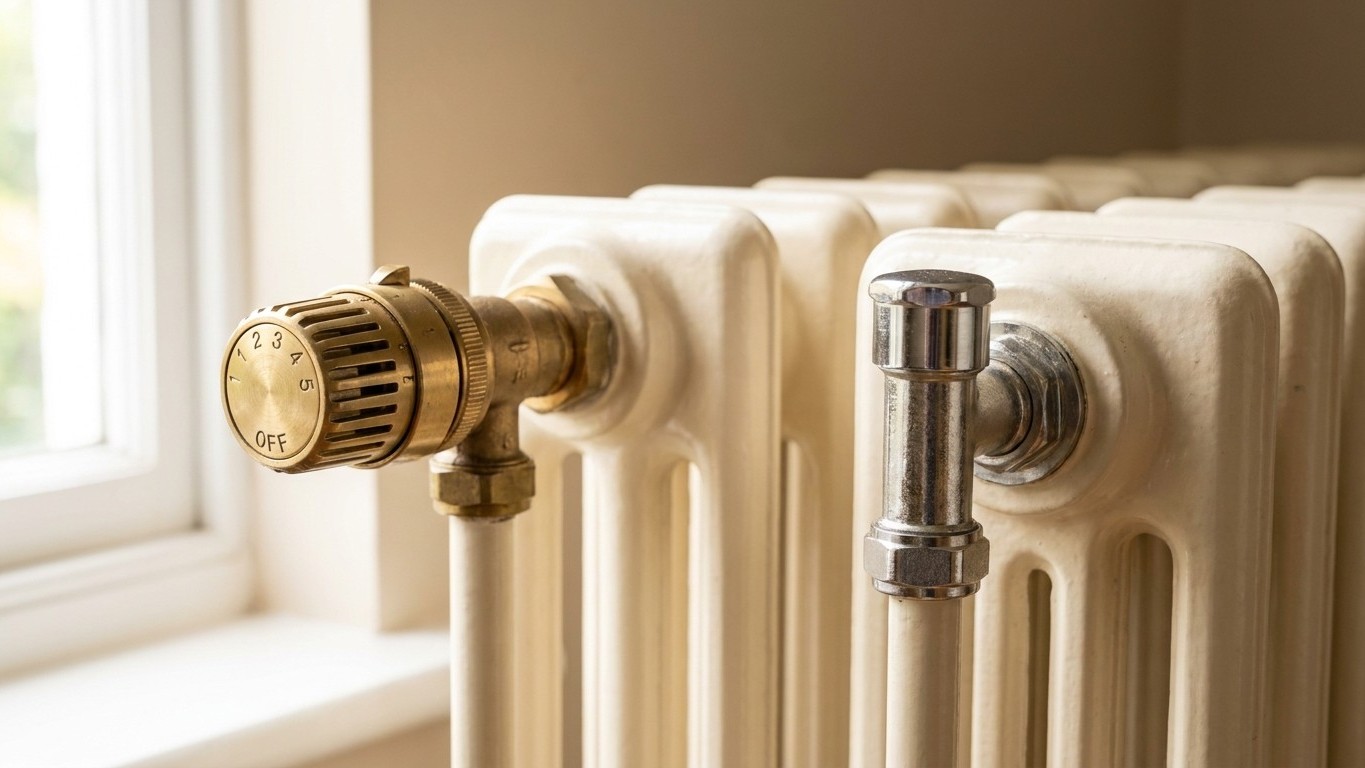

Every hot-water radiator has two valves, and they don’t do the same job. One controls how much hot water flows in right now. The other is set once, then left alone. A thermostatic head only replaces the first one, and it works by sensing air temperature, not by cranking out more heat. Get the two ends confused, or fight the head against a wall thermostat, and one room stays cold no matter what you do.
Two ends, two different jobs

Before anything else: a radiator is not a heating system. It’s what a boiler pushes heat into, as steam or as hot water, and every fault described here belongs to that loop, not to the metal panel sitting in the room. Home inspection reports even file it under “steam or hot water system” for that reason. Which family you have changes what you’re allowed to touch, so check that first.
On a hot-water radiator, look at both ends. One end has a valve you can turn, day to day, to let more or less hot water flow through. On many systems this is the valve that carries a thermostatic head. The other end has what plumbers call a lockshield valve, usually capped with a plain metal cover you’d need a small wrench or screwdriver to move at all.
That lockshield isn’t decorative. It’s set once, during installation or a balancing pass, to control the flow rate of that specific radiator relative to every other radiator on the same loop. A radiator closer to the boiler naturally wants to grab more hot water than one at the far end of the house. The lockshield throttles the near one back slightly, so the far one still gets its share. Touch it without knowing the original setting and you can quietly starve a room three doors down, one that seemed to have nothing wrong with it before.
This is why fiddling with the wrong end backfires. A homeowner who can’t get a room warm enough sometimes cranks the lockshield instead of the flow valve, thinking it’s just a stiffer knob. It moves the balance for the whole loop, and the room that was fine yesterday is cold today. If a radiator seems wrong, the flow-side valve, the one meant for daily adjustment, is where to start. The lockshield is a set-and-forget part.
A steam radiator works differently and has no lockshield to balance. It has a single supply valve, meant to be fully open or fully closed, and an air vent that does the balancing job instead. There’s no bleed key involved, and it should never be opened up the way you’d bleed a hot-water radiator. That distinction matters enough that it gets its own section further down.
What a thermostatic head actually senses
A thermostatic radiator valve head looks like a dial with numbers, and it’s tempting to treat it like a power setting, low heat at one end, blast-furnace at the other. That’s not what’s happening inside it. The head contains a small thermostat, usually a wax or liquid capsule that expands and contracts with temperature. It senses the air immediately around itself and closes the valve once that air reaches the level the number represents. Turning the dial to its highest setting doesn’t push more heat into the radiator; it just tells the valve to stay open longer before it decides the room is warm enough.
That single fact explains a strange complaint people write into forums and never quite solve: one radiator “won’t get hot” no matter how far the dial is turned. Often the head itself is fine. It’s buried behind a curtain, tucked under a windowsill shelf, or boxed in by furniture, and it’s sensing a small pocket of trapped warm air rather than the room’s real temperature. The head reads that pocket as “warm enough,” shuts the valve early, and the rest of the room never gets its share of heat. Moving the head into open air, or replacing a shrouded valve with a remote-sensor version, usually fixes it without touching anything upstream.
The numbers themselves don’t map to a fixed thermometer reading this brief can responsibly quote, because that varies by manufacturer and by where the head sits in the room. What’s consistent across nearly all of them is the behavior at each end of the dial:
| Dial position | What it does |
|---|---|
| Low numbers | Valve closes at a lower air temperature; room runs cooler |
| Mid-range numbers | Typical comfort range for an occupied room |
| High numbers | Valve stays open longer; room runs warmer, not “harder” |
| Snowflake / frost setting | Valve opens only if the room gets cold enough to risk freezing pipes, otherwise stays shut |
That frost setting is worth knowing about on its own. It’s meant for a room you’re not using, a guest room, a workshop, a vacation home, and it keeps the radiator essentially off while still protecting the plumbing behind the wall from a hard freeze. It is not a normal daily setting for a room people sit in.
Using them with the room thermostat
A house with both thermostatic radiator heads and a wall-mounted room thermostat has two controls doing two different jobs, and mixing them up is one of the most common ways a heating system gets blamed for something it isn’t doing. The room thermostat, usually in a hallway or main living space, decides whether the boiler fires at all. The thermostatic heads on individual radiators decide how much of that heat each room actually receives once the boiler is running. One is a system-wide switch. The others are room-by-room valves downstream of it.
That division is useful, not redundant. A house can have the boiler running because the thermostat calls for heat, while a spare bedroom stays cool because its thermostatic head is turned low, and a sunroom that gets afternoon sun stays comfortable because its head cuts the flow early. None of that fights the room thermostat; it works alongside it. The trouble starts when the room holding the wall thermostat also has a thermostatic head set differently, each one trying to override the other. That room should have a plain, non-thermostatic valve, or a head left wide open, so the thermostat that governs the whole boiler is reading the room honestly instead of arguing with a valve next to it.
On the setback question, the U.S. Department of Energy is specific: “You can save as much as 10% a year on heating and cooling by simply turning your thermostat back 7-10°F for 8 hours a day from its normal setting.” That’s a real, quotable number, and it applies across heating systems generally. But a steam or hot-water system doesn’t respond the way forced air does. Forced air can swing a room’s temperature in minutes. A radiator loop is heating water and cast iron or steel, both of which hold their temperature and release it slowly, which means a deep setback that works fine on a furnace-and-ductwork system can leave a hot-water house noticeably cold for the first hour after the thermostat calls for heat again. A smaller setback, held for the same 8 hours, is usually the more comfortable trade in one of these houses.
Stuck pins, and the steam equivalent
A thermostatic valve that’s sat wide open all summer can seize in place, and the symptom is specific: the radiator stays cold no matter where the dial is set, or it stays hot no matter where the dial is set, because the pin inside the valve body that the head is supposed to push isn’t moving anymore. Before assuming the valve itself is dead, there’s a simple sequence worth trying.
- Turn the thermostatic head fully off and leave it there for a few minutes, then turn it fully to maximum, repeating this a few times to work the pin loose.
- If nothing changes, remove the head from the valve body (usually a collar or ring you unscrew or unclip) and look at the exposed pin.
- With the head off, gently press the pin in with a fingertip or a small blunt tool. It should move and spring back. If it’s stuck flush or stuck extended, that’s the seized point.
- Tap lightly around the valve body while working the pin, which is often enough to break loose the mineral or rust deposit holding it.
- Reattach the head once the pin moves freely under light pressure, and test through its full range before walking away.
None of this applies to a steam radiator, which has no thermostatic head to seize in the first place. A steam radiator is controlled by its air vent, not by a valve at the supply end. The vent lets air escape as steam fills the radiator, and once steam reaches the vent, it closes and traps the heat inside. An adjustable vent, one with a dial rather than a fixed hole size, changes how fast that radiator fills and how long it takes to feel warm; a wide-open vent fills fast, a nearly closed one fills slowly and keeps that radiator cooler than its neighbors. For the whistling, hissing, and vent-sizing side of that system, the site’s guide on steam radiator vents covers it in detail.
Common questions
Can I put a thermostatic head on any radiator?
Only if the radiator has a valve body designed to accept one, typically a hot-water radiator’s supply-side valve. A steam radiator’s supply valve is not built for a thermostatic head and shouldn’t be adapted for one.
Why does one room stay cold while the rest of the house is warm?
Check the thermostatic head first for a blocked sensor (curtains, furniture, a shelf), then check whether the lockshield valve on that radiator was recently disturbed, since that’s the balancing valve for the whole loop.
Should I turn the thermostatic head to maximum for faster heat?
It won’t heat the room faster. It only keeps the valve open longer before the head decides the air is warm enough, which mainly affects how long, not how hot.
Does the lockshield valve ever need adjusting by a homeowner?
Rarely, and not casually. It’s meant to be set once during system balancing. If radiators seem unbalanced across the house, that’s worth a proper balancing pass rather than turning the lockshield by guesswork.