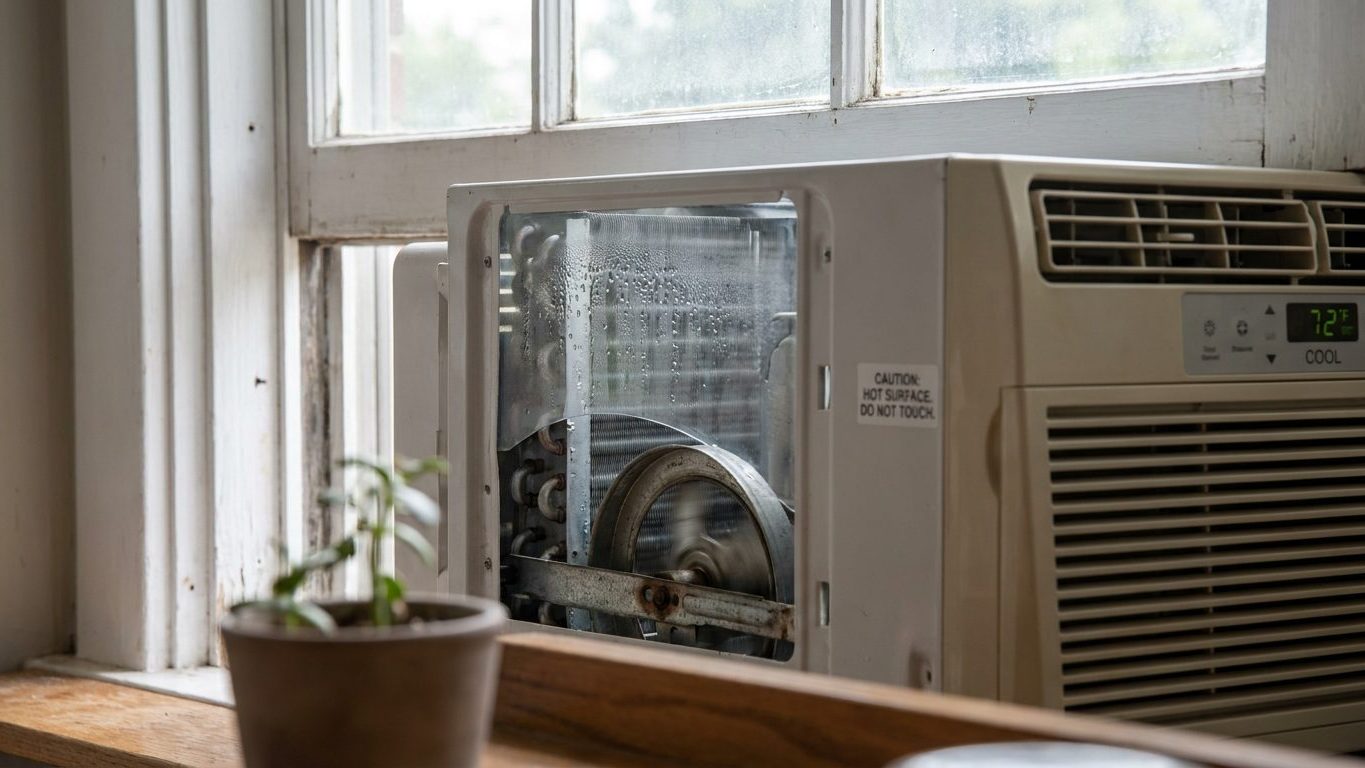

Most window air conditioner noise falls into one of two buckets: sounds the machine is supposed to make, and sounds that mean something has shifted loose or worn out. A surprising number of “broken” units are actually fine, just poorly seated in the window. Sorting out which bucket you’re in usually takes less than five minutes of listening.
What is normal, and what is not
Sounds that mean the unit is working
A compressor kicking on with a solid thunk is normal. That’s the sound of a heavy motor engaging, and it should settle into a steady hum within a second or two, not keep clunking. The fan note changing when you bump the speed setting from low to high is also expected; a sharper whoosh at high speed and a softer one at low speed is the unit doing exactly what the dial asked it to do.
The one that throws people off is water. On humid days, a window unit pulls a fair amount of moisture out of the air, and that water has to go somewhere. Many units route it onto the condenser coil in back, where a spinning slinger ring flings droplets against the coil to help cool it and speed evaporation. That flicking, spattering sound, sometimes described as light rain hitting a tin roof, is by design. It’s not a leak, and it’s not a sign the drain pan is failing.
Sounds that mean something’s wrong
A rattle that wasn’t there last summer usually means something is loose or something has fallen where it shouldn’t be. A metallic scrape, especially one that rises and falls with the fan speed, points to a moving part touching something it isn’t supposed to touch. A buzz that comes and goes as you open or close the window sash is a strong clue the cabinet itself is vibrating against the frame rather than the compressor doing anything unusual. And a grinding sound, particularly a low growl right when the compressor starts, is the one that deserves the most attention, because it often points to a mount or bearing wearing out rather than something a homeowner can shake loose.
None of these four require you to replace the unit on the spot. But they do mean it’s worth another five minutes figuring out whether the window or the machine itself is the source.
It is often the window
Here’s the detail that saves a lot of people a service call: a window air conditioner is bolted into a sash that was built to hold glass, not a fifty-plus pound vibrating motor. When that sash is even slightly loose, the whole window becomes a soundboard, amplifying vibration that the unit itself is barely producing. The tell is simple. Lay a flat hand on the window frame while the compressor is running. If the buzz or rattle drops noticeably the moment you apply pressure, the fault isn’t inside the machine at all.
A short sequence for tracking it down
Work through these in order rather than jumping straight to the last one:
- Firm up the sash. Check that the top sash is locked down against the unit and that any locking clips or brackets are actually engaged, not just resting in place.
- Add foam or rubber weatherstrip between the unit’s cabinet and the window frame wherever they touch. This single step resolves more buzzing complaints than any other adjustment, because it breaks the direct metal-to-wood or metal-to-vinyl contact that carries vibration into the frame.
- Check that the side accordion panels aren’t drumming. These thin panels are convenient for sealing gaps on either side of the unit, but they flex easily, and a panel that’s bowing in the airflow will hum or flap. A strip of foam tape along the panel’s edge usually quiets it.
- Make sure the unit isn’t resting on the frame at only one point. A cabinet that touches the sill at one corner and hovers slightly everywhere else will rock with the compressor’s vibration instead of sitting still. Shims under the low corner, even something as simple as folded cardboard, can level it out.
Worth noting here, briefly: these units are heavy, and a sash that isn’t properly secured is a real weight-at-the-window risk, not just a noise problem. Confirming the unit is seated and supported the way the installation instructions describe is worth doing for that reason alone, separate from any buzz it might be causing.
If you’ve gone through all four steps and the vibration is still there the moment you take your hand off the frame, the noise is very likely coming from inside the cabinet, which is the next thing to check.
Inside the unit
Before touching anything past this point, unplug the unit. Everything described below involves getting close to a fan blade or a panel that sits directly in front of one, and that’s not worth doing with the motor live.
Once it’s unplugged, most internal noises sort into a short list. Some are a five-minute fix. Others are a sign the unit is aging out and better handled by a technician, or simply accepted as the cost of a few more seasons of use.
| Noise | Usually caused by | Fixable at home? |
|---|---|---|
| Rattle | Debris, a leaf, or dust buildup resting against the fan blade | Yes, usually a quick clean-out |
| Clanging or thumping | A bent fan blade catching on the housing with each rotation | Sometimes, if the bend is minor and can be straightened carefully |
| Buzzing from the front | A loose front panel or grille vibrating against the cabinet | Yes, tightening the screws or clips usually solves it |
| Scraping | The fan cage rubbing against its housing, often from a shifted mount | Sometimes; may need realignment a technician handles more reliably |
| Grinding or growling | A compressor mount that has aged and hardened, letting the compressor vibrate against the cabinet | No, this is where a homeowner should stop and call a technician |
The pattern in that table is worth noticing: anything involving debris, dust, or a loose panel is fair game for a homeowner with a screwdriver and a flashlight. Anything involving the compressor’s mounting, or a fan cage that’s shifted out of alignment, moves into territory where the fix requires taking the cabinet apart in ways that risk the sealed refrigerant system if done carelessly. At that point, the practical question isn’t whether it can be fixed, it’s whether the unit is old enough that a repair bill makes sense compared to running it a bit longer or replacing it.
Reducing what cannot be removed
A room air conditioner is a compressor sitting a few feet from wherever you sleep, work, or watch television, and there is no adjustment that makes that fully silent. What’s realistic is reducing the noise that reaches you, not eliminating it.
Three things that actually move the needle
Where the unit sits in the window matters more than people expect. A unit angled toward a corner, or one where the compressor side faces the room rather than away from it, throws more sound at you than the same machine positioned with the compressor housing angled outward.
Sizing matters just as much, and in the opposite direction from what people assume. A unit sized correctly for the room runs longer at a steady, moderate speed. An oversized unit cools the room fast, shuts off, and then cycles back on again within minutes, and each of those restarts includes the loudest sound the machine makes: the compressor kicking on. Running one properly sized unit continuously is quieter over the course of an evening than running an oversized one that’s constantly stopping and starting.
Fan speed is the trade-off you control directly. Low speed is quieter but moves less air, so the room takes longer to feel cool. High speed cools faster but adds a steady whoosh that some people notice more than the compressor itself, especially at night. There’s no setting that gives you both, so the honest approach is picking the one you’d rather live with rather than assuming a “quiet” setting exists that does both jobs at once.
One more note worth saying plainly: whatever you plug the unit into, avoid running it off an extension cord. If the outlet situation makes that tempting, that’s a question for an electrician, not a workaround to reach for on your own.
Common questions
Why does my window air conditioner get louder at night?
It’s often not louder at all, just more noticeable. Household noise drops after dark, so the same steady hum stands out more than it did during the day. If the sound genuinely changes at night, check whether cooler outdoor air is causing the compressor to cycle differently.
Is it normal for a window unit to vibrate the whole wall?
No. A properly seated unit with the sash secured and foam padding between the cabinet and frame should transmit very little vibration beyond the window itself. Vibration reaching the wall usually means the sash isn’t locked down or the unit is resting unevenly.
Can a dirty filter cause new noise?
A dirty filter more often causes weak airflow than new noise, since it restricts air rather than touching moving parts. Filter maintenance guidance from ENERGY STAR is written for central heating and cooling equipment, not window units, so check your unit’s manual for its specific filter-cleaning interval.
Should I try to tighten the compressor mount myself?
No. The compressor sits inside a sealed refrigerant system, and getting to its mount usually means opening parts of the cabinet not meant to be opened casually. A grinding or growling sound tied to the compressor is the clearest sign in this whole list that it’s time to call a technician rather than reach for a screwdriver.