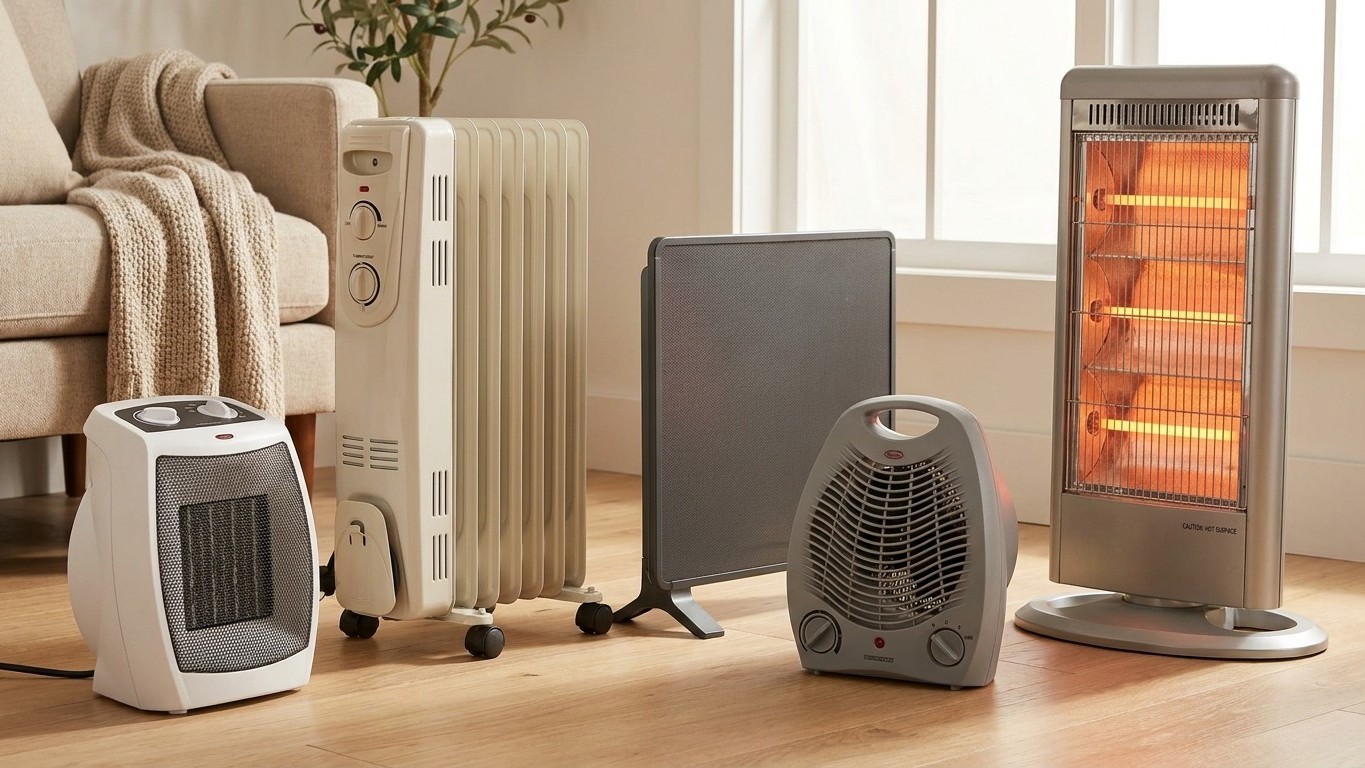

Ask which space heater is “best” and you’re asking the wrong question. The real split is mechanical: does the unit warm the air in a room, or does it warm surfaces and skin directly? Ceramic fan heaters, oil-filled radiators, micathermic panels and fan-forced convectors all fall on one side of that line. Quartz and infrared heaters sit on the other. Propane and kerosene units are a separate category entirely, because they burn fuel indoors. Which one suits you depends on the room, not a spec sheet.
Two ways to move heat, and everything follows

Every electric space heater on the market does one of two things. It either heats the air around it and lets that warm air circulate through the room (convection), or it emits infrared energy that heats whatever solid object stands in its path, including a person, without needing to heat the air in between (radiant). That single distinction explains almost every practical difference you’ll notice between models, brands and price points.
Convection is the slow build. A ceramic element or an oil-filled radiator warms the air touching it. That warm air rises, cooler air moves in to replace it, and over time the whole room drifts upward in temperature. It’s the same principle as a furnace, just on a smaller scale and without ductwork. The tradeoff is time: a convection heater in a cold room can take twenty minutes or more before you notice a real difference, because it’s working on the entire volume of air, not on you specifically.
Radiant heat skips that step. Stand in front of a quartz or infrared element and you feel warmth within seconds, the same way standing in direct sun feels warm even when the surrounding air is cold. The heater isn’t raising the room’s temperature in any meaningful way; it’s warming the surfaces, including your skin, that fall within its line of sight. Step out of the beam and the sensation drops off almost immediately.
That difference dictates use. Convection heat suits a room you’ll occupy for hours: a home office, a den, a bedroom before sleep. Because it evens out across the space, it keeps working even after you’ve moved to a different chair or turned your back on the unit. Radiant heat suits the opposite case, a single person who needs warmth fast in a space that’s too large, too draughty, or too briefly occupied to justify heating the whole air volume, like a garage workbench or a three-season porch.
Neither approach is superior in the abstract. A radiant heater in a large open room will leave you warm only in the spot you’re standing, while everyone else in the room stays cold. A convection heater in a garage with the door cracked open will run for an hour and barely move the Thermostat, because the warmed air keeps escaping. The mechanism has to match the room and the way you plan to use it, which is the question worth answering before you look at any single model.
The types side by side
| Type | How it heats | How fast you feel it | How quiet it is | What it suits |
|---|---|---|---|---|
| Ceramic fan heater | Convection: a fan pushes air across a heated ceramic plate | Fast, noticeable within a couple minutes | Fan noise, a steady hum | Quick spot warming under a desk or in a small bathroom |
| Oil-filled radiator | Convection: sealed oil inside the fins heats up and radiates slowly into the room | Slow, often 20 to 30 minutes before it’s noticeable | Silent, no fan | Steady background heat in a bedroom or office over hours |
| Radiant / quartz / infrared | Radiant: a glowing element emits infrared energy directly at people and objects | Instant, felt as soon as you’re in the beam | Silent | One person in a large, drafty or briefly occupied space |
| Micathermic panel | Mostly radiant with some convection: thin mica sheets heat and radiate outward | Moderate, a few minutes | Silent, no moving parts | Low-profile wall or floor heating in a living space |
| Fan-forced convector | Convection: a heating coil with a fan forces warm air out quickly | Fast | Audible fan running continuously | Fast whole-room heat in an entryway or bathroom |
One point in this table matters more than any other, and it’s easy to miss. Every one of these units is a plain electric resistance heater, and electric resistance heating converts essentially all the electricity it draws into heat. There’s no efficient or inefficient type here in terms of running cost per unit of warmth produced. A 1,500-watt ceramic heater and a 1,500-watt oil-filled radiator cost the same to run for an hour, because both turn nearly every watt into heat. What differs between them isn’t how much heat you get for your money, it’s how that heat reaches you, how quickly, and in what pattern across the room.
That reframes the whole comparison. Choosing between a fan heater and a radiator isn’t a decision about efficiency, it’s a decision about delivery: do you want heat now, in a beam, or heat gradually, filling the room? The wattage on the label tells you the maximum heat output and, roughly, the operating cost. The type tells you how that output behaves once it leaves the unit.
The ones that burn fuel are a different question
Propane and kerosene space heaters don’t belong in the comparison above, because they don’t just move heat, they produce it by burning fuel indoors. That single fact changes the questions you need to ask before buying or using one, and those questions have no equivalent with an electric unit.
A fuel-burning heater consumes oxygen from the room as it burns, and it releases combustion byproducts back into that same air, including carbon monoxide, a gas with no smell and no color. It also produces water vapor as a byproduct of combustion, which can raise humidity and contribute to condensation on windows and walls in a closed space. None of that applies to a ceramic heater, an oil-filled radiator, or any of the other types covered above, because none of them burn anything.
This is also the point where the U.S. Fire Administration is direct about a related but distinct piece of equipment: “Never use an oven to heat your home.” An oven burns fuel or draws heavy electrical current for a purpose it wasn’t designed or vented for, and the same logic, that combustion and heat production need equipment built and vented specifically for the job, applies to any propane or kerosene unit brought indoors.
Vented fuel appliances, including anything connected to a chimney or flue, come with their own maintenance question that has nothing to do with electric heaters. The U.S. Fire Administration advises to “maintain heating equipment and chimneys by having them cleaned and inspected each year by a professional.” That’s a yearly, professional task, not a seasonal wipe-down.
None of this means a propane or kerosene heater is automatically unsafe to own. It means the questions are different in kind, not just degree: combustion air supply, carbon monoxide exposure, and moisture buildup are considerations an electric ceramic heater or radiator simply doesn’t raise. If you’re weighing a fuel-burning unit, that decision deserves its own dedicated look at ventilation requirements and detector placement rather than a paragraph tucked into a comparison of electric types.
Choosing by the room, not by the heater
Flip the question around and it gets easier. Instead of asking which type of heater is best, ask what the room actually is: its size, how well it’s insulated, how much air leaks in around doors and windows, how long you’ll be in it, and whether anyone else needs it warm too. Four common situations cover most households.
- A home office used all day. An oil-filled radiator or a micathermic panel makes sense here. Both run silently for hours without the drone of a fan, and because you’re seated in one spot for long stretches, the slow, even build of convection heat has time to work.
- A bedroom occupied at night. A silent convection unit again fits best for pre-warming the room before you get into bed. But the U.S. Fire Administration is specific on this point: “Turn space heaters off when leaving the room or going to bed.” The practical routine is to run it while you read or get ready, then switch it off, ideally with an automatic shutoff timer, before you fall asleep.
- A garage workshop used for an hour. A radiant or quartz heater is the right tool, because it warms you directly without trying to raise the temperature of a large, often poorly sealed space that will just lose that heat back out through the door and walls.
- A bathroom. A fan-forced convector delivers a fast blast of warmth for the short window most people spend in there, but it needs to be a unit rated for damp locations and kept well clear of the tub, sink and shower.
Whichever type ends up in the room, the same physical clearance rule applies everywhere. The U.S. Fire Administration puts it plainly: “Keep anything that can burn at least 3 feet from all heat sources including fireplaces, wood stoves, radiators, space heaters or candles.” That distance matters because portable heaters are involved in a disproportionate share of serious outcomes. The U.S. Fire Administration’s 2017-2019 report on portable heater fires found an estimated annual average of 1,100 fires, 65 deaths, 150 injuries and $51 million in property loss in residential buildings. Portable heaters accounted for roughly 3% of home heating fires overall, but roughly 41% of fatal home heating fires, a gap that says less about the equipment itself and more about how close it sits to furniture, bedding and curtains when something goes wrong.
For help matching wattage to square footage before you shop, see the space heater sizing guide. For a look at what any of these types actually cost to run over a season, see the running cost breakdown.
Common questions
Is a ceramic heater the same as an infrared heater?
No. A ceramic heater is a convection type, it uses a fan to push air across a heated ceramic plate and blows warm air into the room. An infrared or quartz heater is radiant, it emits infrared energy that warms people and objects directly, without needing to heat the surrounding air first.
Which type of space heater is quietest?
Oil-filled radiators, micathermic panels and radiant/quartz heaters all run without a fan, so they’re silent in operation. Ceramic fan heaters and fan-forced convectors both rely on a fan to move air, which means audible noise for as long as they’re running.
Do oil-filled radiators use more electricity than ceramic heaters?
Not for the same wattage. Both are electric resistance heaters, and resistance heating converts nearly all the electricity drawn into heat regardless of the type. A 1,500-watt radiator and a 1,500-watt ceramic heater cost roughly the same to run for the same amount of time; they just deliver that heat differently.
Are propane and kerosene heaters covered by the same buying advice as electric types?
No. Fuel-burning heaters consume oxygen and produce combustion byproducts, including carbon monoxide, that electric units never generate. They raise separate questions around ventilation, detector placement and professional inspection of any vented equipment, which is worth researching on its own before choosing one for indoor use.