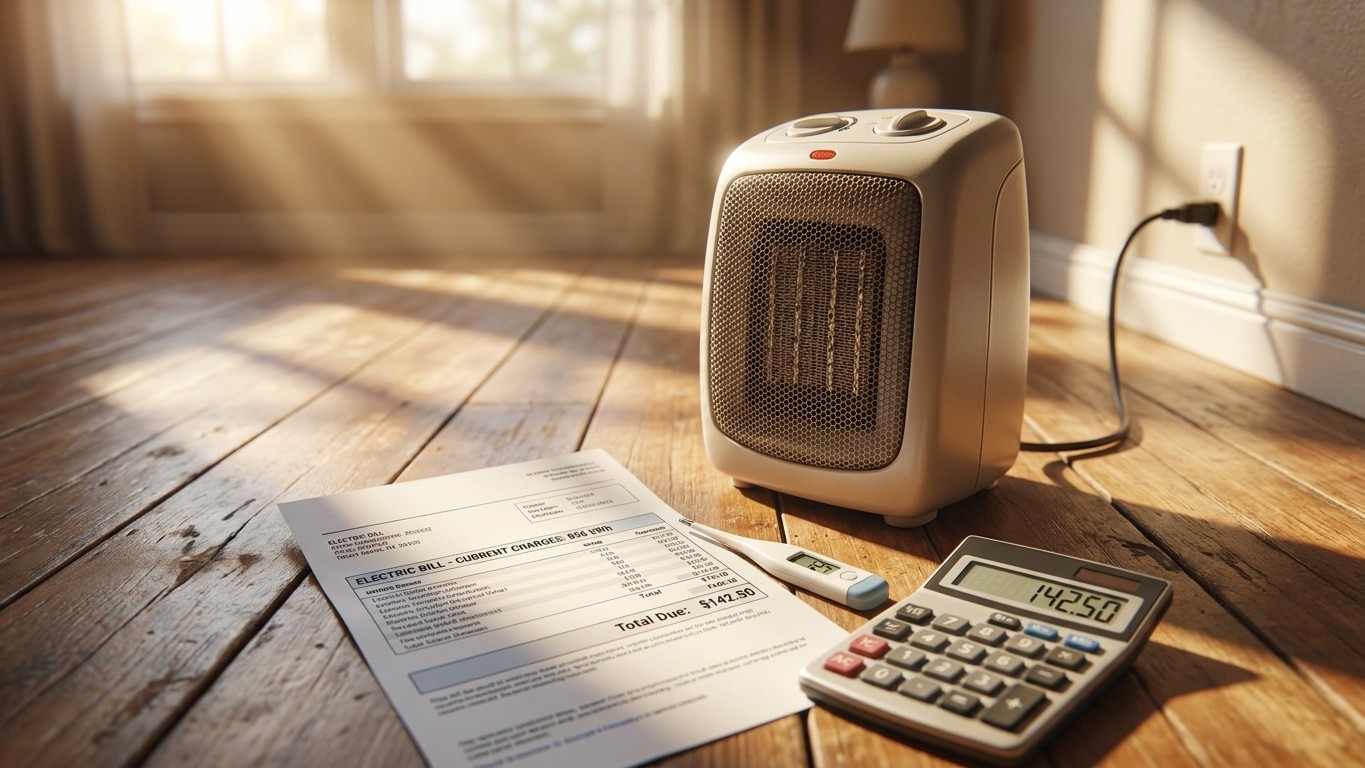

A 1,500-watt space heater running four hours a day costs whatever your electricity rate says it costs, multiplied by 6 kilowatt-hours. That’s the whole formula. The only variable that actually changes the answer is the price per kilowatt-hour on your utility bill, and that number swings by more than a factor of three depending on which state you live in. Everything else, wattage, hours, Thermostat settings, is arithmetic you can do in your head.
The only calculation you need

Start with the nameplate wattage, usually stamped on the back or bottom of the unit, or printed right on the box. A common space heater draws 1,500 watts on its highest setting. Divide by 1,000 and you get 1.5 kilowatts. That’s step one, and it never changes no matter where you live or what you pay for power.
Step two is time. Run that 1,500-watt heater for four hours and you’ve used 1.5 kW times 4 hours, which equals 6 kilowatt-hours (kWh). This is the unit your electric meter actually tracks, and it’s the same unit that shows up as a line item on your bill.
Step three is the only part that’s personal to you: your rate. Multiply the 6 kWh by whatever your utility charges per kilowatt-hour, and you have your cost for that four-hour stretch. Run the heater eight hours instead of four, and you simply double the kWh figure, then multiply again.
Where to find your rate
Your own electric bill is the only number that matters here, because it already includes your utility’s actual rate structure, any seasonal adjustments, and local surcharges. Look for “price per kWh” or a total dollar amount divided by total kWh used that month. If you want a sense of how your state compares to others, the U.S. Energy Information Administration’s Electric Power Monthly publishes state-level average residential electricity prices, along with regional tables in its Short-Term Energy Outlook. Those figures are dated to a specific month, and they shift over time, so treat them as a comparison tool, not a fixed number to plug into your own math.
This is why generic “a space heater costs $X to run” articles are close to useless. A household in a state with cheap power and a household in a state with expensive power can run the identical heater for the identical number of hours and end up with bills that differ by triple. The calculation is universal. The price behind it isn’t.
Why the label wattage overstates the bill
Here’s the correction almost every cost estimate skips: the wattage on the box is the heater’s maximum draw, not its average draw. Most space heaters sold today have a built-in Thermostat, and once the room reaches the set temperature, the heater doesn’t keep running at full power continuously. It cycles, switching off, letting the room drift down a degree or two, then switching back on.
That means the real electricity consumption is the wattage multiplied by the fraction of the hour the heating element is actually energized, not the full hour. A heater that’s actually drawing power only 40 percent of the time it’s turned on is using 40 percent of the energy the label wattage would suggest for that period. Run the same math as before, six hours of “on” time, but if the element is only actually heating for two of those hours, your real consumption is 3 kWh, not 9 kWh.
What pushes that fraction up or down
Several conditions make a heater run closer to full-time, which pushes your real cost toward the label-wattage ceiling:
- A large room, which takes longer to heat and loses warmth faster
- Poor insulation or an older, drafty window near the heater
- A big temperature gap between outdoor and target indoor temperature
- A thermostat set high relative to the room’s natural heat loss
A small, well-sealed room with a modest temperature target lets the heater reach its set point quickly and then coast, cycling on briefly and staying off for longer stretches. The same heater in a drafty, oversized room barely gets a break.
The practical takeaway: the full-wattage, full-hours calculation from the section above is a ceiling, not a real-world estimate. It tells you the worst case, the most you could possibly spend running that heater for that many hours. Your actual bill will likely land somewhere below it, and how far below depends entirely on how hard the room is fighting the heater.
Cheaper than the furnace, or not
This is the comparison most people actually want answered, and it deserves a careful answer rather than a percentage pulled from nowhere. Heating a single room with a plug-in space heater instead of heating the entire house with central heating can save money. But that saving only shows up under one specific condition: you have to genuinely turn the central thermostat down, and you have to genuinely spend your time in that one heated room.
Picture a household that lowers the central thermostat by several degrees during the evening, then heats only the living room where everyone’s actually sitting, using a space heater. The furnace burns less fuel heating bedrooms and hallways nobody’s occupying, and the electricity cost of the one space heater partially offsets that reduction. Whether the net result is cheaper depends on three numbers that are all local: what fuel the central system burns (natural gas, heating oil, propane, electricity), the local price of that fuel, and the local price of electricity. Those three numbers vary by state and by season, which is exactly why no single percentage-savings figure applies nationwide. A household on cheap natural gas and expensive electricity might find the space heater strategy doesn’t pay off the way it would for a household on pricier oil heat and cheaper power.
The trap is just as important as the saving. If you run a space heater in one room without lowering the central thermostat, you haven’t replaced any central heating cost. You’ve simply added a new cost on top of the existing one. This happens more often than people admit, someone gets cold in a home office or basement, plugs in a heater “just for a bit,” and the central system keeps running at its usual setting the whole time. That’s pure addition, no offset, and it shows up on the bill as exactly that.
For a fuller breakdown of when heating a single room actually beats heating the whole house, and how to set up your thermostat and habits to make it work, see our guide on heating one room instead of the whole house.
The types that are not cheaper
Here’s the claim worth distrusting whenever you see it in a product description: that one style of electric space heater is meaningfully more efficient, and therefore cheaper to run, than another. It isn’t, at least not among the common resistance-heating types. A ceramic heater, an oil-filled radiator, and a quartz infrared heater, all drawing 1,500 watts, convert essentially all of that electricity into heat and cost the same to run for the same number of hours. This is basic physics: electric resistance heating is close to 100 percent efficient at turning electrical energy into heat, so there’s very little room for one design to squeeze out more warmth per watt than another.
What actually differs between them
What changes between heater types isn’t the cost per watt, it’s comfort and how you end up using the thing. An oil-filled radiator heats slowly and holds its warmth after it shuts off, spreading heat gently through a room over time. A ceramic heater with a fan pushes warm air out quickly, heating a room faster but losing that heat faster too once it’s off. A quartz or infrared heater warms objects and people directly in its line of sight rather than heating the surrounding air first.
That last point matters for your wallet in a real way. Because a radiant or infrared heater warms your body directly rather than warming the air around you, you may feel comfortable with the thermostat set lower than you would with a convection-style heater warming the whole room’s air. A lower effective setting, or shorter run time because you feel warm faster, does translate into real savings, but the saving comes from your behavior and the room’s cycling, not from any inherent efficiency advantage baked into the heater’s design.
So when a listing or an ad claims a particular heater style is “more efficient” and therefore cheaper to run, run it through the physics: same wattage, same conversion to heat, same cost per hour of actual operation. Any real-world savings will come from how the heat pattern changes your behavior, not from the heater itself using electricity more cleverly.
Common questions
Does a lower heater setting always cost less?
Generally yes, because a lower setting typically means lower wattage draw or a shorter duty cycle before the thermostat cuts the element off. But the actual savings depend on how much longer the heater has to run at that lower setting to reach the same comfort level in the room.
Do space heaters use more electricity than a refrigerator?
A typical space heater on high draws far more power at any given moment (1,500 watts) than a refrigerator, which cycles on and off and averages a much lower wattage over a full day. Run the space heater for several hours and its total kWh use for that stretch will likely exceed the refrigerator’s daily total.
Is it cheaper to leave a space heater on low all day or run it high for a few hours?
There’s no universal answer, since it depends on the room’s heat loss and how the thermostat cycles on each setting. The arithmetic from the first section, wattage times hours times your rate, applies to both scenarios; the difference is how many actual kilowatt-hours each approach consumes by the end of the day.
Will a space heater raise my electric bill noticeably?
It can, especially if run for many hours daily across a heating season, since the added kilowatt-hours accumulate month over month. Comparing a bill from a month with heavy space heater use against a similar month without one is the most direct way to see the actual impact for your household.