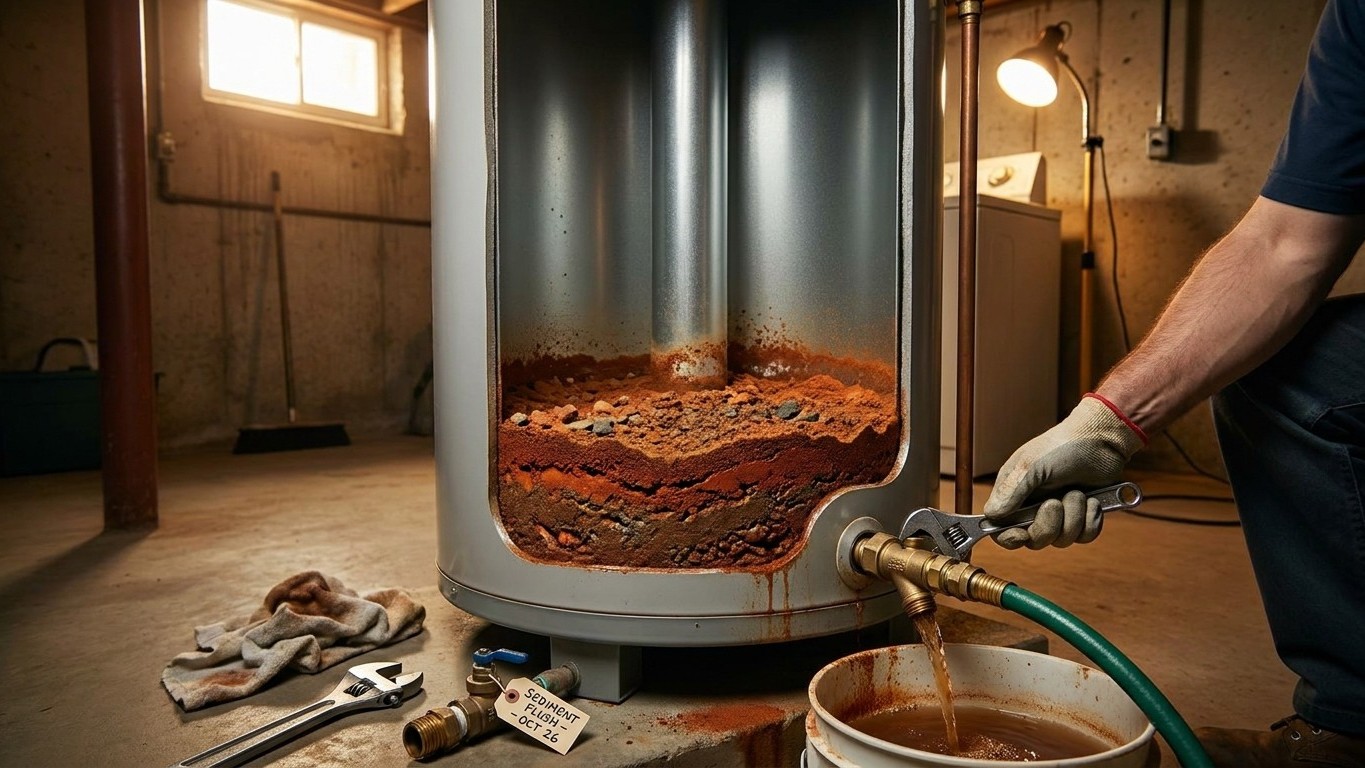

Most manufacturers and plumbers recommend flushing a water heater once a year, and homes on hard water often need it twice that often. The reason is simple: sediment builds up in the tank no matter what, and the only variable is how fast. Skip the flush long enough and you’re not just losing efficiency, you’re shortening the appliance’s working life and paying more for the same hot shower.
Sediment costs capacity and life
Every gallon of tap water carries dissolved minerals, mostly calcium and magnesium, and every time that water heats up, some of those minerals drop out of solution and settle at the bottom of the tank. Over months, that loose grit compacts into a layer that eats into the tank’s usable volume. A 40-gallon water heater with two inches of sediment on the floor isn’t really a 40-gallon water heater anymore. It’s smaller, and it runs out of hot water sooner than it used to, even though nothing about your household’s habits changed.
The bigger issue is what that layer does to the burner or the lower heating element. On a gas unit, sediment sits between the flame and the water it’s supposed to heat, acting like a blanket. The burner has to run longer to get the same Temperature rise, and that extra heat gets absorbed by the sediment layer itself rather than the water above it. On an electric unit, the lower element can end up partially buried, forcing it to work through debris instead of water, which raises the odds of premature element failure. Either way, the tank works harder for a result that used to come easily.
Hard water is the single biggest factor that raises how often this matters. Homes supplied by wells or by municipal systems with high mineral content build sediment noticeably faster than homes on naturally soft water. If you’ve never had your water tested, a local water utility or a home test kit can tell you where you land. Households on the harder end of that scale are the ones who benefit most from checking the tank every six months instead of waiting for the annual mark.
| Water hardness | Suggested flush frequency |
|---|---|
| Soft to moderately hard | Once a year |
| Hard or very hard, or well water | Every 6 months |
None of this shows up as a dramatic failure. It shows up as a slightly higher utility bill, a slightly slower recovery time between showers, and a tank that quietly ages faster than its neighbor down the street with softer water.
The procedure, in the right order
Flushing a water heater isn’t complicated, but the sequence matters more than people assume, and skipping a step is how tanks and elements get damaged. Follow it in order, not from memory of what seemed logical.
- Cut the power or the gas. Flip the breaker for an electric unit, or turn the gas valve to “pilot” or off, depending on the model. Check the label and manual for the exact setting.
- Let the tank cool. Water straight out of a heater can scald, and a hot tank draining fast can also stress fittings. Give it time before touching any valve.
- Shut off the cold water supply at the valve on top of the tank, so no fresh water refills it while you’re draining.
- Attach a hose to the drain valve near the base and run it to a floor drain, a sump, or outside where hot mineral-laden water won’t damage landscaping.
- Open a hot water tap somewhere in the house. This breaks the vacuum inside the tank, so it drains instead of glugging and stalling.
- Open the drain valve and let the tank empty completely, along with whatever sediment has settled at the bottom. A few short bursts of the cold supply valve, opened and closed, can help stir up stubborn buildup and flush it out the hose.
- Close the drain valve, disconnect the hose, and refill the tank fully before doing anything else. Open the cold supply valve and leave the hot tap open until water runs steady with no sputtering, which means the tank is full and the air is out.
That last step is the one that trips people up, and on an electric water heater it isn’t optional. The heating elements inside are designed to transfer heat into surrounding water. Power one up while the tank is still dry, or even partly empty, and the element has nothing to absorb the heat it’s producing. It can burn out in seconds, sometimes before you’ve even finished flipping the breaker back on. Refill completely, confirm steady flow from the hot tap, and only then restore power or relight the gas burner following the manufacturer’s lighting instructions on the unit’s label.
Gas or propane units carry an extra consideration throughout this whole process: they’re fuel-burning appliances. That means the same carbon monoxide precautions that apply to any gas appliance apply here, colorless and odorless, with a functioning CO alarm nearby as the only reliable early warning. An electric or heat pump water heater burns nothing and carries no such risk.
When the drain valve will not close again
Here’s the failure mode nobody mentions until it happens to them: an old plastic drain valve that has sat untouched for years can open just fine, then refuse to reseal. The plastic gets brittle, the seat inside collects its own film of mineral deposit, and once you’ve disturbed it, it may drip or run steadily instead of shutting off clean. This shows up most often on tanks that have never been flushed since installation, sometimes a decade or more of sediment and mineral scale sitting against a valve that was never designed to be a permanent, untouched fixture.
What to have on hand before you start
Anyone flushing a tank that’s never been flushed before should treat the drain valve as a likely point of failure, not a formality. Keep a replacement brass quarter-turn valve within reach, along with the wrench and plumber’s tape needed to swap it, and know where the home’s main water shutoff is located in case the original valve won’t close and you need to stop water flow immediately. A cap or plug sized to the drain valve’s threads can also serve as a stopgap seal if the valve itself won’t fully shut.
When to call a plumber instead
If the water heater is old enough that nobody in the household remembers a prior flush, or if the unit shows rust at the fittings, a plumber performing the first flush is a reasonable call rather than an overcautious one. A professional can assess the valve and the tank’s overall condition before opening anything, and has the parts and shutoff access to handle a valve that fails to reseal without turning a routine maintenance task into a flooded utility closet. Once that first flush is done safely and the valve has been tested or replaced, annual or twice-yearly flushing going forward is usually a straightforward homeowner task.
Common questions
Does flushing a water heater save money on utility bills?
The U.S. Department of Energy attributes roughly 14% to 25% of a home’s total energy use to water heating, and a tank clogged with sediment needs more energy to deliver the same hot water. Regular flushing keeps that share closer to the low end of the range rather than the high end.
What temperature should the thermostat be set to after a flush?
The Department of Energy recommends 120°F, describing it as comfortable for most household uses. It’s a compromise: lower settings save energy and reduce scald risk, while higher settings raise both. Households with a vulnerable occupant, an infant, an elderly resident, or someone immunocompromised, should also weigh that stored water held too cool is a recognized concern for bacterial growth, and ask their doctor or their local water utility for guidance specific to their situation.
Do new water heaters need less frequent flushing?
No. Amended federal efficiency standards have pushed common electric storage water heaters up to the efficiency level of an entry-level heat pump water heater, but that change addresses energy use, not sediment. Newer units still collect mineral deposits at the same rate their water hardness dictates, and still need the same flushing schedule.
Can flushing be done on a tankless water heater the same way?
No. Tankless units use a different descaling process involving a pump and a vinegar or manufacturer-approved solution circulated through the heat exchanger, not a simple drain-and-refill. Check the unit’s manual for the specific procedure, since tankless maintenance differs enough from tank-style flushing that following storage-tank steps won’t clean it properly.