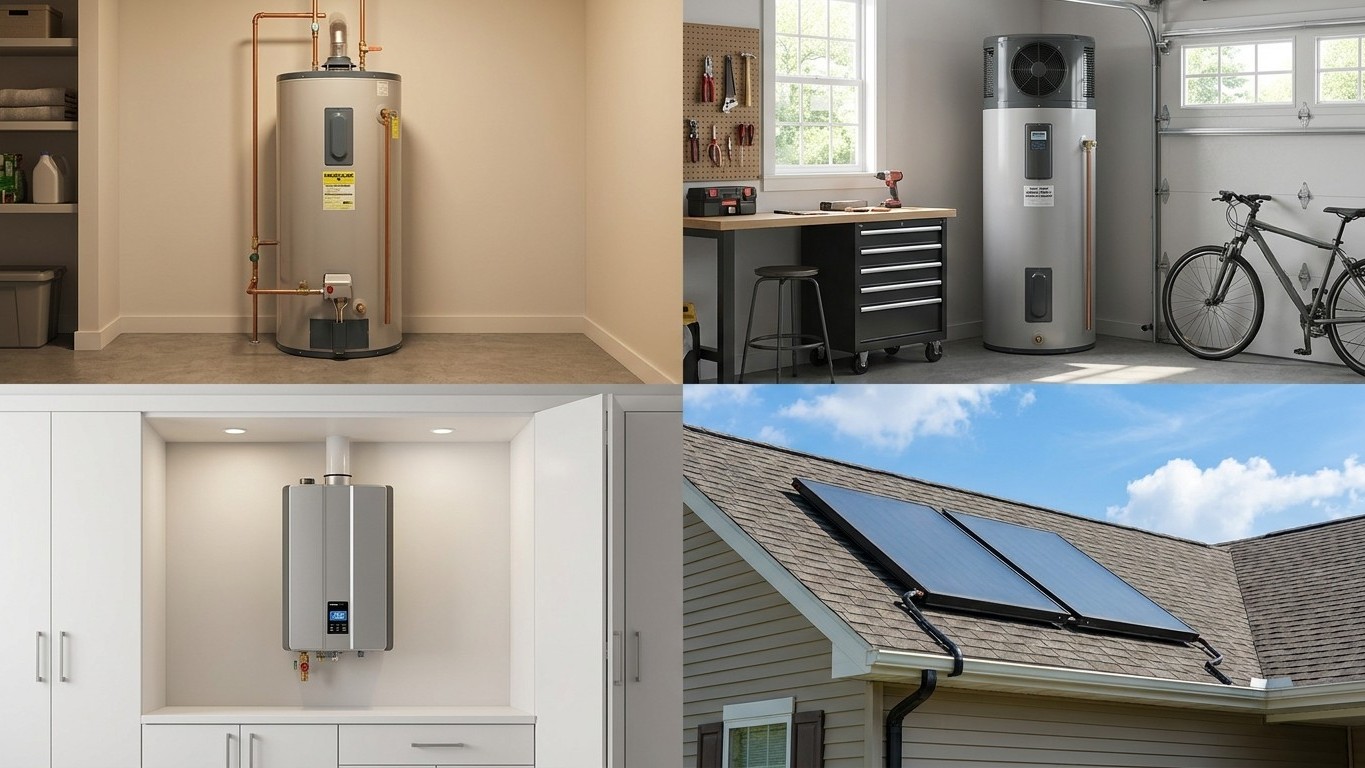

Four technologies make hot water in American homes: storage tanks, tankless units, heat pump water heaters, and solar systems. A storage tank heats and holds a supply of water, ready to draw down. A tankless unit fires up only when a faucet opens, heating water as it passes through. A heat pump moves heat from the surrounding air into the water instead of generating it directly. Solar collects the sun’s energy on a rooftop panel, usually backed up by one of the other three. The right pick depends on your fuel line, your available space, and how many people are showering before 8 a.m.
Four ways to make hot water
The mechanism behind each type explains almost everything else about it, including the electric bill and the size of the closet it needs.
| Type | How it makes heat | What it needs installed | Demand spike behavior | Best suited to |
|---|---|---|---|---|
| Storage tank | Gas burner or electric elements heat a standing supply | Fuel line or 240V circuit, tank footprint, venting if gas | Draws down reserve, then recovers over time | Simple installs, replacement-in-kind jobs |
| Tankless | Heat exchanger fires on demand as water flows | Gas line sized for higher BTU load, or heavy-duty electric circuit | Delivers continuous hot water but has a flow-rate ceiling | Homes short on floor space, staggered rather than simultaneous use |
| Heat pump | Compressor pulls heat from surrounding air, transfers it to water | 240V circuit, air volume around the unit, condensate drain | Slower recovery than gas; some models add electric backup elements | Garages or basements with stable air temperature, all-electric homes |
| Solar | Rooftop collector gathers solar energy, transfers it to a storage tank | Roof space and orientation, collector loop, backup heat source | Backup unit covers cloudy stretches and overnight demand | Sunbelt states, households wanting to offset a gas or electric bill |
A tank stores. A tankless makes hot water on demand instead of holding a reserve. A heat pump moves existing heat rather than generating new heat from a flame or a resistance element. Solar collects heat that’s already arriving for free and stores it until it’s needed. Those four verbs, store, make, move, collect, are really the whole story.
One distinction matters beyond mechanics: fuel-burning appliances. Gas and propane storage tanks and gas tankless units burn fuel, and that means carbon monoxide is part of the equation. CO is colorless and odorless, and a working CO alarm near a fuel-burning water heater isn’t optional. Electric storage tanks and heat pump units burn nothing, so that particular risk doesn’t apply to them.
What the new standards change
The Department of Energy has amended federal efficiency standards in a way that reshapes what a “standard” electric water heater even means. According to the DOE, the amended rules push common electric storage water heaters up to the efficiency level of an entry-level heat pump water heater. In practice, that means the electric-resistance tank many households grew up replacing every decade or so is being phased toward heat pump technology for a wide swath of typical residential sizes.
Who this actually affects
This concerns the ordinary electric storage tanks sold for standard residential use, the kind installed in a basement or a utility closet and replaced on a like-for-like basis when the old one fails. It doesn’t rewrite the rules for gas-fired tanks, tankless units, or solar systems, which fall under separate efficiency categories. No effective date has been confirmed here, so treat the timeline as something to verify with a licensed installer or your local code office rather than something to assume.
The practical fallout is straightforward: homeowners planning a straight swap, an electric tank for an electric tank, may find that the replacement unit behaves differently than the one it’s replacing. Heat pump water heaters need airflow around the unit and enough clearance to pull ambient heat from the room, which is a different installation footprint than a resistance tank ever needed. That’s worth flagging before an old unit fails on a Friday night and a contractor is standing in the utility closet with a tape measure.
None of this touches the thermostat setting, which is a separate lever entirely. The DOE recommends setting a water heater thermostat to 120°F, a temperature it describes as comfortable for most household uses. That number is a compromise, not a hard rule: lower it and you save energy and cut scald risk, raise it and you get both faster recovery and a bigger bill along with more risk at the tap. Households with infants, older adults, or anyone with sensitive skin often lean toward the lower end of that range for exactly that reason.
There’s a second side to that same coin, and it deserves to be said plainly rather than glossed over. Stored water held too cool is a recognized concern for bacterial growth, including legionella, so dialing a tank all the way down isn’t automatically the safer move for every household. No specific temperature threshold for that risk has been verified here, and none should be assumed. Anyone with vulnerable occupants at home (infants, people undergoing chemotherapy, transplant recipients) has good reason to ask a doctor or the local water utility what setting makes sense for their situation, rather than defaulting to the DOE’s general comfort recommendation.
Which suits which house
Water heating isn’t a rounding error on the utility bill. The DOE attributes roughly 14% to 25% of a home’s total energy consumption to water heating, which puts it in the same conversation as heating and cooling when you’re deciding where to spend on efficiency. That range is wide because it depends heavily on climate, household size, and which of the four types is doing the work, which is exactly why the decision below matters more than it might seem.
Start with peak demand, not average use
The question that actually decides this isn’t “how much hot water does my family use in a day,” it’s “what happens when three showers, a dishwasher, and a washing machine all want hot water within the same twenty minutes.” A storage tank handles that spike by drawing down a reserve, which means the tank has to be sized for the worst morning, not the average one. A tankless unit sidesteps the reserve problem entirely but runs into a flow-rate ceiling: ask it to serve too many fixtures simultaneously and the water temperature drops rather than the supply running out. Sizing details for both approaches are covered in our water heater sizing guide, and the tankless-specific tradeoffs are worth a closer look on our tankless water heaters page before committing to one.
Fuel availability narrows the field fast. A house with no gas line on the street is choosing between electric storage, heat pump, or solar with electric backup, full stop. A house with gas already run to the water heater location keeps a gas tank or gas tankless on the table, both of which tend to recover faster than electric options during a demand spike.
Space and location matter more than people expect
A heat pump water heater needs room to breathe. It pulls ambient heat from the air around it, so a cramped, poorly ventilated closet works against the very mechanism that makes it efficient. It also tends to cool the room it sits in, which is a feature in a hot garage in Arizona and a liability in a heated utility room in Minnesota come January. A tankless unit solves a space problem by mounting on a wall and skipping the tank footprint altogether, which matters in a condo or a small home where every square foot of the mechanical closet counts. Solar needs a roof with the right orientation and enough unshaded exposure, which rules it out for plenty of lots regardless of how much a homeowner might want the energy offset.
Whether the unit sits in heated or unheated space changes the math too. A storage tank in an unconditioned garage loses more heat to its surroundings than the same tank in a heated basement, so it works harder to hold its set temperature. A heat pump in that same unheated garage may struggle in genuinely cold climates, since it depends on drawing heat from air that’s already thin on it. None of these are dealbreakers on their own, but stacked together, they’re usually what separates the household that’s happy with its choice five years later from the one that isn’t.
Common questions
Can I switch from a gas storage tank to an electric heat pump water heater?
Often yes, but it typically means adding a dedicated 240V circuit where a gas line used to do the work, and finding a spot with enough air volume around the unit for the heat pump to operate efficiently. A licensed electrician and installer can confirm what your specific space and panel can support.
Does a tankless water heater ever run out of hot water?
Not in the way a tank does, since it isn’t drawing down a reserve. But every tankless unit has a maximum flow rate it can heat at once, so running several fixtures simultaneously can drop the delivered temperature even though the water never technically runs out.
Is solar water heating realistic outside of sunny states?
It works in most climates, but the economics lean heavily toward regions with strong, consistent sun exposure. Every solar water heating system pairs with a backup, usually gas or electric, to cover cloudy days and nighttime demand, so it’s never a stand-alone solution.
Do I need a carbon monoxide alarm for an electric or heat pump water heater?
Not because of the water heater itself, since electric and heat pump units burn no fuel and produce no CO. A working CO alarm is still good practice in any home with other fuel-burning appliances, but the water heater isn’t the reason for it in this case.