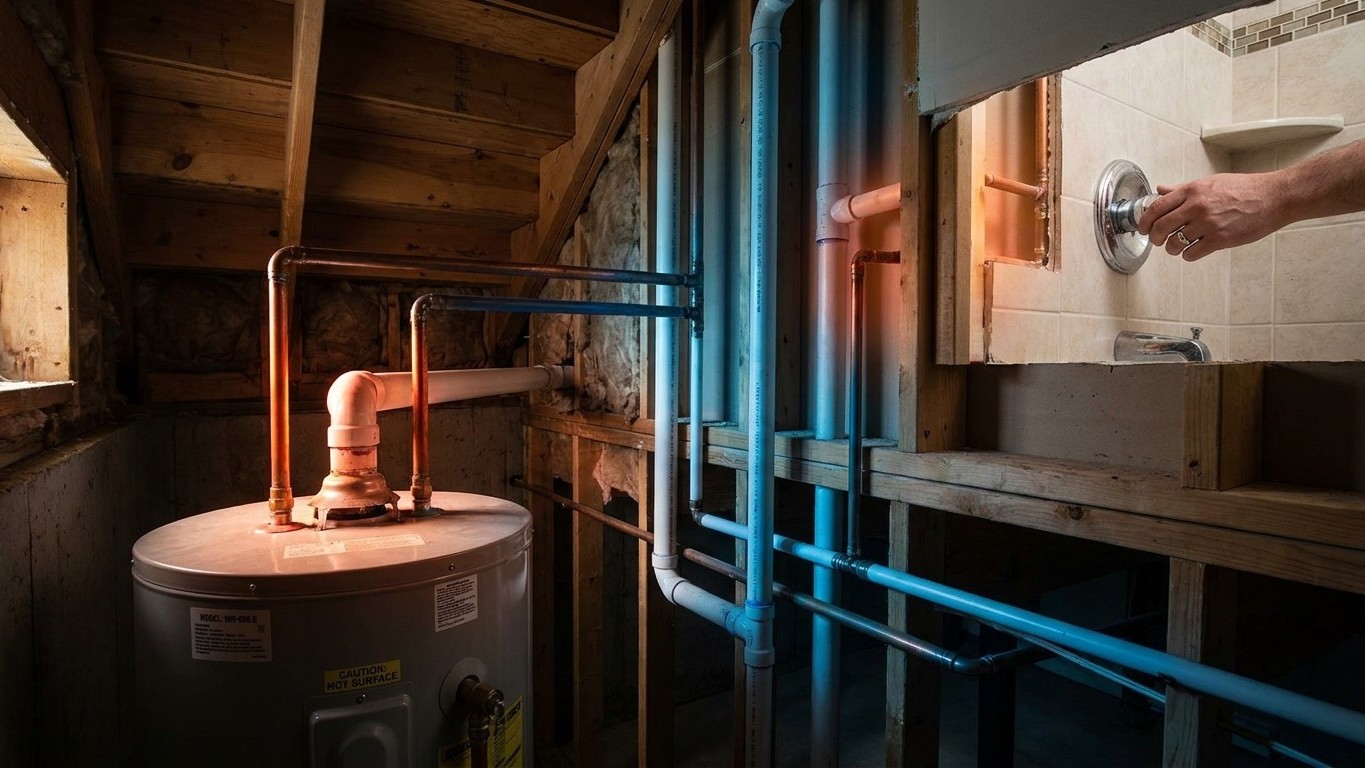

Every tap in your house sits at the end of a pipe, and that pipe is full of water that cooled off the moment you last used it. Turning the handle doesn’t summon hot water instantly, it pushes that cold column out first. The heater itself is rarely the bottleneck. The plumbing between the tank and the fixture is what makes you stand there counting seconds.
The water in the pipe is the whole problem
Picture the pipe as a garden hose that runs from your water heater, through the walls, and up to the shower head. Whatever sat in that hose since your last shower has gone room-temperature, or colder if it runs through an unheated crawlspace. When you open the valve, the heater doesn’t need to “catch up.” It’s already sending hot water. You’re just waiting for the cooled-off volume ahead of it to clear the line before the hot stuff shows up at the nozzle.
That’s why the distance matters more than almost anything else. A bathroom sink six feet from the water heater might deliver hot water in five or ten seconds. A shower on the far side of the house, especially a second-story bathroom above a garage or over an unconditioned space, can take a minute or more. The pipe run is longer, so there’s simply more cooled water to push out before anything useful arrives.
Pipe diameter plays a role too, though it’s a smaller factor than most homeowners assume. A wider pipe holds more volume per foot, so the same length of 3/4-inch pipe holds noticeably more standing water than 1/2-inch pipe. Builders sometimes oversize trunk lines for pressure and flow reasons, not realizing they’re adding to the wait at the far end.
Layout compounds all of this. Homes built with the water heater centrally located, feeding a compact cluster of bathrooms and the kitchen nearby, tend to have short waits everywhere. Homes where the heater sits in a garage or basement corner, then feeds a primary suite added onto the back of the house, almost always have one bathroom that’s the household’s known “slow” fixture. If you’ve lived somewhere long enough, you already know which faucet that is. It’s not that the heater is undersized or failing, it’s that the fixture is furthest from the source, and physics doesn’t negotiate.
This is also why turning up the thermostat doesn’t fix the wait. A hotter tank sends hotter water, but it still has to travel the same distance through the same cooled pipe first. The delay is a function of pipe length and volume, not of how hot the tank runs. Any real fix has to change what happens in that stretch of pipe, either by keeping it warmer between uses or by giving the cooled water somewhere to go faster.
Insulating the pipes
Pipe insulation is the cheapest response to a slow tap, and it’s worth doing, but it’s important to understand what it actually accomplishes. Wrapping foam sleeves around exposed hot water lines does not make the first draw of the day arrive any faster. That first glass of cooled water still has to clear the pipe no matter how well insulated it is. What insulation changes is how long the water stays warm once it’s already sitting in that pipe.
Here’s where it earns its keep: households that use a tap repeatedly over a short span. Think of a morning routine where someone runs the bathroom sink, steps away to brush their teeth, then comes back to rinse a razor. Without insulation, that pipe cools quickly, especially where it runs through a cold basement, an exterior wall, or an unconditioned attic. With insulation, the water sitting in the line loses heat more slowly, so a second or third use within a short window arrives warm faster than it would in bare copper or PEX.
The effect is most noticeable on long runs and on pipes exposed to real temperature swings, like lines running through a garage or crawlspace in a cold climate. A three-foot stretch of pipe under a kitchen sink, already inside conditioned space, won’t show much benefit from insulation because it wasn’t losing heat fast to begin with. The payoff scales with exposure and with how often the household returns to the same tap.
What insulation is, and isn’t, good for
Insulating pipes is a maintenance-level project, not a renovation. Pre-slit foam tubing sized to the pipe diameter, taped at the seams and joints, is the standard approach, and it’s something a homeowner can do in an afternoon in an accessible basement or crawlspace. It won’t touch the wait for the very first draw of hot water in the morning or after hours of no use, since that pipe has fully cooled to ambient temperature regardless of how well it’s wrapped. For that problem, the fix has to move water, not just slow down its cooling.
Some households insulate and call it done, and for a lot of layouts that’s a reasonable stopping point. If your slow tap is only slow on the very first use of the day and fine after that, insulation was never going to solve your specific complaint anyway. It’s a good move for comfort and for shaving a little off standby heat loss in the pipe, but it’s not the answer to “why does my shower take a minute to warm up every single time.”
Recirculation, and what it costs
A recirculation system is the fix that actually addresses the first-draw wait, because it changes the premise entirely: instead of cooled water sitting in the pipe until you push it out, a small pump continuously or intermittently moves water through a loop, so hot water is already sitting near the fixture when you open the tap. Some systems use a dedicated return line back to the water heater; others, in retrofit situations, use the cold line as the return path with a special valve at the farthest fixture. Either way, the goal is the same: keep the pipe near the tap already warm.
The catch is energy. A loop that runs continuously is moving hot water through pipe all day, and every foot of that pipe is radiating heat into the surrounding wall, basement, or crawlspace, whether or not anyone is about to use a faucet. That’s standby loss working against you around the clock instead of just between draws. This is exactly why the Department of Energy’s broader point about water heating matters here: the agency attributes roughly 14% to 25% of a home’s energy consumption to water heating, and a poorly managed recirculation loop is one of the easiest ways to push your own household toward the higher end of that range.
The workaround is running the loop on demand or on a timer rather than continuously. A demand-controlled system uses a sensor or a push-button near the fixture to trigger the pump only when someone’s about to use hot water, so it moves the cooled water out of the way just before you turn the tap, then shuts off. A timer-based system runs the pump only during hours the household is actually active, say morning and evening, and stays off overnight and during the workday. Both approaches keep most of the convenience while cutting the standby loss of a loop that never rests.
Matching the setup to the household
A continuously running loop makes sense mainly in homes where hot water is needed unpredictably all day, like a household with a home health aide, shift workers on staggered schedules, or a long single run to one frequently used bathroom. For most households, demand or timer control gets nearly all the comfort benefit for a fraction of the running cost. A household with one slow, far-off bathroom and a fairly predictable routine is a good candidate for a demand-triggered retrofit system rather than a full continuous loop.
Whatever the setup, the tank’s thermostat setting still matters. The Department of Energy recommends 120°F, describing it as comfortable for most household uses, and that number is a genuine compromise rather than a fixed rule. Running cooler saves energy and lowers the risk of scald injury at the tap. Running hotter pushes both of those the other way. There’s a real tension on the other side of that dial too: stored water held too cool is a recognized concern for bacterial growth, and lowering a tank’s temperature purely to save energy isn’t a decision to make without thinking it through. Households with infants, elderly residents, or anyone with a compromised immune system should ask their doctor or their local water utility before settling on a setting, rather than guessing.
Anyone shopping for a new tank should also know that amended federal efficiency standards now bring common electric storage water heaters up to roughly the efficiency level of an entry-level heat pump water heater, a shift that applies to storage-style electric units and marks a real jump from older vintages still running in a lot of basements. And if the household’s water heater burns gas or propane, remember that it’s a fuel-burning appliance: carbon monoxide is colorless and odorless, and a working CO alarm near the unit isn’t optional, regardless of whether you’re also running a recirculation loop. An electric or heat pump water heater burns nothing and doesn’t carry that particular risk.
Common questions
Does a bigger water heater mean less waiting?
Not for the wait itself. A larger tank gives you more hot water once it arrives, but the delay before that first hot water reaches a distant faucet is set by the length and diameter of the pipe run, not by tank size.
Will a tankless water heater fix the wait?
A tankless unit still sits somewhere in the house and still feeds the same pipe network. The cooled water already standing in the line between the unit and the tap has to clear out first, so the wait at a distant fixture is often similar unless the plumbing layout or a recirculation setup changes too.
Is it safe to lower my thermostat to save energy?
The Department of Energy’s 120°F recommendation is offered as comfortable for most households and as a way to cut energy use and scald risk, but it’s not a safety code requirement. Households with young children, older adults, or immune-compromised residents should check with their doctor or local water utility before changing the setting.
Is pipe insulation worth doing if I’m not installing recirculation?
Yes, especially on exposed runs through basements, garages, or crawlspaces. It won’t speed up the very first draw of hot water, but it keeps water already in the pipe warmer between repeated uses, which is a real, low-cost comfort gain even without a pump system.