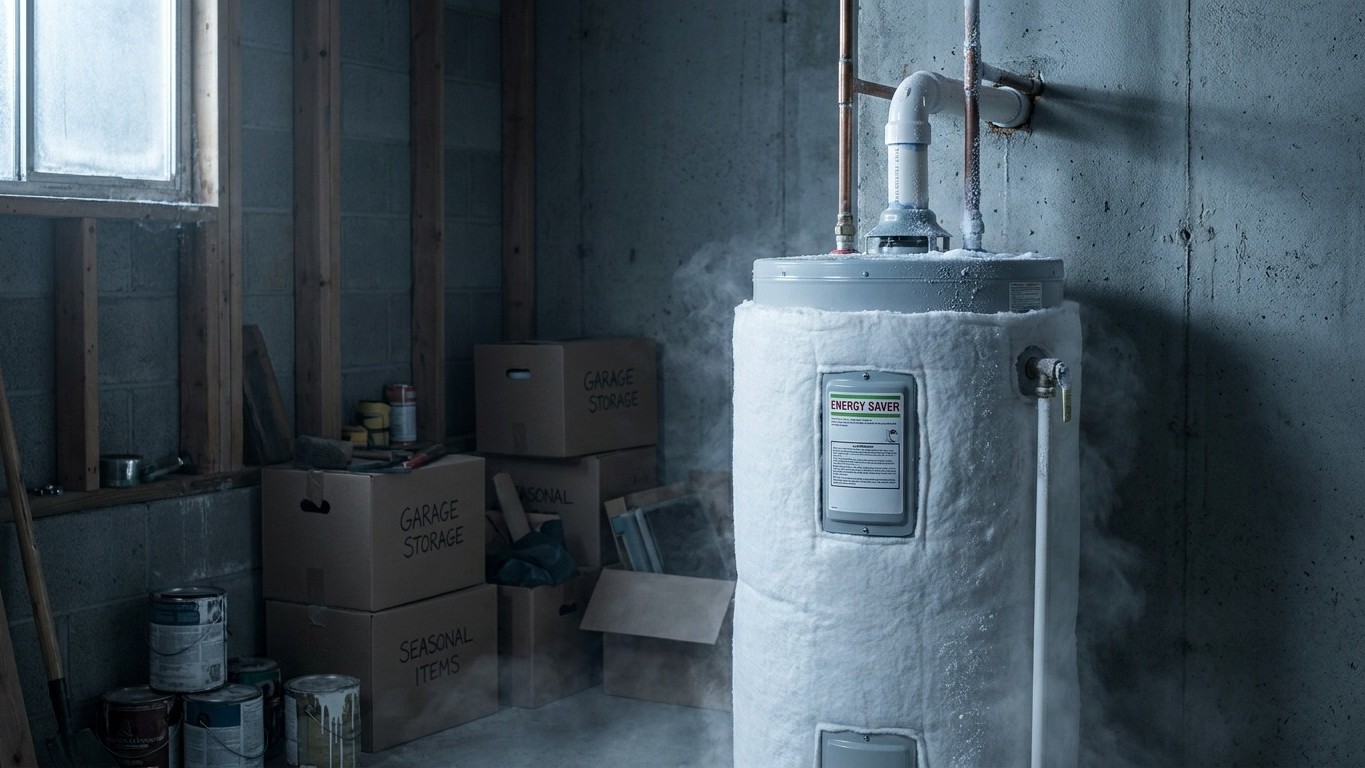

A water heater can sit in a garage or crawlspace without breaking anything, but the location changes the math on every gallon it heats. Cold air pulls energy out of the tank around the clock, freezing temperatures put exposed pipe at risk, and a fuel-burning unit needs specific air supply to run safely. None of that rules out the space. It just means the choices you make there (insulation, unit type, thermostat setting) matter more than they would in a heated closet.
Cold space, higher bill

Every water heater loses some heat through its tank walls no matter where it stands. In a conditioned utility closet, that lost heat still warms the house a little, so it’s not entirely wasted. In an unheated garage, it just leaves. The tank works harder to hold Temperature, the burner or heating element cycles more often, and the household pays for that energy twice: once to generate it, once again because it never reached a faucet.
The U.S. Department of Energy attributes roughly 14% to 25% of a home’s energy use to water heating, a range wide enough to reflect how much household habits and equipment location actually matter. A tank in a cold garage tends to sit at the higher end of that range simply because it’s fighting a bigger temperature gap between the water inside and the air outside, day and night, all winter.
This is exactly why an insulating tank wrap or blanket pays off faster in a garage than almost anywhere else in the house. The colder the surrounding air, the steeper the heat loss, and the more a few dollars of insulation can offset. Manufacturers rate their tanks for a baseline amount of standby loss already, but that rating assumes a reasonably temperate space. A garage in a northern winter isn’t that.
The 120°F compromise
The Department of Energy recommends setting the thermostat to 120°F, describing that setting as comfortable for most household uses. It’s presented as a balance rather than a rule: dial it lower and you save energy while lowering the risk of scalding, dial it higher and both go up together. In a garage unit already losing heat faster than average, that 120°F setting becomes more relevant, not less, since every degree above it is degree lost to the outside air before it ever gets used.
There’s a real tension worth naming honestly. Lowering the temperature reduces scald risk and trims the energy bill, but water held too cool for too long is a recognized concern for bacterial growth, including legionella. No single threshold is settled science here, and this isn’t the place to invent one. Households with infants, elderly residents, or anyone with a weakened immune system should raise the question with their doctor or their local water utility rather than guess.
And why a heat pump unit struggles there
Swapping a standard tank for a heat pump Water Heater Is one of the more effective upgrades available for household energy use, but a cold garage is close to the worst place to put one. A heat pump water heater doesn’t generate heat the way a gas burner or electric element does. It pulls existing heat out of the surrounding air and concentrates it into the tank. That only works well when there’s warm air to pull from.
A garage in December doesn’t offer much. As the surrounding air temperature drops, a heat pump unit has to work harder to extract the same amount of heat, and past a certain point it leans on a backup electric element instead, which erases much of the efficiency advantage that made the upgrade worth considering in the first place. The appliance ends up behaving like an ordinary electric tank for a good part of the year, just one that cost more to install.
There’s a second effect that’s easy to miss until it’s already a problem: a heat pump water heater cools the space it draws from. Installed in a small, already unheated garage, it can push the ambient air even colder, which then drags its own performance down further, a loop that works against itself. That’s manageable in a large, semi-conditioned basement. It’s a much rougher trade in a tight, uninsulated garage bay in a cold climate.
None of this means the technology is a poor choice generally. Federal efficiency standards were amended to bring common electric storage water heaters up toward the efficiency level of an entry-level heat pump unit, a change aimed mainly at standard-size residential electric tanks. That shift reflects how far heat pump technology has already proven itself in the right setting. The garage is simply the wrong setting for a lot of climates, and anyone weighing the swap should look closely at how a heat pump water heater performs in colder ambient air before installing one where the temperature routinely drops. For a full breakdown of how these units work and where they perform best, see our guide to heat pump water heaters.
Freezing and combustion air
Two more constraints belong in this conversation, and both get overlooked until something fails. The first is straightforward: pipework running through an unheated garage or crawlspace can freeze in a hard winter, whether or not the water heater itself is affected. A frozen supply line can split, and the damage often shows up as a leak days later when things thaw, not as a dramatic burst in the moment. Exposed pipe in these spaces generally needs its own insulation or heat tape, independent of whatever protection the tank has.
The second constraint applies specifically to gas and propane water heaters. A fuel-burning appliance needs a reliable supply of combustion air to operate safely, and a garage introduces variables that a heated interior closet doesn’t: vehicle exhaust, stored fuel or solvents, and airflow that changes depending on whether the garage door is open or shut. These units also have requirements around how high off the floor they’re installed, tied to how heavier-than-air vapors (gasoline fumes, for instance) can pool near the ground.
This is deliberately not the place to cite a specific height or a code section. Requirements vary by jurisdiction, by fuel type, and by the specific model’s certification, and getting that number wrong from a general article is worse than not printing it at all. The authority here is the local code office, along with the installation manual that ships with the unit. Anyone installing or Replacing a Water heater in a garage should confirm both before assuming a past setup is still compliant.
A gas or propane water heater is, by definition, a fuel-burning appliance, which means it produces carbon monoxide as a byproduct of normal operation. That gas is colorless and odorless, and a garage installation doesn’t change that risk profile at all, it just changes the surrounding hazards. A working carbon monoxide alarm near the space is not optional. An electric or heat pump water heater, by contrast, burns nothing and carries no such requirement, which is one more factor worth weighing when choosing what type of unit belongs in that space to begin with.
Common questions
Does a garage water heater need extra insulation?
An insulating blanket or wrap tends to pay off faster in a garage than in a conditioned space, since the temperature gap between the tank and the surrounding air is usually larger. Check the manufacturer’s guidance first, since some newer tanks are already well insulated and don’t need an added wrap.
Is 120°F too low for a household with a septic system or older plumbing?
The 120°F figure from the Department of Energy is a general comfort and efficiency recommendation, not a rule tied to plumbing type. Households with specific health concerns, like a member with a weakened immune system, should raise the question with their doctor or their water utility rather than adjust the setting based on plumbing alone.
Can any water heater go in an unheated crawlspace?
Physically, yes, but freezing risk to the connected pipework and, for fuel-burning units, combustion air requirements both need to be addressed. The local code office and the unit’s installation manual determine what’s required for that specific space and fuel type.
Is a heat pump water heater ever a good fit for a garage?
It depends heavily on climate and how conditioned the garage actually is. In a mild climate or a garage that stays reasonably warm, performance losses are smaller. In a cold-climate garage that regularly drops near freezing, a heat pump unit will lean on backup electric heat often enough that much of its efficiency advantage disappears.