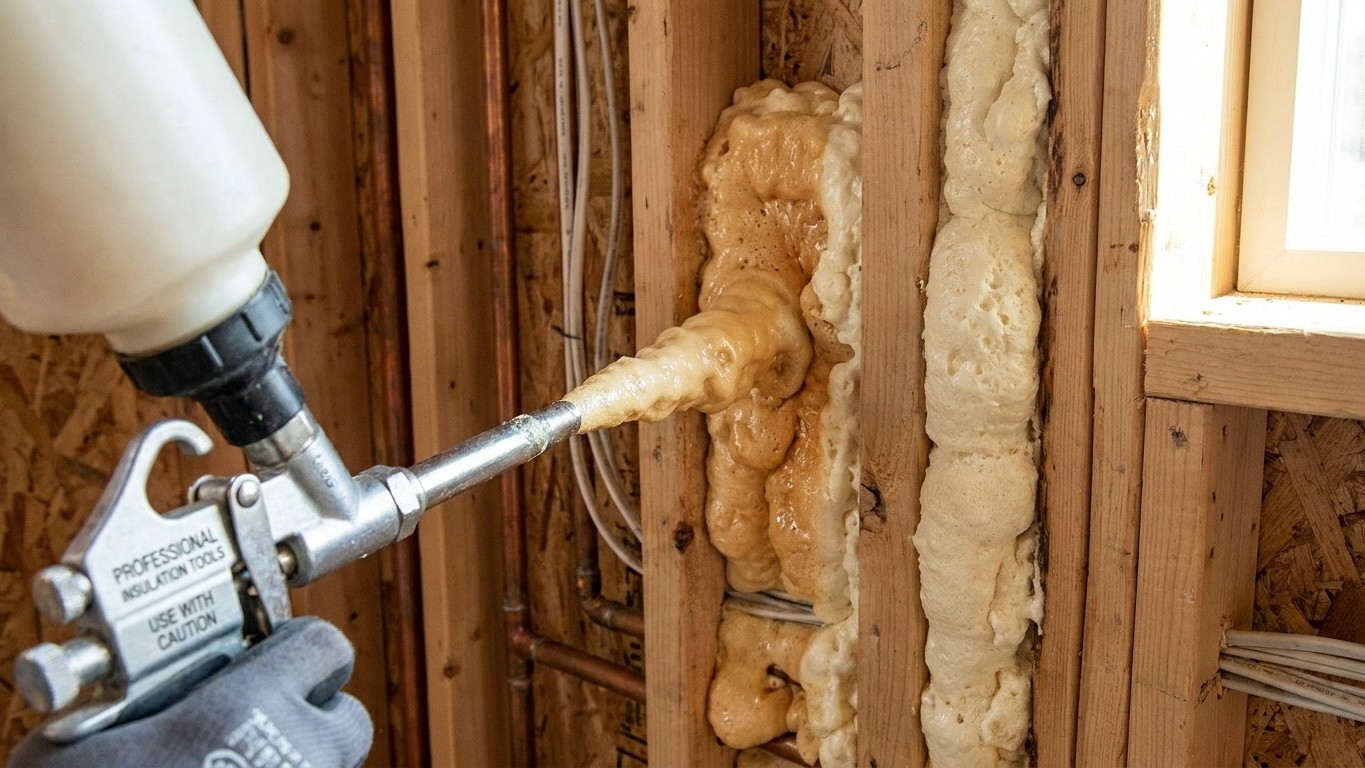

Spray foam insulation does two jobs that other materials split between them: it fills the cavity, and it seals the air leaks inside that cavity, in one application. That’s the appeal. The commitment is what comes after the truck leaves. Once it cures, spray foam bonds to the framing and sheathing it touches. There’s no pulling it back out to inspect a stud bay later, no easy path to rerouting wiring, no take-back if the wrong type went into the wrong place. Every other insulation decision on this site can be revisited down the road. This one, mostly, can’t.
What is actually going on

Two liquid components meet at the tip of a spray gun and react on contact, expanding into a foam that fills the gaps around framing, wiring, and plumbing as it hardens. That expansion is what gives spray foam its air-sealing reputation: it flows into the small irregular voids that batts and loose-fill simply bridge over. But which foam goes in changes almost everything else about the wall or roof it’s filling.
Open-cell foam is soft, spongy, and lower in density. Its cell structure isn’t fully closed, which means it lets water vapor pass through it at a meaningful rate. It’s also vapor-permeable enough that the assembly on either side of it still needs a way to dry. Closed-cell foam is rigid, dense, and largely closes off those cells during the reaction. That structure gives it a much higher R-value per inch than open-cell foam, plus enough rigidity to add real structural stiffening to a wall or roof deck. It also drops permeance sharply, to the point that a thick enough layer of closed-cell foam functions as its own vapor retarder. That single property is the reason the choice between the two isn’t a formality. It decides which direction, if any, the wall assembly can dry.
Why the cavity depth matters more than the label
Insulation packaging lists an R-value and, separately, the thickness needed to reach it, and that thickness is specific to the exact formulation on the label, not a fixed conversion you can apply to any foam. A closed-cell product from one batch and an open-cell product from another will need different depths to hit the same number, so the only reliable source for how deep a given foam needs to go is the technical data printed on that product, not a general rule of thumb.
None of this is priced the same way as batts or loose-fill, and none of it comes with a federal tax credit anymore. The residential energy efficiency credit that used to offset insulation projects closed at the end of 2025. What’s still around are state and utility rebate programs, and they vary by state and by utility territory, so the only reliable place to check what applies to a specific address is that state’s energy office.
Where it belongs, and where it does not
The decisions spray foam locks in are physical: once it’s sprayed, it can’t be cleanly removed to inspect the wood behind it, and it covers the sheathing so that any hidden rot, moisture stain, or damaged framing goes unseen for as long as the foam stays put. That’s not a reason to avoid it everywhere. It’s a reason to be specific about where the trade-off is worth making.
| Situation | Spray foam’s fit | What goes wrong if used anyway |
|---|---|---|
| Rim joists and band joists | Strong fit; irregular, hard-to-seal geometry that spray foam fills well | Rarely goes wrong here; this is one of its best uses |
| Wall cavities during new construction or a full gut, sheathing already exposed | Strong fit; the sheathing is visible and inspectable before foam goes in | Not applicable; this is the intended use case |
| Existing finished wall, siding intact, foam injected through drilled holes | Workable but blind; no visual check of the sheathing condition before or after | Hidden rot or an existing leak gets sealed in rather than found |
| Attic floor, open and walkable | Usually a poor fit; loose-fill or batts do the job at lower commitment and cost | An accessible attic becomes permanently harder to re-wire, re-vent, or re-inspect |
| Roof deck, unvented “hot roof” assembly | Strong fit; closed-cell foam is the standard material for this specific assembly | Open-cell alone in this spot without a separate vapor strategy can trap moisture in the roof deck |
| Garage ceiling under living space | Usable, but the assembly must still meet the fire-separation rating required between a garage and the house | Foam applied without maintaining that separation can violate that fire-rated assembly |
The wrong-place pattern repeats: spray foam does its best work where the surface it’s covering has already been checked, or doesn’t need checking, because the assembly is new or fully exposed. It does its worst work as a patch applied blind through a hole in a finished wall, because that’s exactly the situation where you most want to see what you’re covering up before you cover it up.
The moisture side of the decision
Every insulation choice is also a decision about which direction moisture is allowed to move through a wall or roof, and spray foam forces that decision earlier and more permanently than batts or loose-fill do. A wall has to be able to dry toward at least one side. Figure out which side that is before the foam goes in, because once it’s cured, the wall’s drying path is set.
Closed-cell foam, applied thick enough, is dense enough to act as its own vapor retarder, which changes what else the assembly needs and what it can tolerate on the other side. Open-cell foam doesn’t do that; it stays vapor-permeable, so the assembly still depends on whatever vapor control exists elsewhere in the wall, plus a real drying path on at least one face.
Where this gets genuinely regional is whether an interior vapor retarder is required at all. It isn’t, uniformly. The model energy code does not require an interior vapor retarder in the three warmest climate zones, where the drying direction and moisture risks run differently than they do in a cold northern climate. That’s not a detail this national page can resolve for a specific address, and guessing wrong here is how you get moisture trapped inside a wall instead of a wall that dries the way it’s supposed to. Check the vapor barrier guide and the page for your own state before deciding which face gets the vapor control layer.
It’s worth separating two things that get conflated constantly: a vapor retarder and an air barrier are not the same job. A vapor retarder slows the diffusion of water vapor through a material over time. An air barrier stops bulk air, and the moisture it carries, from moving through gaps, cracks, and penetrations. Spray foam can function as both at once in the right assembly, which is part of why it’s popular, but treating the two as interchangeable elsewhere in the same house, in materials that only do one job, is a common source of the trapped-moisture problems that show up years after installation.
What to settle before you buy anything
ENERGY STAR treats air sealing and adding insulation as two steps of one project, in that order, not as a choice between them. Sealing the leaks first is what makes the insulation that follows perform the way it’s rated to. EPA estimates that homeowners can save an average of 15% on heating and cooling costs (or an average of 11% on total energy costs) by air sealing their homes and adding insulation in attics, floors over crawl spaces, and accessible basement rim joists. That figure describes those specific locations and comes from modeling a typical existing home, not a guarantee for any one house, and it doesn’t extend to walls, windows, or doors.
Before spray foam or any other material goes into an attic, find out what’s already there. ENERGY STAR’s retrofit guidance splits attic targets by whether the space is currently uninsulated or already has 3 to 4 inches in place, because the right amount to add depends on that starting point, and it varies by climate zone.
| Climate zone | Attic if uninsulated | Attic if already 3–4 inches | Floor |
|---|---|---|---|
| Zone 1 | R30 | R25 | R13 |
| Zone 2 | R49 | R38 | R13 |
| Zone 3 | R49 | R38 | R19 |
| Zones 4A and 4B | R60 | R49 | R19 |
| Zones 6, 5, and 4C | R60 | R49 | R30 |
| Zones 7 and 8 | R60 | R49 | R38 |
This page can’t tell you which zone a given address falls in; that’s published as a map, not a list, and assigning one without it would be a guess. Check ENERGY STAR’s climate zone map before buying based on any of these numbers.
A few checks come before any of that arithmetic matters. Confirm the cavity is actually accessible; a finished wall with intact siding is a different job than an open attic. If there’s existing insulation in the attic, don’t disturb it until you know what it is: older vermiculite or any material that might contain asbestos should be left alone and assessed rather than stirred up or walked through. Stay on the joists, not the drywall, if you’re up there at all. If a combustion appliance, like a furnace or water heater, sits in the space you’re about to seal tighter, have it evaluated first; tightening a room changes how that appliance draws air. And note the clearances required around chimneys, flues, and certain recessed light fixtures, which are set by the fixture or appliance itself, not by the insulation.
Common questions
Can spray foam be removed if it’s applied wrong?
Not cleanly. Cured spray foam bonds to the wood it touches, so removing it means scraping or cutting it away, often damaging the framing or sheathing underneath in the process. That’s the core reason to settle open-cell versus closed-cell, and the location, before spraying rather than after.
Does spray foam need a separate vapor barrier?
It depends on the type and thickness, and on the climate zone. A thick enough layer of closed-cell foam can act as its own vapor retarder; open-cell foam generally doesn’t, and the rest of the assembly needs its own strategy. Since the requirement isn’t uniform nationally, check the vapor barrier guide and your state’s page before assuming either way.
Is spray foam better than batts or loose-fill for an attic floor?
Not usually. An open, walkable attic floor is one of the easier places to insulate with batts or loose-fill, and doing so keeps the space accessible for future wiring or repairs. Spray foam’s advantage shows up more in irregular spots like rim joists or an unvented roof deck, not on an open attic floor.
Do state or utility rebates still apply to spray foam projects?
Some do, but they vary by state and by utility, and the federal residential energy credit that used to apply to insulation work closed at the end of 2025. Check your own state’s energy office for what’s currently available before assuming a discount applies.