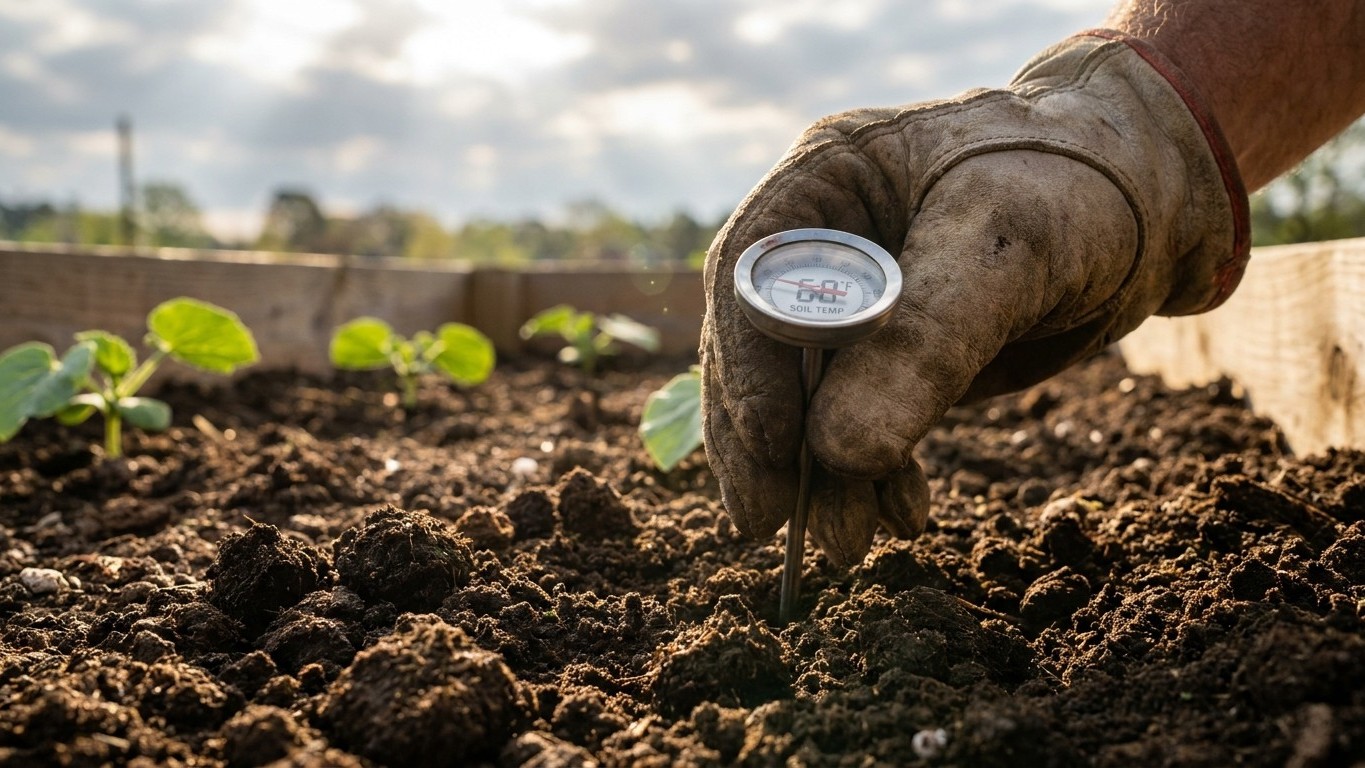

Growing Melons in Nunavut, in open garden soil, isn’t a realistic project: the territory’s climate never delivers the sustained heat melons need to set fruit and ripen. Environment and Climate Change Canada’s reference station at Rankin Inlet records zero days a year above 90°F and a mean frost-free window of roughly 86 days. Anyone attempting it outdoors needs season-extension structures, not just a sunny spot and a later planting date.
When the soil is warm enough in Nunavut

The date most gardeners reach for first is the last spring frost: on average June 19 at Rankin Inlet A, according to Environment and Climate Change Canada’s 1981-2010 Canadian Climate Normals. That figure is a mean, not a guarantee. In one year out of two, frost actually falls later than June 19 at that station, so treating it as a safe planting cutoff is a mistake gardeners make everywhere, not just here.
But frost dates are only a stand-in for the number that actually matters to a melon plant: soil temperature. Melon seed barely germinates in cold soil, and transplanted roots stall rather than grow until the ground has warmed well past the point where air frost stops being a threat. In most of the continental United States, soil catches up to that threshold a few weeks after the last frost. That gap is the part of the calendar this page has to be honest about, because Nunavut’s numbers change what happens in that gap entirely.
Why the usual gap doesn’t close here
Soil warms because the air above it stays warm long enough, day after day, to move heat downward. That’s exactly what’s missing at Rankin Inlet: the same climate normals that give the June 19 frost date also show zero days a year reaching 90°F. Without stretches of real heat, the soil-warming that other regions take for granted after their last frost happens slowly, unevenly, and to a shallower depth. The reference city sits in Canadian plant hardiness zone 0a, a rating built from Natural Resources Canada’s seven-variable system rather than the single-variable USDA scale used elsewhere on this site. The two scales don’t convert, and it would be misleading to compare 0a to a Southern Hemisphere-style USDA zone. What it does tell a gardener plainly is that this is among the coldest classified zones on the Canadian map.
None of this rules out melon growing entirely, it just moves the whole project indoors or under cover. Raised beds warmed with dark mulch, cold frames, and heated high tunnels do the soil-warming work that open ground here won’t do on its own. For the region-specific techniques and any variety trial results for northern Canadian growing conditions, the federal extension resource at agriculture.canada.ca is the source to check before buying seed, since the territorial department’s own site isn’t reliably reachable.
How long the season lasts here
Subtracting the two mean dates from the same Rankin Inlet A record gives a frost-free window of about 86 days, running from June 19 to the average first fall frost on September 13. Both dates come from the same 1981-2010 Canadian Climate Normals, so the subtraction holds, but the caution attached to each date applies just as much to the window itself: these are averages, and real years run shorter on either end more often than gardening calendars like to admit.
An 86-day window is short by any US comparison, and it changes the basic strategy. In regions with a four-to-five-month frost-free season, gardeners can plant an early crop and follow it with a second sowing once the first is harvested, timing the whole sequence with a succession sowing guide built around their local frost dates. Nunavut’s window doesn’t leave room for that kind of sequencing. The single planting a grower gets is the only one that matters, which raises the stakes on getting it started correctly rather than starting it twice.
That single-shot reality also settles a question that comes up in warmer regions: whether to direct-seed or transplant. With no second attempt available if an early transplant fails to a late cold snap, and no long tail of season left to recover lost weeks, starting melon seedlings indoors and checking their root systems before they go into warmed beds is the safer approach here, even though it takes more work than it would in a longer season further south. The frost-free window buys 86 days on average; the heat available inside those days is a separate question entirely, and not a favorable one at this latitude.
Heat and water in Nunavut

Melons don’t ripen on calendar days, they ripen on accumulated warmth, and that’s where Rankin Inlet’s record is unambiguous: zero days a year above 90°F, per the same 1981-2010 ECCC normals. That count comes from a single reference station, not a claim about every microclimate in the territory, but it’s the only measured figure available and it points in one direction. A frost-free window of 86 days filled with cool days doesn’t bank the heat units a melon needs, no matter how carefully the sowing date is chosen.
Rainfall tells a complementary story rather than a competing one. Summer rain across June, July and August averages about 5.0 inches, out of 12.2 inches for the full year, with the driest month being June at 1.05 inches.
| Month | Average rainfall |
|---|---|
| June | 1.05 in |
| July | 1.65 in |
| August | 2.26 in |
That’s a modest total, but paired with almost no heat to evaporate it, the moisture tends to sit rather than dry off quickly. This is the opposite problem from what a hot southern territory deals with, where irrigation decides fruit size and a dry final fortnight decides sugar content. In a cool, damp climate like this one, the risks run toward powdery mildew on leaves, slow and uneven ripening, and fungal disease taking hold in foliage that never gets a real chance to dry out between rain events. Any grower working under cover here should treat airflow and leaf dryness as seriously as they treat warmth, since a greenhouse that traps humidity along with heat trades one problem for another.
Which melons suit Nunavut
Everything in this territory’s numbers points toward one type of melon: the earliest-maturing kind available, started indoors well ahead of the June transplant window, and grown under cover rather than in open beds. A short frost-free window rewards types bred to finish fast; a climate with zero days above 90°F rewards types that don’t depend on prolonged heat to sweeten; a cool, damp summer rewards types selected for resistance to the fungal pressure that comes with slow-drying leaves. Those three criteria, taken together, narrow the field considerably before a single seed packet gets opened.
This page won’t name a cultivar, and that’s a deliberate choice rather than an oversight. Seed performance varies enough between growing regions that a variety trialled and recommended for, say, coastal Alaska or the Canadian Prairies has no guaranteed relevance to a Nunavut greenhouse, and naming one here would be a recommendation this page has no way to back up. The people who do have that data are provincial and federal extension services running actual trial plots. The territorial department’s own site currently refuses automated verification, so the working link is the federal resource at agriculture.canada.ca, which is the place to ask which early, disease-resistant types have actually been grown successfully under northern Canadian conditions.
What’s worth carrying forward from this page is the reasoning, not a shopping list: pick the fastest type on offer, start it well ahead of transplant under real warmth, give it airflow rather than a sealed humid tunnel, and treat every frost date and heat figure here as an average a real season can beat or miss in either direction.