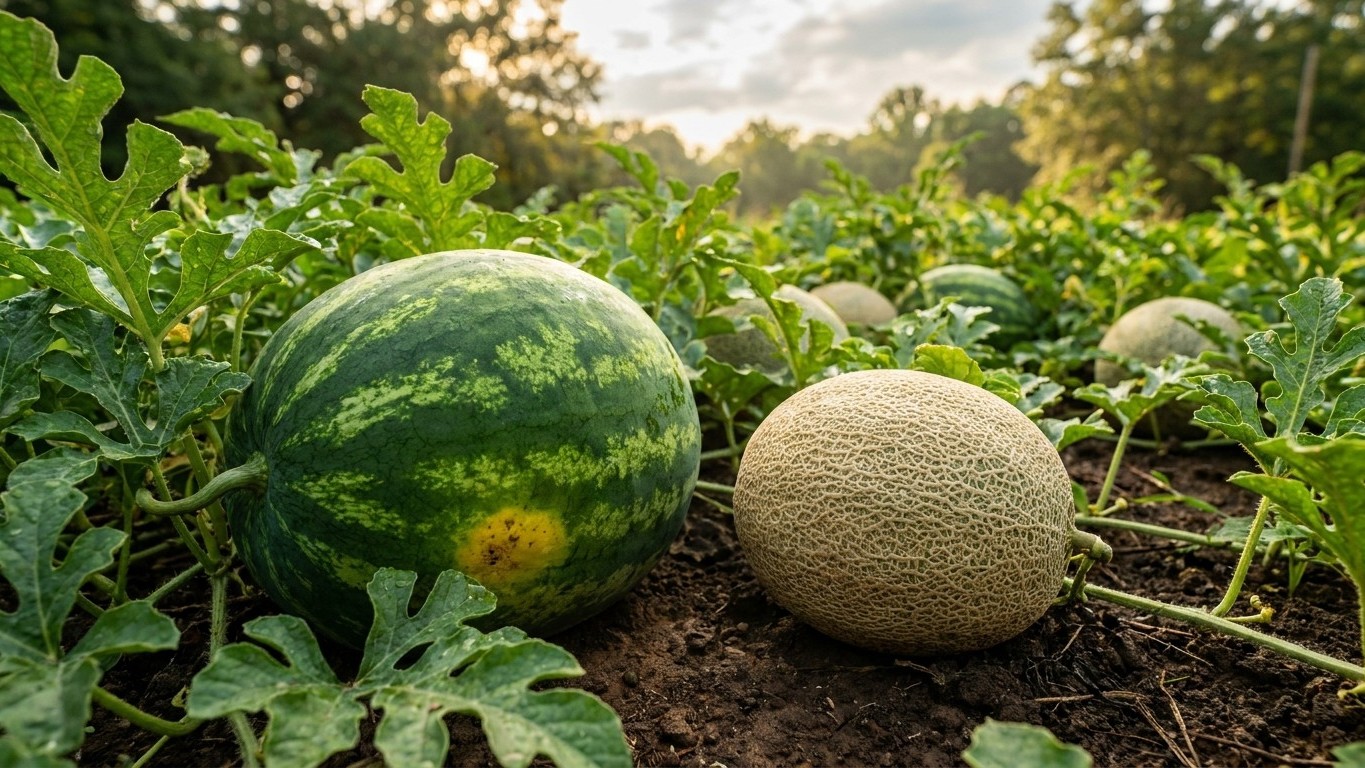

Florida’s best melons are the ones bred to shrug off humidity and heat, not the vines that need three dry months to ripen. In the northern part of the state, that means fast, disease-resistant watermelons and cantaloupes planted between the last spring frost and the first fall one. In central and south Florida, where frost rarely happens, the same logic applies to a completely different calendar: winter, not summer, is prime melon season.
The short answer for Florida
Start with the fact that decides everything else: north Florida, represented by the Jacksonville reference station, sees its last spring freeze between February 16 and March 7, and its first fall freeze between November 26 and December 13. That gives a frost-free window of roughly nine months, plenty of time for melons on paper. But layered on top of that window are 73.2 days a year above 90F and about 21.2 inches of rain across June, July and August alone. That combination, long season plus brutal mid-summer heat and humidity, is what should drive variety choice here, not days-to-maturity charts written for a drier climate.
For north Florida, the safest bet by type is a short-to-mid maturity watermelon or cantaloupe, something that can be planted early enough to bulk up and finish before the worst of the summer heat and rain arrive together. Disease resistance matters more here than in almost any inland state: fusarium wilt, downy mildew and powdery mildew all thrive in the exact stretch of weather (hot, wet, humid) that Florida summers deliver on schedule. Cultivars bred with resistance packages against those diseases, the kind extension trial reports typically flag, outperform older heirloom types that were selected in drier growing regions and were never tested against Florida’s rain totals.
For central and south Florida, the type question flips entirely. Because these zones rarely see a hard freeze, growers are not racing a frost clock, they are racing the wet season. The workable window runs through the cooler, drier months, roughly fall through spring, with summer treated as the off-season because that is when the heat load and rainfall both peak. A melon variety that would be planted in April in Jacksonville is often better planted in October or November farther south.
None of this is a single-variety answer, and it shouldn’t be. The honest short answer is: pick a fast-maturing, disease-resistant type, and pick your planting month based on which half of the state’s climate pattern you’re actually gardening in, not the one printed on a seed packet grown for the Midwest.
What will not work here
Long-season heirloom melons, the ones that need 90 days or more of relatively dry, low-humidity weather to ripen without splitting or rotting, are a poor match for a state where summer alone delivers 21.2 inches of rain and 73.2 days above 90F. A melon that needs that much time will spend a big chunk of its life sitting in the wettest, hottest stretch of the Florida year, exactly the conditions that fungal diseases need to spread through a planting. This is not a marginal risk; it is close to guaranteed in most seasons.
Watering on a fixed weekly schedule fails here for two opposite reasons depending on the month. During the driest part of summer, July’s 6.77 inches still arrives mostly as short, heavy thunderstorms rather than steady soaking rain, so a gardener who assumes “it rained this week, I can skip watering” often finds the top few inches of sandy Florida soil already dry again within a day or two. On the other hand, adding a full weekly watering on top of an already wet August (6.88 inches) simply keeps the root zone saturated, which is a direct invitation to root rot and the same fungal pressure that heirloom varieties already struggle with. Melons need irrigation tuned to the week’s actual rainfall, not a fixed calendar habit.
Tight spacing is the third failure point, and it is specific to a humid climate rather than a universal melon rule. Vines planted close together in a dry, low-humidity state can get away with it because airflow isn’t doing much work anyway. In Florida, where summer humidity sits alongside that much rainfall, cramped spacing traps moisture around leaves and fruit and speeds up exactly the mildew problems the state’s climate already favors. Wider spacing than a seed packet from a drier region recommends is not optional here, it is close to mandatory.
Finally, applying a single statewide planting date is a mistake baked into the geography itself, covered in the next section: a date that works in Jacksonville can put a plant directly into a killing frost, or directly into the start of the wet season, depending on where in Florida it’s used.
What changes across Florida
Florida’s USDA Plant Hardiness Zone range runs from 8b up to 11b, one of the widest spreads of any state in the country. That range, built on a single measure (the average annual extreme minimum temperature), is not a detail to skip past. It means a melon calendar built around Jacksonville’s frost dates describes conditions that simply don’t exist for a large share of the state’s gardeners.
North versus central and south, side by side
| Region (reference) | Approx. USDA zone | Frost pattern | Main melon season |
|---|---|---|---|
| North Florida (Jacksonville area) | 8b-9a | Freeze possible mid-Feb to early March, and late Nov to mid-Dec | Spring through early fall, timed around frost dates |
| Central and south Florida | 9b-11b | Effectively frost-free most years | Fall through spring; summer avoided for heat and rain |
The practical shift for a reader is straightforward once the zone map is in front of them. Anyone gardening near the northern reference station should keep working around the frost window given above, planting after the spring freeze risk drops and finishing well before the fall one arrives. Anyone farther south, where winter freezes are rare or absent, should stop thinking in terms of frost dates altogether and instead treat the wet, superheated middle of the year as the season to avoid, shifting the whole planting calendar toward the cooler months instead.
There is no single planting month that serves both ends of this range honestly. A statewide melon guide that gives one date is really describing one region’s climate and calling it Florida’s.
Where to check this for your own county
The state-level pattern above is a starting point, not a final answer. Florida’s own land-grant extension network, UF/IFAS Solutions for Your Life, exists specifically to narrow that range down to a single county, and that narrower recommendation should always outrank a statewide one.
Two things are worth pulling up on that site before planting. First, the local planting calendar for the specific county, which will already have folded in whether that county sits in the frost-driven north Florida pattern or the frost-free, wet-season-driven pattern that governs most of the peninsula. A county calendar removes the guesswork of deciding which side of the state’s climate split applies to a particular garden. Second, look for whatever variety trial results or recommended cultivar lists the local county extension office has published for melons; these are drawn from actual local growing seasons rather than generalized state or national averages, and they will reflect the specific disease pressure, soil type and rainfall pattern of that county far than a statewide hardiness zone range ever could.
This matters more in Florida than in most states precisely because of that 8b-to-11b spread. A recommendation calibrated for the Jacksonville area could actively mislead a gardener working in a frost-free zone a few hundred miles south, and vice versa. The state page, this one included, can only describe the pattern and the split; the county office is the source that resolves which half of that split actually applies to a given backyard.
Checking this against your own garden
Dates and averages describe a typical year, not this year, and the garden itself will usually say more than either one. Soil warmth by feel is the first check: melon seed germinates poorly in cold soil no matter what the calendar says, so pressing a hand a few inches into the bed and feeling for warmth that holds steady, rather than soil that still feels cold from a recent snap, is a better planting signal than any printed date.
The first flush of male flowers on an existing planting is the second signal worth watching. Melon vines typically produce male blooms well before the female flowers that actually set fruit, and a strong early flush of males is a sign the plant considers conditions warm and stable enough to start reproducing. A weak or delayed flush, especially compared to how the same variety behaved in a previous year, often points to a cooler or slower-warming spot in that specific yard than the general area suggests.
The third signal is the first set of true leaves, the leaves that emerge after the initial seed leaves and actually look like miniature melon foliage. How quickly they appear and how vigorous they look says a lot about whether the local soil temperature and moisture are matching what the surrounding region typically offers. A slow, pale start in a spot expected to be warm and fast-draining can mean a low pocket, heavier shade, or wetter soil than the rest of the property, all of which shift the real planting window for that bed away from the county average.