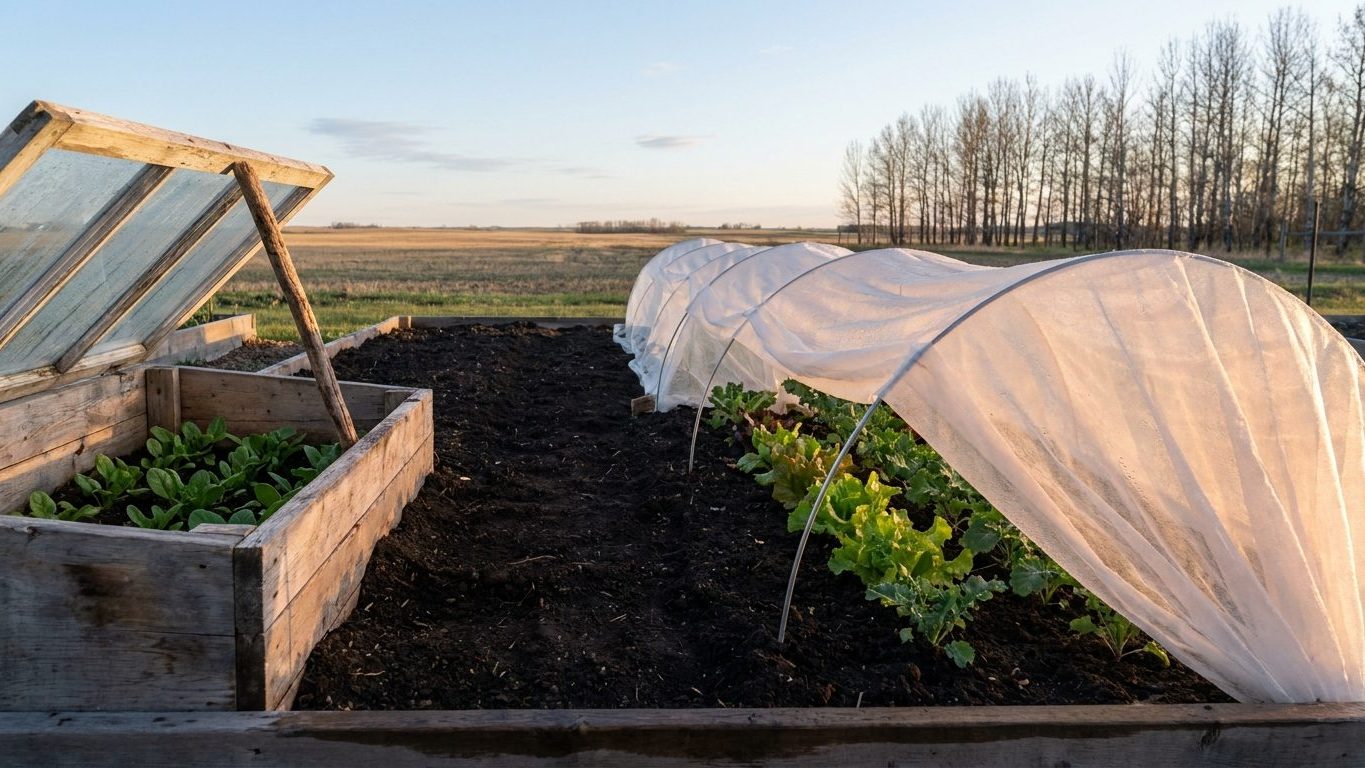

In north Florida, frost cloth and low tunnels are the season extenders worth owning. They carry winter vegetables through the few freezes a typical year delivers. Farther south the problem flips. Frost is rarely the limit there, so the useful extender is shade cloth, which protects against summer heat. Which tool you want depends on where you garden, since the state spans USDA zones 8b to 11b.
The short answer for Florida
Use lightweight frost cloth (sold as row cover) over hoops or stakes in north Florida, and use shade cloth in central and south Florida. Frost cloth handles the occasional hard night. Shade cloth handles the months when heat, not cold, shuts the garden down. Cold frames and low tunnels are the next step up, but only in the northern part of the state.
The numbers explain why. The reference station is Jacksonville’s airport, at 30.48 degrees north. According to the NOAA NCEI 1991-2020 Climate Normals, the last spring freeze there falls between February 16 and March 7, and the first fall freeze between November 26 and December 13. Those dates are a probability, not a calendar. They mark the band where the chance of a 32°F freeze sits between 30 and 70 percent. The airport is also an inland site, and three of the thirty fall seasons in the record saw no freeze at all.
The mean daily minimum of the coldest month there is 42.9°F. That is well above freezing, which is why a Jacksonville garden doesn’t need a heated greenhouse or an insulated cold frame. What it needs is cheap insurance for the handful of nights when a cold front drops the temperature below the average. A roll of frost cloth and a few hoops fit that job, and so does an old bedsheet in a pinch.
For gardeners in central and south Florida, the calendar inverts. Those regions are effectively frost-free, so the main growing season runs through winter, and summer becomes the hard part. Do not apply the Jacksonville window to Orlando or Miami. A south Florida gardener who waits for “the last frost” before planting will lose the best months of the year.
The general principles are covered in Extending the Growing Season in Florida, and the timing question has its own page, When to Cover Your Garden in Florida. This page sticks to the choice of tool.
What will not work here
Sealed clear plastic is the first thing to skip. A tunnel that works in a cold, dry climate turns into a steam room on a sunny Florida winter afternoon, with humid air trapped against the leaves. Foliage disease follows, and tender seedlings cook before the next cold night arrives. If you use plastic at all, it has to be vented or opened by mid-morning, which means someone has to be home to do it.
Heavy insulation is the second thing. Deep, double-glazed cold frames and heated greenhouses are built for places where the coldest month averages well below freezing. At a coldest-month mean minimum of 42.9°F, the money is better spent elsewhere. The same goes for water walls and thermal mass: they solve a problem that Jacksonville mostly doesn’t have.
Third, don’t expect a longer warm season. In Jacksonville the first fall freeze arrives between November 26 and December 13, and the last spring freeze between February 16 and March 7. That leaves the winter gap short enough that extenders here are about protecting cool-season crops such as lettuce, broccoli and collards through occasional hard nights. They are not about squeezing tomatoes into December. Frost cloth over a summer crop in November buys a few weeks at best.
Fourth, don’t plan around the frost dates in the wrong region. Those dates describe one inland station in north Florida. In central and south Florida, buying frost cloth “for the first frost” is mostly wasted money, and the better purchase is shade cloth for the long summer. Tomatoes, lettuce and other cool-season crops belong in the winter there, and starting them in a northern spring slot sets them up to meet heat they can’t take.
Finally, don’t treat the averages as a guarantee. A mean daily minimum of 42.9°F is an average, and individual nights run colder. Three of thirty falls without a freeze sounds reassuring, but it means twenty-seven did have one. Leaving covers in the shed because “it usually doesn’t freeze” is how a bed of young transplants gets lost in one night. Close spacing under covers compounds the problem in humid air, so give plants room to dry out between waterings.
What changes across Florida
Florida is not one garden. The USDA Plant Hardiness Zone Map 2023 (built on 1991-2020 normals) places the state in zones 8b to 11b. That is a spread of several zones, and the map is built on one variable, the average annual extreme minimum temperature. There is no single answer for “what to use” across all of it. A single recommendation would be wrong for much of the state.
| Part of the state | Main seasonal problem | Extender that fits |
|---|---|---|
| North Florida (Jacksonville area and the Panhandle) | Occasional freezes, roughly late November to early March | Frost cloth, low hoops, cold frames |
| Central Florida | Effectively frost-free; summer heat and rain | Shade cloth, trellises for afternoon shade |
| South Florida | Effectively frost-free; long hot, wet summer | Shade cloth, raised beds for drainage |
Treat the table as a guide to the direction of the shift, not a prescription. The freeze dates in the facts belong to Jacksonville only. A reader in the Panhandle will likely see colder nights than the airport station records, and a reader along the coast may see milder ones.
Latitude matters too, though for a different reason. The 30.48 degrees north figure belongs to Jacksonville, not to the whole state. Day length, rather than warmth, tells an onion when to stop making leaves and start making a bulb. Someone near the Georgia line and someone in the Keys sit at very different latitudes, so onion types and planting windows shift. If you live near the edge of the state, check your own latitude before borrowing a date from this page.
To find out which zone applies to you, use the USDA map and look up your ZIP code. This page can’t tell you, and shouldn’t guess.
Where to check this for your own county
Your county office of UF/IFAS Extension is the next stop. Every Florida county has one, and the staff there know which crops, covers and planting dates hold up locally. Two things are worth looking for on its pages.
- The local planting calendar, which will show when to start each crop in your county, not in Jacksonville.
- The varieties trialled in your county, meaning the ones tested in local soil, heat and humidity rather than recommended from a catalog.
A county recommendation beats a state one, and this page is the state one. It averages across a region that runs from the Georgia line to the Keys. The extension service works at the scale where a recommendation can be right: your soil, your rainfall, your pests.
It is also worth calling or emailing the county office with a specific question. Ask when local gardeners usually cover, whether shade cloth is common for summer vegetables in your area, and which tomato or bean varieties have done well in county trials. Master Gardener volunteers often staff the phone line, and they tend to know which cold nights caught people off guard last year.
One caution: this page does not have a county-level calendar for Florida, and it won’t pretend to. The statewide facts here come from one NOAA station, and every county-specific question belongs with extension.
Checking this against your own garden
Your own observations outrank every date on this page. Three are worth watching, and none needs an instrument.
Soil warmth by feel
Push your hand a couple of inches into the bed on a cool morning. Cold, damp soil means seeds will sit and rot, while soil that feels mild is ready for planting. Compare a bed against a house wall with one in an open corner. The difference tells you which spots hold warmth, and where covers will matter most.
The first flush of male flowers
Squash, cucumbers and melons put out male flowers before female ones. When they open, the plant is growing in conditions it likes. If one bed flowers days before another, the early one is your warm microclimate, and the late one is where a cover or a delay makes sense.
The first true leaves
Seedlings show two seed leaves first, then the true leaves. Compare seedlings under a cover with ones outside it, or in different parts of the yard. Faster true leaves mean warmer air and soil. Stalled seedlings point to a cold pocket, often a low spot where chilled air settles on still nights.
Common questions
Do I need season extenders in Miami or Orlando?
Mostly not for cold. Central and south Florida are effectively frost-free, and the Jacksonville freeze window doesn’t apply there. Shade cloth for summer is the more useful purchase, and your county extension office can confirm local conditions.
Is frost cloth or plastic better in Florida?
Frost cloth is the safer choice. It breathes, so humid air and sunny afternoons are less likely to cook the plants underneath. Plastic holds heat but needs venting, and in Florida’s humidity it invites disease if left closed.
When should I put covers on?
Cover before dusk on nights when a freeze is forecast, and uncover once temperatures climb the next morning. The timing details are in When to Cover Your Garden in Florida.
Can season extenders help in summer?
Yes, in the form of shade cloth. In central and south Florida, where summer is the hard season, it is the main extender. It softens afternoon sun and heat stress for crops that would otherwise stall or scorch.