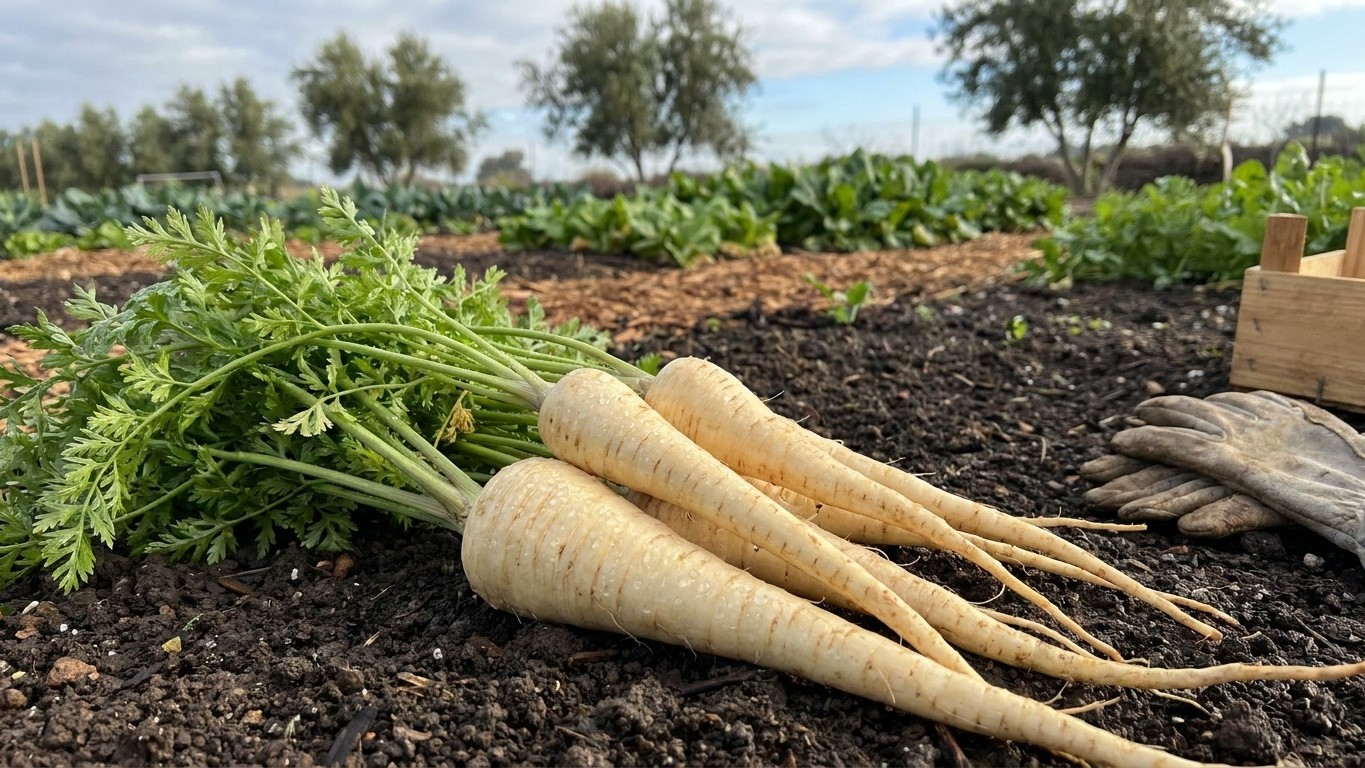

Lift parsnips only after several frosty weeks, which in Manitoba means late October at the earliest, since the first fall frost arrives around September 22 on average at Winnipeg. Cold nights turn stored starch into sugar, so patience pays in flavor. In a cold, humid room held at 0 to 1 °C, the roots keep four to six months. Park a bowl of apples nearby, though, and they turn bitter.
The short answer
Does Manitoba deliver several frosty weeks? Comfortably. The mean daily minimum of the coldest month is -21.4 °C at the Winnipeg reference station, according to the Canadian Climate Normals from Environment and Climate Change Canada (ECCC). A parsnip grown here will sweeten, not merely grow. That is a statement about frost exposure. A comfortable hardiness zone does not guarantee sweetness, because the starch-to-sugar conversion depends on weeks of cool, frosty weather, not on a zone number on a map. Utah State University Extension says the same thing in plainer terms: parsnips taste best after several weeks of frost. For the mechanism in more depth, see Will Parsnips Sweeten in Manitoba?
The first fall frost falls on September 22 on average, and that is a midpoint, not a promise. In one year out of two it arrives later. Count several weeks from that date, say four, and you land around October 20. That is my arithmetic, not a published rule, but it explains why lifting in mid-September, the way you would carrots, throws away the best part of the crop. Wait, and dig while the soil is still workable.
One caution on geography. These dates come from the Winnipeg Richardson International Airport station. A province is not one climate, and northern or upland districts run weeks behind it, so shift your own calendar accordingly. If you are gardening well north of the Red River Valley, your frost arrives earlier, and your season is shorter at both ends.
How long they keep once lifted
Four to six months is a long keeper by any standard. The figure comes from USDA Agricultural Handbook 66, in the chapter by P.M.A. Toivonen, and it assumes 0 to 1 °C at 98% relative humidity held steady. Almost no house manages that. A spare fridge, an unheated cellar that stays just above freezing, or a crisper drawer comes closest, and the shorter end of the range is the realistic expectation elsewhere. The handbook’s full text is available from the USDA Agricultural Research Service.
The failure people miss is not cold. Parsnips are not chilling sensitive. The problem is ethylene, the ripening gas that apples and other fruit give off. Parsnips produce almost none themselves, but the handbook reports that even low levels of ethylene in cold storage cause bitterness, likely through a buildup of a compound called xanthotoxin. So keep them away from apples, pears and any ripening fruit, even when the temperature is right. And when you prepare them for storage, top them but do not trim into the crown.
Does the season fit?
Parsnips are sown in place, and the clock of 100 to 120 days runs from seeding, not from the day seedlings show. Here is the arithmetic in words, using the Winnipeg normals:
- The last spring frost falls on May 23 on average. Again, that is a midpoint, and in one year out of two the final frost comes later.
- Sow two to three weeks before that date, which puts seeding between about May 2 and May 9.
- Germination takes 14 to 21 days. Bare soil for two or three weeks is normal, so do not dig it up and re-sow. Parsnip seedlings are famously slow, and the wait is part of the crop.
- Add 100 to 120 days to the sowing date. A May 2 sowing reaches maturity between about August 10 and August 30. A May 9 sowing reaches it between about August 17 and September 6.
- Compare that with the first fall frost on September 22. The roots reach full size 16 to 43 days before the average frost, depending on sowing date and variety speed.
- Then the frost does its work. Frost-free time from May 23 to September 22 is 122 days, but your parsnips start earlier than that, with 136 to 143 days between sowing and the average first frost. That is slack on top of the 100 to 120 they need.
The verdict: it fits comfortably, with the margin shrinking if spring is late. A cold, wet May that delays sowing by two weeks eats most of the spare time in the worst case. The crop is also forgiving, because the roots do not need to be full size by the first frost. They keep bulking up through cool autumn weather, and frost is what finishes them. Sow as early as the soil allows and you will finish ahead of the cold, not behind it. For the broader picture of site, soil and sowing, see Growing Parsnips in Manitoba.
What goes wrong here
Most failures in Manitoba are not about climate. They are about soil, water and storage habits. Here are the common ones, each with its fix.
- Forked roots from heavy or stony ground. A root that hits a stone or a layer of dense clay splits and twists. Utah State University Extension recommends deep sandy soil and says heavy soil must be double dug. If your garden is heavy clay, loosen it deeply before sowing, and clear stones from the full depth of the row.
- Forked roots from overwatering. This is a separate cause, and the remedy is different. Soil kept constantly wet can also produce branching roots even when the ground is loose. Water deeply but less often, and let the surface dry between waterings instead of keeping it soggy.
- A season that runs out. A late sowing, say after the end of May, leaves roots small when the cold arrives. Sow in early May, seeding about two to three weeks before the mean last frost, and remember the 14 to 21 day germination wait.
- A fall too mild to sweeten. This is rare in Manitoba, given a coldest-month mean minimum of -21.4 °C. Still, a warm autumn can delay the first hard frosts. The fix is simply waiting, since sweetness depends on frosty weeks, not the calendar date. Taste a root before lifting the whole row.
- Bitterness in storage. The cause is ethylene from nearby apples or ripening fruit. Store parsnips alone, in a separate cold space or a sealed container well away from fruit.
- Rot or shriveling in storage. The recommended 98% humidity is hard to hold. Cut into the crown and the root decays faster, so top them but leave the crown intact, and keep them cold, close to 0 to 1 °C.
- Pest damage in the row. Tunnels and chewed roots can be mistaken for storage rot. See What Eats Parsnip in Manitoba, and When to tell the difference.
Common questions
How many days from seeding to harvest?
Parsnips need 100 to 120 days from seeding. In Manitoba, a sowing in the first week or so of May reaches that point in August or early September, well before the average first frost on September 22. The frost then sweetens them.
Can I store parsnips with apples?
No. Parsnips make very little ethylene, but exposure to low levels of it in cold storage causes bitterness. Even at the right temperature, a root stored next to ripening fruit can taste off. Keep them apart.
Should I cut the tops off before storing?
Yes, top them after harvest, but do not trim into the crown. The USDA handbook says this specifically. Cut the foliage off cleanly above the crown and leave the shoulder of the root intact.
Is the Winnipeg frost date the date for my garden?
Only if you garden near Winnipeg. The May 23 and September 22 averages come from the Winnipeg Richardson International Airport station, and both are midpoints, with frost later than the date in half of all years. Northern and upland Manitoba run weeks behind. Local conditions, such as a low spot where cold air pools, can shift the date again, and no figure here covers those.