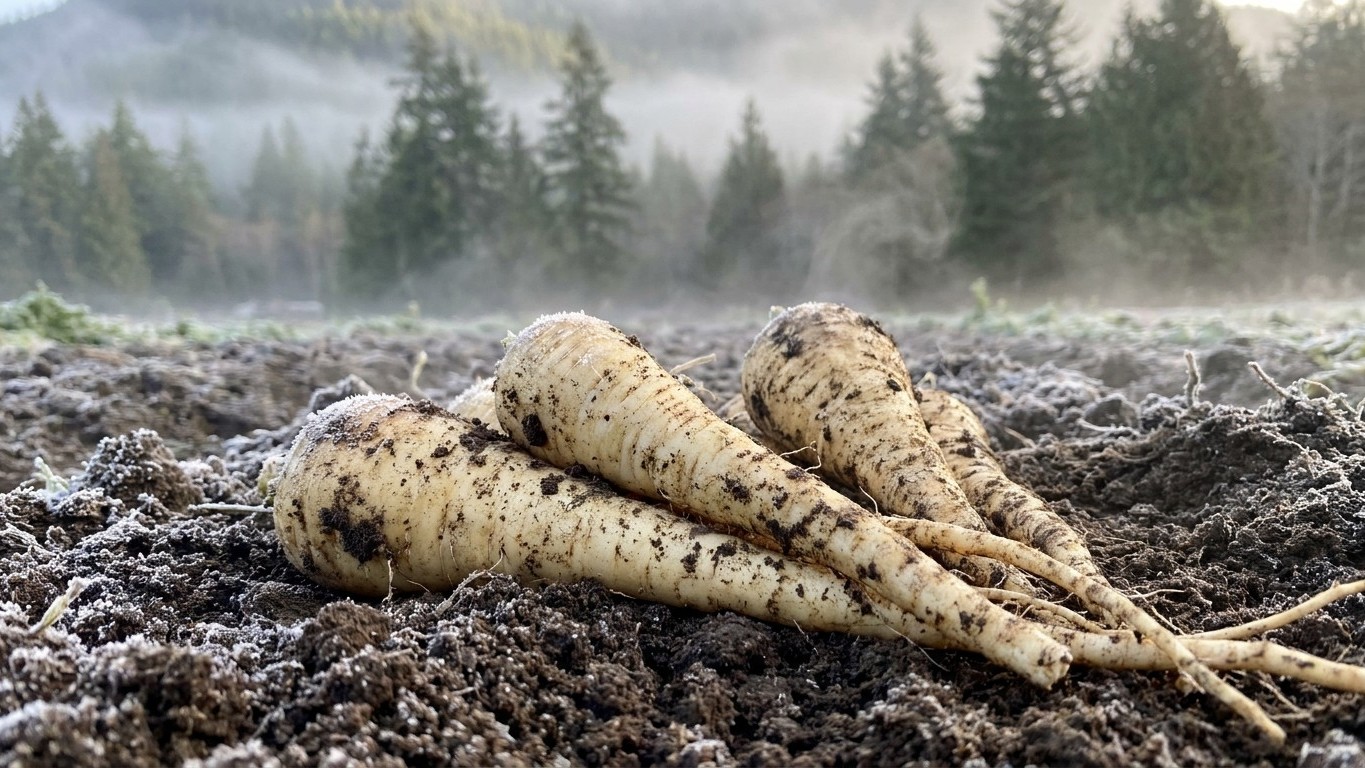

Lift parsnips after several frosty weeks, not after a calendar date. At Toronto’s airport station the first fall frost averages October 16, so sweet roots start in November, not October. Cold is what turns starch to sugar, and an early dig gives you a bland root. Once lifted, parsnips keep four to six months at 0 to 1 °C (32 to 34 °F) with near-saturated humidity. Few kitchens manage that, and one neighbour in the fruit bowl can turn the roots bitter.
The short answer
Does this part of Ontario deliver several frosty weeks? Yes. The mean daily minimum of the coldest month is -10.2 °C at the Toronto reference station, from Environment and Climate Change Canada’s Canadian Climate Normals. That is an average overnight low, not a record, so ordinary winters supply the cold, not just freak snaps. A parsnip grown here will sweeten, not merely grow. Utah State University Extension puts it plainly: parsnips taste best after several weeks of cool, frosty weather, which converts stored starch to sugar.
The driver is frost exposure on the root, not the hardiness zone. A comfortable zone number tells you what survives a winter. It says nothing about how many frosty weeks a root actually sits through, and a plausible-sounding swap of one for the other would mislead you. The conversion itself is covered in Will Parsnips Sweeten in Ontario?
When to lift
The first fall frost averages October 16 and the last spring frost averages April 30, both from the Toronto Pearson station. Treat them as midpoints, not safe dates. In one year out of two the frost lands later than the average. The same station also doesn’t speak for the whole province: northern and upland districts run weeks behind it, and your own dates shift with them.
Utah State says “several weeks” of frost and gives no exact count, so I won’t invent one. The practical test is a taste test. Starting in November, pull one root, scrub it, and taste it raw or roasted. If it’s starchy, leave the rest. If it’s sweet, lift as you need them.
Why storage is about ethylene, not cold
Parsnips aren’t chilling sensitive, so cold isn’t what ruins them. Ethylene is. USDA Agricultural Handbook 66 notes that parsnips produce very little of the gas themselves, under 0.1 µL kg-1 h-1 at 20 °C (68 °F). But exposure to low levels of it in cold storage causes bitterness, likely from a compound called xanthotoxin building up. Apples, pears and any ripening fruit give off ethylene. Keep parsnips in the same crisper or cold cellar as fruit, even at the right temperature, and they turn bitter. The handbook’s full text is on the USDA site.
The handbook’s figure is four to six months at 0 to 1 °C with 98% relative humidity. That is a long keeper by any standard, but the number assumes both readings held steady, which almost no house does. Top the roots after lifting, but don’t trim into the crown. For the wider growing picture, see Growing Parsnips in Ontario.
Does the season fit?
Parsnips are sown in place, and the 100 to 120 days run from seeding, not from transplanting. The target is a sowing 2 to 3 weeks before the last frost. Here is the arithmetic at the Toronto station, step by step.
- Start from the last frost. On average it falls on April 30, and in half of all years it falls later. Use it as the middle of a window.
- Back up 2 to 3 weeks. That puts sowing between about April 9 and April 16, whenever the soil is workable.
- Allow for germination. Seed takes 14 to 21 days to come up, so the row looks like bare soil into early May. Those days count inside the 100 to 120, not on top of them.
- Add 100 to 120 days. A sowing on April 9 reaches full size between about July 18 and August 7. One on April 16 reaches it between about July 25 and August 14.
- Compare with the fall frost. With the first frost averaging October 16, roots finish sizing up roughly 63 to 90 days before it arrives. The average frost-free stretch is about 169 days, against the 100 to 120 the crop needs.
On paper this fits comfortably. The margin is deliberate: sweetening needs those weeks after the first frost, so the roots should be full size when the cold arrives, not still growing into it.
Where the arithmetic bends
A sowing slipped to the end of May still lands between early and late September at this station, which is tight on sweetness only if frost comes early. The real squeeze is further north. A district whose last frost runs three weeks behind Toronto’s pushes the whole chain back three weeks, and the buffer before October shrinks with it. Count back from your own local first-frost date, not the Toronto one. And since the Canadian normals behind these dates cover an earlier span than the US figures used elsewhere on this site, don’t compare the two pages date for date.
What goes wrong here
Most failures trace to the bed or the calendar, not the climate. These are the ones this soil and weather tend to produce, each with its fix.
- Forked roots in heavy or stony ground. Utah State recommends deep sandy soil and says heavy soil must be double dug. Many Ontario yards sit on clay or stony till, so dig a test hole in your own bed instead of assuming. Double dig, pull the stones, and loosen to well below spade depth. A raised bed of loose mix is the fallback.
- Forked roots from overwatering. A separate cause with a separate fix, even when the roots look the same. Water deeply but less often, and only when the soil a couple of inches down is dry. A constantly wet bed also drowns the slow, deep taproot.
- Bare soil after two weeks. Germination takes 14 to 21 days. Digging up the row at day ten and re-sowing wastes seed and resets the clock. Mark the row, keep the surface from crusting, and wait out the three weeks.
- A season that runs out. A late sowing in a cooler district leaves too little time before the fall frost. Sow as early as the soil can be worked, and count 100 to 120 days forward from the real sowing date, not the intended one.
- A winter too mild to sweeten. The Toronto average is cold enough, but a given year or a sheltered spot can fall short. A fine, large root can still taste starchy. Taste before you lift, and leave the bed alone until the roots turn sweet.
- Bitterness in storage. Ethylene from nearby fruit, not cold, causes it. Store roots away from apples and ripening produce, and top them without cutting into the crown.
Reading the damage before you blame the weather
Chewed or tunnelled roots are a different problem from forked ones, and the fix is not in the soil. For what feeds on the crop and when, see What Eats Parsnip in Ontario, and When.
Common questions
What is the earliest I can lift parsnips and still get sweet roots?
There’s no fixed date, only an order of events. The first frost averages October 16 at Toronto Pearson, and Utah State says the roots need several weeks of frosty weather after that. In practice that points to November, and your local frost dates may push it later. Taste a root before you commit.
The row looks empty after ten days. Should I re-sow?
No. Parsnip seed takes 14 to 21 days to germinate, so bare soil at day ten is normal. Re-sowing too soon creates uneven rows where some roots have a head start of weeks.
Is it a problem to store parsnips with apples?
Yes. Parsnips themselves give off almost no ethylene, but they are sensitive to it. Even low levels in cold storage cause bitterness, so keep them in a separate crisper, cellar bin or container from apples and other ripening fruit.
How long do lifted parsnips really keep?
Four to six months is the USDA Handbook 66 figure, at 0 to 1 °C (32 to 34 °F) with 98% relative humidity. Most homes can’t hold both readings steadily, so expect less, and this page has no sourced figure for a typical fridge or basement. Top the roots but leave the crown intact, because cutting into it shortens their keeping time.