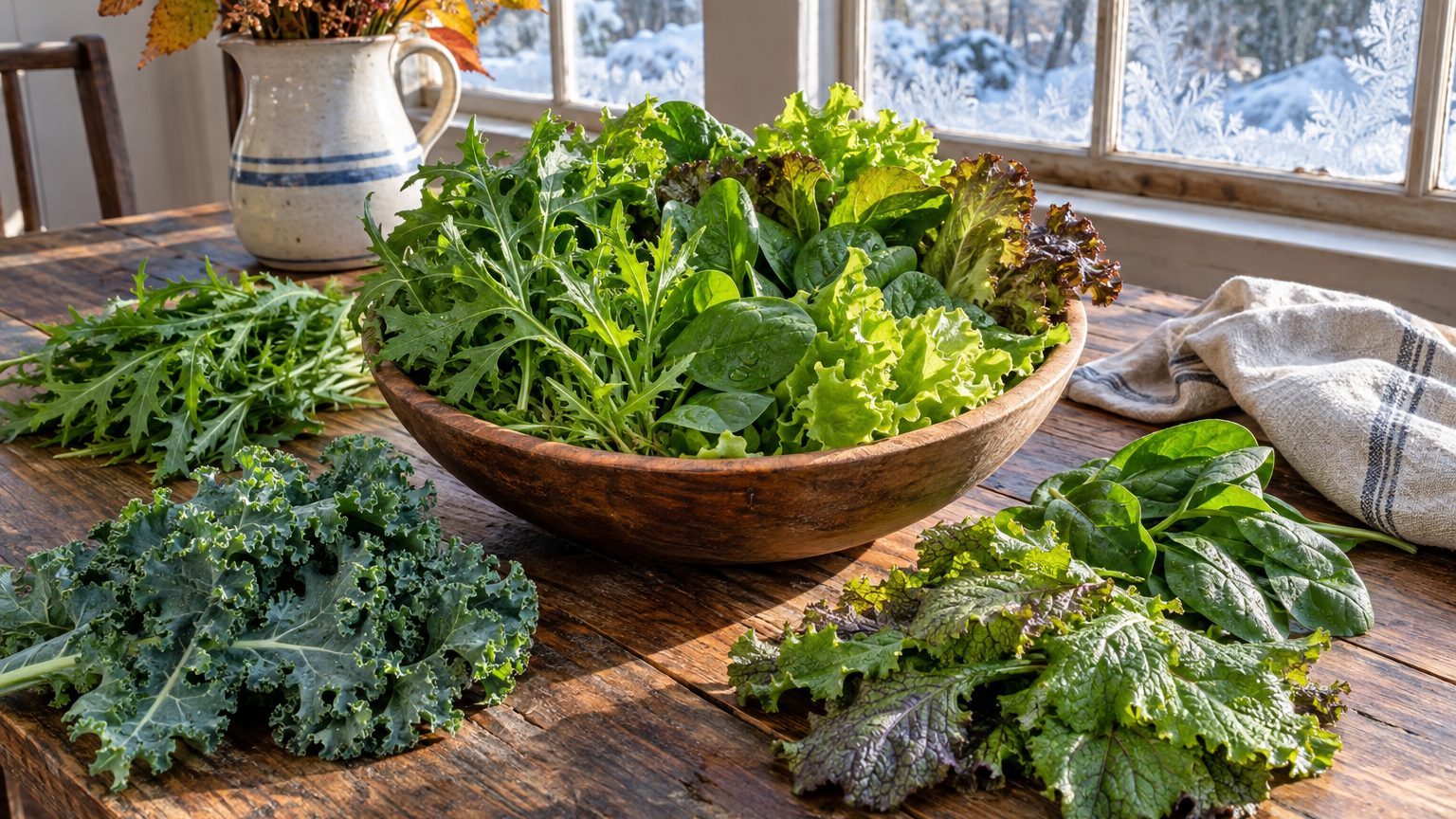

The best winter salads for Florida are the quick, cool-season leafy types: loose-leaf lettuce, arugula, mustard greens, Asian greens like mizuna and tatsoi, and kale or collards for sturdier bowls. Slow heading lettuces rank lower. North Florida has a true frost season, while central and south Florida treat winter as the main growing season. The right pick depends on how fast a crop finishes before warmth returns.
The short answer for Florida
Choose by type, not by cultivar name. Fast, cut-and-come-again leaves fit Florida best, because the cool window is short and the warm one is long. Loose-leaf lettuce, arugula, mustard and Asian greens give you harvests quickly. Kale and collards hold on longest as days warm up. Head lettuce and romaine are the gamble, worth trying mostly in the cooler north.
The cold itself is rarely the limit. At the Jacksonville reference station, the mean daily minimum of the coldest month is 42.9°F, well above freezing on average. Salad greens shrug off numbers like that. The trouble comes from the other end of the thermometer.
Frost dates, and what they measure
For north Florida, the NOAA 1991-2020 normals at the Jacksonville airport station put the last spring freeze between February 16 and March 7, and the first fall freeze between November 26 and December 13. Those dates are a probability, not a promise: they mark the band where the odds of a 32°F freeze sit between 30 and 70 percent. The airport is an inland site, and in three of the thirty fall seasons measured, no freeze came at all.
Central and south Florida are effectively frost-free, so those dates do not apply to Orlando or Miami. There the calendar inverts: the main season runs through winter, and summer is the hard part. This page does not carry frost dates for those regions, because there is no frost window to give.
Types compared
| Type | Strength in Florida | Watch for |
|---|---|---|
| Loose-leaf lettuce | Forgiving, harvest leaf by leaf | Bolts and turns bitter as warmth returns |
| Arugula | Very fast from seed | Runs to flower quickly in warm spells |
| Mustard and Asian greens | Quick, handle cool nights well | Sharp flavor intensifies with heat |
| Kale and collards | Hardy, productive longest into spring | Takes more room per plant |
| Head lettuce and romaine | Good texture where the cool season runs long | Slow to finish; often beaten by warm weather |
Sowing dates for the north are laid out in When to Sow Winter Salads in Florida.
What will not work here
Slow, heading crops are the first casualty. A head of romaine needs weeks of steady cool weather to fill out, and in much of Florida a run of warm days arrives before it does. The plant responds by sending up a flower stalk, and the leaves go bitter. You end up with a tall, tough plant instead of a salad.
Seed packet advice is the second trap. Most packets are written for northern states: “sow as soon as the soil can be worked in spring.” In Florida, that advice points you at the wrong half of the year. Spring sowings in central and south Florida meet rising heat almost immediately, and lettuce seed can sulk or fail to sprout in warm soil. Sow in the cool months instead, and treat spring as the end of the season rather than the start.
Humidity is the third problem, and it punishes tight spacing. Salad greens packed shoulder to shoulder stay wet after dew, rain or irrigation, and damp foliage invites fungal leaf spots. Give lettuce and kale room for air to move, and water in the morning so leaves dry before evening. Overhead watering late in the day is a habit worth dropping.
Florida soils add a quieter problem. Many gardens sit on sandy ground that drains fast and holds few nutrients, so greens that need steady moisture and steady feeding can stall between waterings. A weekly soak does not suit quick-growing salad crops here. Light, frequent watering and compost worked into the bed help far more than a single deep drink.
Finally, do not trust the mild average in the north. A coldest-month minimum of 42.9°F is a mean, and individual nights can still dip to 32°F, especially in the late-February to early-March band. Established kale and collards handle that. Tender seedlings and young lettuce do better with a sheet of frost cloth on hand. Keep it nearby from late November on, and the odd cold snap won’t wipe out a bed.
What changes across Florida
Florida is not one garden. The USDA Plant Hardiness Zone Map (2023, built on 1991-2020 normals) runs from zone 8b to 11b across the state. That is seven half-zone steps, from the freeze-prone north to the frost-free far south. There is no single answer for the whole state, and any advice that pretends otherwise is guessing.
The zone system rests on one variable: the average annual extreme minimum temperature. It tells you how much cold a place can throw at a plant. It says nothing about heat, humidity, or how long the cool season lasts, and those matter more for salads. A bed in zone 10 may never see frost yet still be too hot by April for lettuce to hold.
If you garden in north Florida, plan around the frost window above. Sow in fall, keep frost cloth ready, and lean on the hardier greens through the coldest weeks. Early spring sowings after the last-freeze band can work, but they are a short race against warming days.
If you garden in central or south Florida, drop the frost thinking altogether. Your cool season is your growing season, and the goal is to get plants established and harvested before the heat returns. Choose the fastest types, sow in succession so you are not stuck with one overripe row, and give afternoon shade if your bed bakes.
Altitude does little here. Florida is flat, so latitude does most of the work, and a few miles inland or a few miles south can shift your conditions more than any hill. Look up your own zone on the USDA map instead of assuming one. This page won’t tell you which zone you are in.
Where to check this for your own county
Your state extension service is the next stop. UF/IFAS Extension runs a county office across Florida, staffed by people who know your soil, your pests and your local weather. Find your county office there and look for two things: the local vegetable planting calendar, and the varieties that have been trialled in your county.
The calendar matters because Florida’s regions plant on very different schedules. The trials matter because a variety that thrives in one county’s sandy soil and humidity may struggle in the next. Extension staff can also tell you which leaf diseases are active locally and what to do about them.
A county recommendation beats a state one. This page is the state one: it works from a single northern reference station and a statewide zone range, so it can point you in a direction but cannot pin down your sowing week. When the county calendar and this page disagree, go with the county.
For the bigger picture on salad crops in the state, Winter Salads for Florida Gardens collects the whole topic in one place.
Checking this against your own garden
Your own observation outranks every date on this page. Three things are worth watching, and none needs equipment.
- Soil warmth by feel. Push your fingers into the top inch of the bed in the morning. If it feels pleasantly cool, lettuce seed will sprout. If it feels warm like bathwater, wait. A bed against a sunny wall will warm sooner than one in open shade, and that tells you where to sow first and last.
- The first true leaves. The first pair are seed leaves. The next ones look like the real plant. How long they take to appear shows how fast your bed grows in cool weather, and a slow bed is usually a cold or shaded one.
- The rising center. When the middle of a lettuce or arugula plant starts to stretch into a stalk, it is bolting. Whichever bed does this first is your hottest microclimate.
Write down the date each one happens. Next season, that short list of dates will tell you more about your yard than any statewide table, and it makes the county calendar easier to adjust.
Common questions
Can I grow lettuce in Miami in winter?
Yes. South Florida is effectively frost-free, so winter is the main growing season there. Sow in the cool months and expect heat to end the harvest in spring. This page does not give Miami sowing dates, so check your county extension calendar.
What is the easiest winter salad crop in Florida?
Loose-leaf lettuce and arugula are the easiest starters. They grow quickly and you can pick leaves as you need them. Kale and collards last longest into warmer weather.
Do I need frost protection?
In north Florida, keep frost cloth handy. The Jacksonville normals show a freeze is possible from late November and again in the February 16 to March 7 band. In three of thirty falls measured, no freeze came at all, so some years you will not need it.
Can I use the Jacksonville dates for Orlando?
No. Jacksonville is in north Florida and its airport is an inland site. Central Florida is effectively frost-free, so those freeze dates do not apply, and its growing calendar runs through winter.