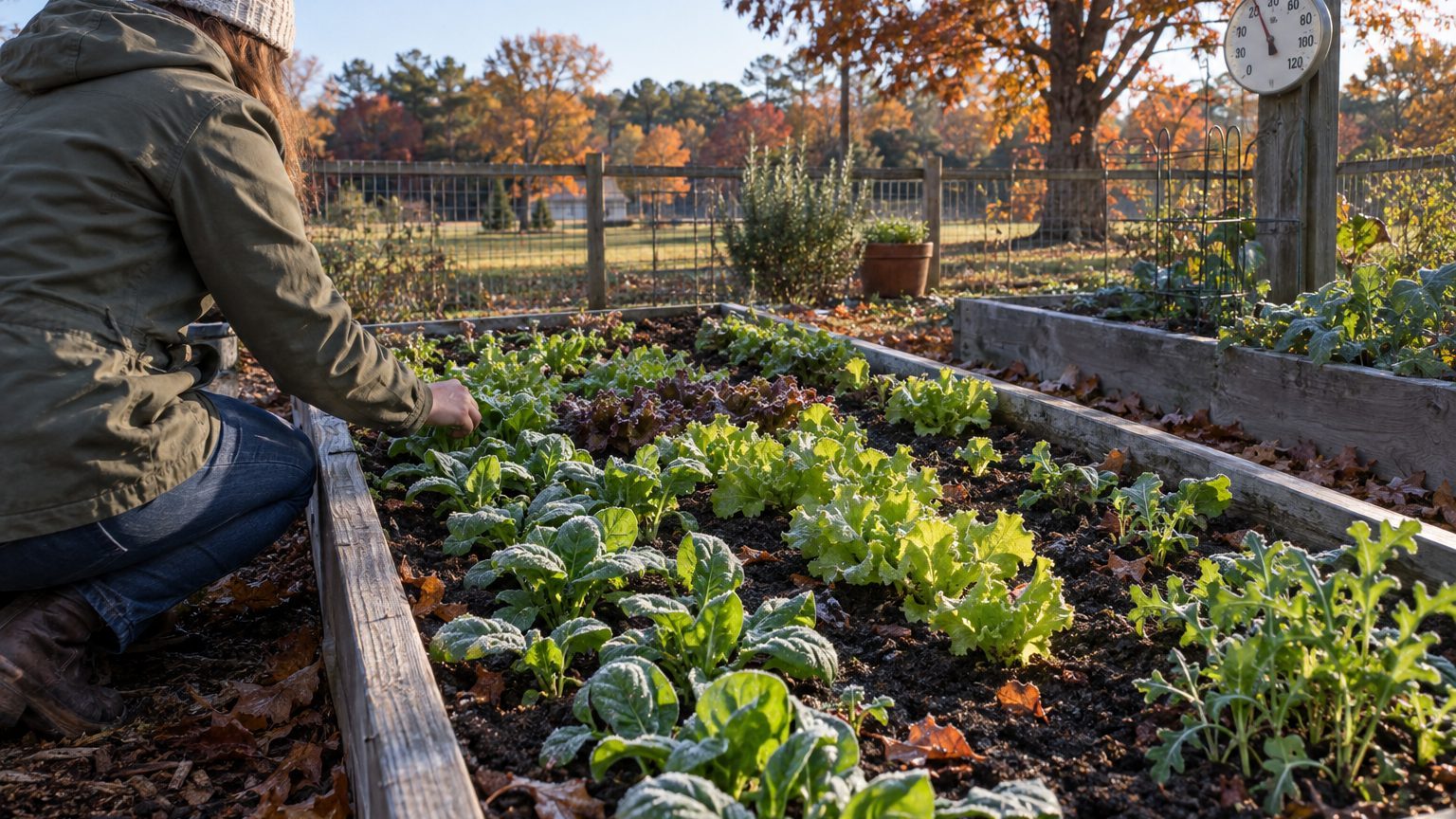

Florida has no single sowing date for winter salads, because the state runs from freeze-prone north Florida down to a nearly frost-free south. Fall is the sowing season almost everywhere. What changes is how far you can stretch it, and what you count backward from. The dates below come from Jacksonville, the reference station.
The short answer for Florida
In north Florida, sow winter salads in fall so seedlings are established before the first 32°F freeze, which at Jacksonville falls between November 26 and December 13. Keep sowing through winter, and expect the season to wind down around the spring window of February 16 to March 7, when the last freeze typically passes.
What those dates are a probability of
Both windows come from the NOAA NCEI 1991-2020 Climate Normals for the Jacksonville airport station (USW00013889). They are the 30 to 70 percent band of probability for a 32°F freeze. That makes them a spread of odds, not a deadline. A freeze can arrive before the fall window opens, and some years it never arrives at all: three of the thirty fall seasons in the record saw no freeze.
The airport is also an inland site, so a garden near the coast may run milder than these dates suggest. Treat the windows as a starting frame for north Florida, not a prescription.
Why fall, and why now
The coldest month at the Jacksonville reference station averages a daily minimum of 42.9°F. That is the mean low, not the record low, and it sits well above freezing. Cold is rarely what stops a salad bed here. Heat is. Most lettuce and other cool-season greens sown into warm soil germinate poorly or bolt early, so the practical start of the season is when summer heat finally breaks, not a calendar date.
This page does not have a sourced sowing date by crop, so it will not invent one. For which greens suit that window, see The Best Winter Salads for Florida. For the broader picture of growing them here, start with Winter Salads for Florida Gardens.
What will not work here
Applying the Jacksonville dates to the rest of the state
The biggest failure is copying the November 26 to December 13 window into an Orlando or Miami garden. Central and south Florida are effectively frost-free, so there is no first fall frost to count from. A gardener who waits for one will wait through the entire salad season. The calendar inverts there: the main season runs through winter, and summer is the hard part.
Sowing early, into summer heat
The second failure is eagerness. Florida fall can feel like summer well into the season, and lettuce seed sown into hot soil often germinates unevenly or not at all. Seedlings that do come up tend to stretch, turn bitter, and bolt before they make a decent head. Sowing a few weeks later, once nights genuinely cool, usually beats sowing early and replanting.
Sowing too late carries its own risk in the north. With the fall freeze window opening November 26, seedlings sown late may be tiny when the first hard freeze arrives. Small, unestablished plants take a hit that larger ones shrug off. Since freezes are a probability and not a certainty, a bit of frost cloth in the shed is cheap insurance.
Close spacing in a humid climate
Florida’s humidity punishes crowded beds. Salad greens packed tightly stay wet longer after rain or irrigation, which invites rot and leaf diseases. Spacing recommendations printed on a seed packet written for a drier region may be too tight here. Give plants room for air to move, and water in the morning so leaves dry before evening.
Last, don’t plan the season around cold. At a 42.9°F mean low for the coldest month, a typical winter night here is mild for a salad crop. The plants that fail in Florida usually fail from warmth, wet, or the wrong start date, not from winter.
What changes across Florida
The USDA Plant Hardiness Zone Map (2023, built on 1991-2020 normals) places Florida in zones 8b to 11b. That is a wide spread, and the system rests on one variable: the average annual extreme minimum temperature. No single answer fits the whole state, and any date on this page is a Jacksonville answer first.
| Part of the state | Freeze risk | What the calendar looks like |
|---|---|---|
| North Florida (Jacksonville is the reference) | Freezes occur: first-freeze window November 26 to December 13, last-freeze window February 16 to March 7 | Sow in fall, protect against freezes, finish before spring heat |
| Central Florida | Effectively frost-free | Inverted: winter is the main season, summer is the hard part |
| South Florida | Effectively frost-free | Inverted: winter is the main season, summer is the hard part |
The table is deliberately coarse. This page has no dated sowing windows for central or south Florida, and it will not stretch Jacksonville numbers to cover them. A reader in the north should lean on the freeze windows and watch for cold pockets. A reader in the south should ignore frost dates and think about when heat and rain ease off.
Where exactly you land in zones 8b to 11b is something to check, not guess. Look up your location on the USDA Plant Hardiness Zone Map rather than assuming from the nearest big city. Even within a county, a low yard that collects cold air or a sheltered south-facing wall can shift your results by a few weeks.
Where to check this for your own county
Your state extension service is the next stop. In Florida that is UF/IFAS Extension, which runs county offices across the state. Those offices know local soils, local pests, and what has actually grown well in the county.
Two things are worth looking for there. The first is a local planting calendar for vegetables, which will give sowing windows tuned to your area instead of a statewide frame. The second is a list of varieties trialled in your county. A lettuce that performs in one part of the state can sulk in another, and a trial result beats a catalog description.
A county recommendation beats a state one, every time. This page is the state one. It tells you the shape of the season and the traps to avoid, but a county agent can tell you which week to sow in your own soil. The page has no county-level calendar to offer, and it will not pretend otherwise.
If a calendar you find is for another crop, such as a lawn, don’t borrow it. Match the document to what you are growing and the place you are growing it.
Checking this against your own garden
Your own observations outrank every date above. Three are worth watching, and none needs equipment.
Soil warmth by feel. Push a hand a few inches into the bed in mid-afternoon. If it feels warm, like a bath, lettuce seed will struggle, so wait. Compare a bed against a house wall with one in the open. The warmer spot tells you where heat lingers, which matters at the start and at the end of the season.
The first flush of male flowers. On squash or cucumber vines, male flowers show up first as the weather warms. Spot them in spring and the salad season is closing. Spot them earlier than the neighbors do and your garden runs warm.
The first true leaves. After the seed leaves, the first true leaves show how well a sowing is doing. Fast, sturdy ones mean the spot suits the crop. Slow, leggy ones in one bed and not another point to shade, cold air, or warmth you hadn’t noticed.
Write the dates down for a season or two. A scrawled note on a calendar is more local than any county table.
Common questions
Can I use the Jacksonville dates in Orlando or Miami?
No. The November 26 to December 13 and February 16 to March 7 windows describe 32°F freeze odds at a north Florida station. Central and south Florida are effectively frost-free, so the calendar there inverts: winter is the main growing season and summer is the hard part.
What do the frost dates actually mean?
They are the 30 to 70 percent probability band for a 32°F freeze in NOAA’s 1991-2020 normals. They are not guarantees. In three of thirty falls at that station, no freeze came at all.
Will a freeze kill my winter salads?
It depends on the crop and the plant’s size. The coldest month averages a 42.9°F daily low in Jacksonville, but individual nights can fall below freezing. Choosing hardy types matters, and the best varieties page covers that decision.
Is my garden in zone 8b to 11b?
The range describes the whole state, not your yard. Check your location on the USDA Plant Hardiness Zone Map, and remember that zone rests on one variable, average annual extreme minimum temperature, so it says nothing about summer heat, which is what ends the Florida salad season.