
North Florida’s frost-free window, anchored to Jacksonville, runs from a last spring frost of February 16 to March 7 through to a first fall frost of November 26 to December 13. That’s the planting math for the northern third of the state. Push south toward Orlando or Miami and the calendar flips entirely: frost turns rare or absent, and the growing season shifts into winter, with summer becoming the season to sit out instead of garden through.
When the soil is warm enough in Florida

The NOAA climate normals for station USW00013889, the Jacksonville reference station, put the last spring frost somewhere between February 16 and March 7, based on the 1991-2020 record. That’s a 30-to-70 percent freeze probability band, not a hard line, and three of the thirty years in that dataset saw no freeze at all at this inland airport site. So the date is a probability, not a promise, and treating it as a guarantee is where a lot of early seedlings get burned.
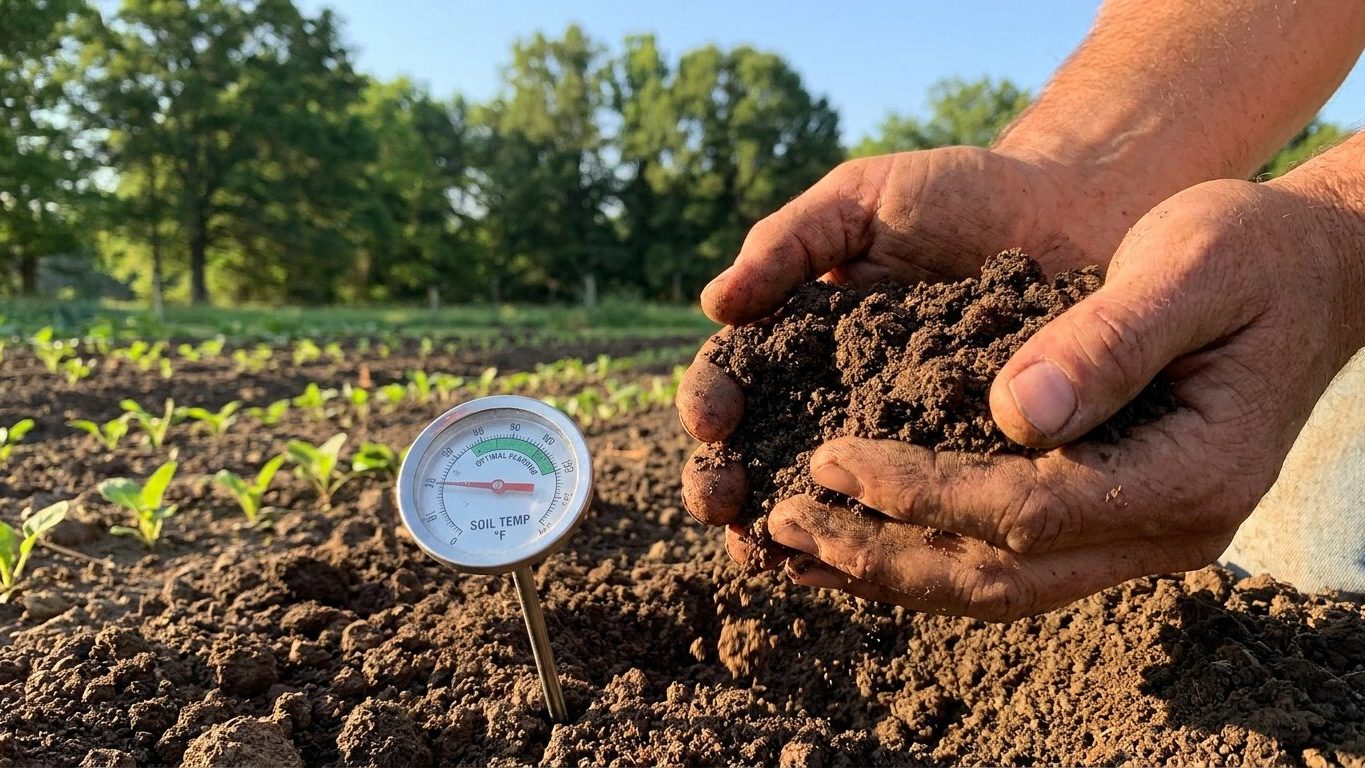
Frost is really a stand-in for something else: soil temperature. Winter squash seed germinates slowly and unevenly in cold ground, and the roots that follow do a poor job establishing in it too. Air temperature clears the freeze risk by early March in most years around Jacksonville, but soil doesn’t warm to squash-friendly levels on the same schedule as the air above it, since ground holds both cold and heat longer than air does. Gardeners who wait a week or two past the statistical last-frost date, until the soil itself has caught up, tend to see faster, more even germination than those who plant the day the freeze probability drops.
None of this discussion applies south of roughly the Jacksonville latitude. The state’s USDA hardiness zones span 8b to 11b under the USDA Plant Hardiness Zone Map, built on 1991-2020 average extreme minimum temperatures, and Jacksonville sits toward the cooler end of that span. Move further south into the peninsula and frost becomes rare or nonexistent, which means the entire logic of “wait for the last frost, then plant” stops applying. Central and south Florida gardeners instead plant winter squash through the cooler months, fall into early spring, and treat summer heat and humidity as the barrier to work around rather than the season to garden through.
For anyone in the Jacksonville area or points north, the practical rule is to use the probability window rather than a single fixed date, and to lean toward the later end of it if spring has been running cool. For a gardener further south, the calendar isn’t simply later in the year, it’s a different shape altogether, and matching a planting plan to the wrong half of the state is the single most common timing mistake.
How long the season lasts here
Doing the subtraction with the two frost dates the record actually gives: from the earliest last spring frost (February 16) to the earliest first fall frost (November 26) spans 283 days. From the latest last spring frost (March 7) to the latest first fall frost (December 13) spans 281 days. Either way, north Florida’s frost-free stretch runs just over nine months, since the spring and fall windows each shift by roughly the same three weeks and largely cancel each other out.
A window that long makes a second sowing realistic. Winter squash isn’t a fast crop, but with nine-plus months of frost-free ground, a north Florida gardener can put in an early spring planting, let it mature and cure before the thick of midsummer disease pressure, then follow with a second sowing timed to finish well before the first fall frost risk arrives in late November. Staggering plantings this way also spreads the harvest out and hedges against one planting failing to a pest or disease outbreak. Working out exactly when a second sowing needs to go in, counting backward from the first fall frost date, is covered in the succession sowing guide on this site.
A long window also lowers the stakes of choosing between direct-seeding and transplanting. In a territory where the frost-free stretch barely covers one planting, starting seedlings indoors and moving them out with roots already established can buy a couple of critical weeks. With nine-plus months of clear ground in north Florida, direct-seeding is usually just as workable, since there’s enough calendar left to absorb a slower start without threatening the harvest.
None of this math holds once frost stops being the limiting factor. In central and south Florida, where hard freezes are rare, first and last frost dates aren’t the boundaries that matter at all. There, it’s the arrival of sustained summer heat, not the return of frost, that closes the growing window, which changes the entire succession-planting calculation and is worth checking against local extension guidance rather than this frost-based math.
Heat and water in Florida

At the Jacksonville reference station, the year averages 73.2 days at or above 90 degrees Fahrenheit, per NOAA’s 1991-2020 climate normals. That’s a heavy heat load. For winter squash, a crop that needs its fruit to mature fully on the vine before frost (an immature squash neither cures properly nor stores), that many days above 90 degrees speeds early vine growth but also stresses pollination and fruit-set once temperatures sit in the 90s for weeks at a stretch.
What sets Florida apart from most other hot-summer territories is that the heat doesn’t come with dry air. Summer rainfall at the same station averages about 21.2 inches across June, July and August alone, out of 53.4 inches for the full year, with June bringing 7.6 inches, July 6.77, and August 6.88. July, technically the driest of the three summer months, still delivers more rain in a single month than plenty of gardens elsewhere see across an entire summer.
That combination, heavy heat paired with heavy summer rain, is a different problem from the hot, dry pattern that drives irrigation schedules in other territories. Where a hot, dry climate means the fight is keeping soil moisture up so fruit can fill out, north Florida’s fight usually runs the opposite direction. Rain arriving as a single afternoon thunderstorm often doesn’t soak in evenly, especially on sandy soil where water passes through fast, and it leaves foliage wet into the evening because the air doesn’t dry out afterward. That standing humidity, combined with warm nights, is what pushes powdery mildew, downy mildew, and fruit rot through Florida squash patches, not a lack of water.
The practical response looks different from a drought-driven watering plan. Spacing plants for airflow, watering at the soil line instead of overhead, and getting foliage dry before evening all matter more here than adding irrigation. A rain gauge on the actual plot still settles the question better than any regional average, since a slope, a sandy patch, or a spot under tree cover can behave very differently from the reference station’s figures. But the working assumption for north Florida should start with disease pressure from humidity, not drought stress from heat.
Which winter squash suit Florida
Given a season shaped by heavy summer humidity and a real, if manageable, frost window, the type of winter squash matters here more than in a milder, drier climate. Disease resistance to powdery and downy mildew is the first thing worth checking, since the state’s combination of heat and standing humidity pushes those diseases harder than almost anything else in the garden. Types with a more open vine habit, one that dries out faster after rain instead of trapping moisture at the crown, tend to hold up better through a Florida summer than dense, sprawling growth patterns.
Where a planting falls closer to the shorter end of that nine-month window, the earliest-maturing types within a given squash category add margin against a late spring cold snap or an early fall frost cutting things short. That margin matters less in north Florida than it would in a genuinely short-season northern territory, given how long the frost-free stretch runs here, but it still counts for a second, later sowing that needs to finish before the fall frost risk arrives.
This page won’t name specific varieties, and that’s a deliberate choice, not an oversight. Trial results shift from season to season and differ sharply even within Florida, between the Panhandle, the Jacksonville area, and the peninsula further south. A type that resists mildew well in one part of the state can struggle in another, depending on humidity levels, soil, and even which strain of a disease happens to be locally dominant that year. The University of Florida’s county extension network, reachable through the statewide directory at sfyl.ifas.ufl.edu, runs the trials that track this county by county, and that’s the source worth checking before buying seed. Refusing to name a cultivar here isn’t a dodge, it’s the honest answer for a state that spans four USDA hardiness zones and two entirely different growing calendars inside one set of borders.