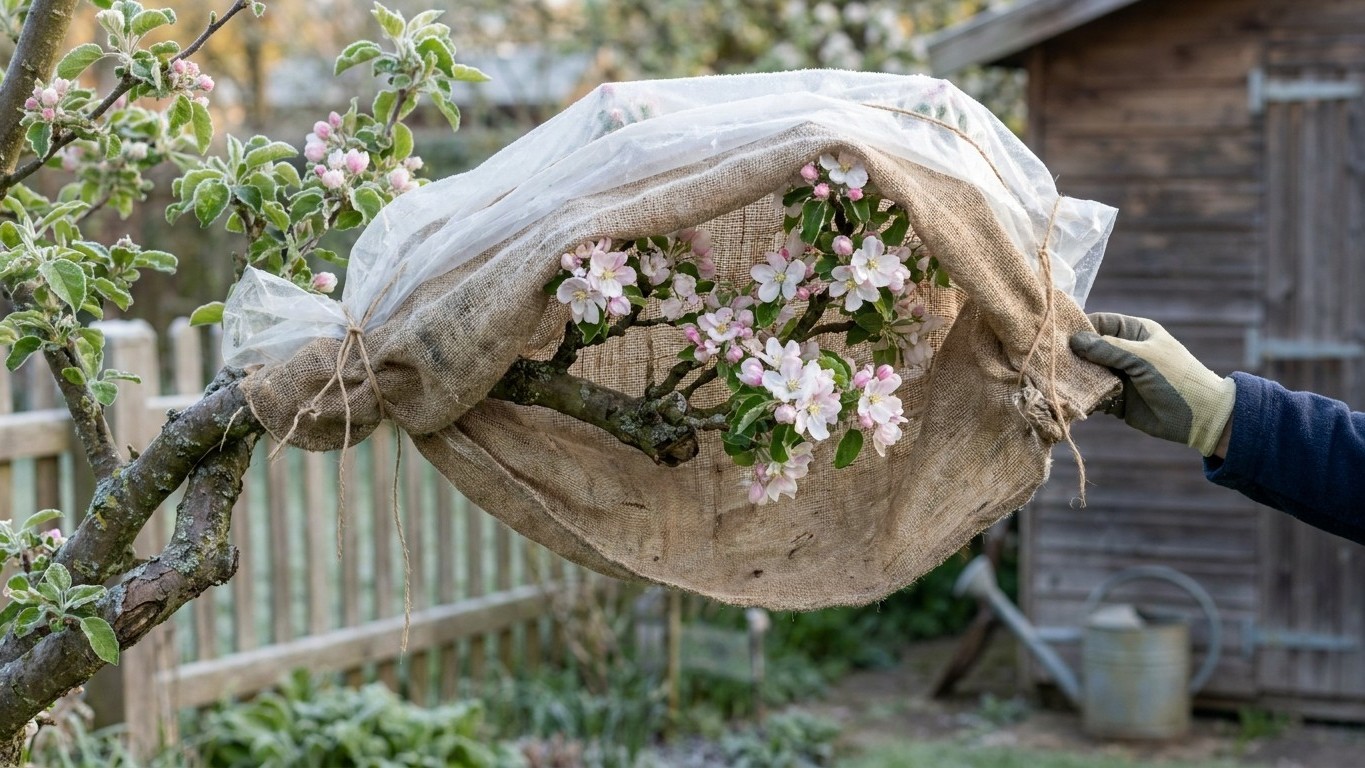

Apple blossom is at its most cold-tender the moment the flower is fully open, far more vulnerable than the tight pink bud before it or the small green fruit that follows at petal fall. No single kill-temperature holds true everywhere, so treat any forecast near freezing as a real threat once bloom starts on your trees. The action that matters most: walk the orchard each morning during bloom and note which flowers are open versus still closed in cluster, since that difference decides whether tonight’s cold does damage or not.
Why it matters
An apple tree blooms once a year. If a late frost kills the open flowers, there is no second flowering to fall back on, and the crop for that season is set or lost inside a few cold hours. That’s different from frost damage to leaves or wood, which a tree usually shrugs off and regrows. A ruined bloom means a ruined harvest, full stop.
What frost actually kills
The stage of bloom matters more than the date on the calendar. A tree can sit at pink bud for a week or more, tolerating cold that would kill the same flowers once they’ve opened. Once petals separate and the flower is fully exposed, the reproductive parts inside are exposed too, and it’s that tissue, the pistil in particular, that frost actually kills. A flower can look fine the morning after a freeze and still fail to set fruit because the pistil browned inside, out of sight.
Protection matters even more on a young tree whose bloom this year is its first real attempt at a harvest. A newly bearing tree that loses that bloom to frost loses a year, not just a season, since it still has to move through dormancy again and rebuild flower buds before its next try. Anyone still working through the earlier stages of getting a tree to that point can find the sequence in Growing Apples.
One more reason this matters: bloom doesn’t open all at once. It spreads over a week or two depending on variety and weather, so a single frost night rarely kills the entire crop outright. Flowers still tight when the cold hit often open undamaged a day or two later, which is why checking stage by stage, rather than writing off the whole bloom after one bad night, is worth the time.
When to do it
Frost protection starts the moment the first flowers reach pink and open bloom, and it stays relevant until petal fall, when the small green fruit forms and gets noticeably tougher. There’s no calendar date to work from here. The stage on the tree in front of you is the only clock that matters, and that stage is set by the weather the tree has already experienced that spring, not by the day on a chart.
A cold snap right after buds swell holds the tree at green tip or pink longer, buying time. A run of warm days pushes bloom open fast, sometimes faster than a grower expects, which is why it pays to check trees daily once buds start to swell rather than assume a week’s grace period.
Bloom groups move the timing between varieties
Not every apple variety on the same property blooms on the same day. Clemson Cooperative Extension’s HGIC 1350 groups varieties into three relative bloom groups: group A, which includes Anna and Dorsett Golden, flowers earliest; group B, covering Fuji, Gala, Ginger Gold, Granny Smith, Jerseymac, Mollie’s Delicious, Mutsu, Red Delicious and Yates, follows; and group C, which includes Arkansas Black, Golden Delicious, Jonagold, Ozark Gold, Priscilla, Rome Beauty and Stayman, blooms last. These groups hold their relative order everywhere, even though the actual date each group opens shifts with the local climate.
In a mixed planting, that means a frost warning during bloom week rarely threatens the whole orchard at once. A group A tree can already be past petal fall and safe while a group C tree nearby is still at open bloom and fully exposed. Knowing which of your trees falls in which group tells you which ones actually need covering on a given night, instead of treating every tree in the yard as equally at risk.
Elevation and site also shift timing within a single property. Low spots and hollows hold cold air and bloom later relative to a slope a few feet higher, and they’re also the first place frost settles on a clear, still night. A tree in a low corner of the yard can need protection for days after the same variety on higher ground has already moved safely into petal fall.
How to do it

Frost protection for apple blossom comes down to trapping heat near the flowers or generating it, and the method that works depends heavily on the size of the tree you’re covering. This is where rootstock decides what’s actually practical, since a tree’s mature height is set by the rootstock it’s grafted onto, not by the variety grafted on top of it.
Covering the canopy
A tree small enough to blanket entirely under a frost cloth, an old sheet, or a floating row cover held clear of the branches is the easiest tree in the orchard to protect on a cold night. Drape the cover before dusk, while the day’s heat is still in the ground and branches, and anchor the edges to the soil so the warmer air underneath doesn’t leak out. Pull the cover off the next morning once temperatures rise back above freezing, since one left on through a sunny day can trap heat and stress the open flowers, and it blocks the pollinators the bloom still needs.
Whether that’s realistic depends on the rootstock. USU Extension’s Apple Production and Variety Recommendations for the Utah Home Garden lists mature heights by rootstock: M.9 tops out at 8 to 12 feet, M.26 and G.11 at 12 to 15 feet, G.30 and M.7 at 18 to 20 feet, M.106 at 25 to 30 feet, MM.111 at 30 to 35 feet, and a seedling rootstock tree at 35 to 40 feet. A full-cover approach only works on the smaller end of that list.
| Rootstock | Mature height (USU) | Full-cover protection |
|---|---|---|
| M.9 | 8-12 ft | Practical with a single sheet or cloth |
| M.26 / G.11 | 12-15 ft | Possible with a simple frame |
| G.30 / M.7 | 18-20 ft | Difficult, cover only the lower limbs |
| M.106 | 25-30 ft | Not practical to cover |
| MM.111 | 30-35 ft | Not practical to cover |
| Seedling | 35-40 ft | Not practical to cover |
Other measures for larger trees
On a tree too tall to blanket, growers fall back on measures that raise the temperature around the whole canopy rather than trapping heat under a cover. Running a sprinkler through the night so the water releases heat as it freezes on the branches is one traditional method, though it has to run continuously until the ice starts melting on its own, since stopping partway can do more harm than the frost itself would have. Wind machines and orchard heaters are commercial-scale tools, generally out of reach for a home planting, but a well-placed fan can sometimes keep cold air from settling in a low spot on a still night.
A simpler step helps regardless of tree size: keep the ground under the canopy bare and moist rather than buried in thick, dry mulch through the bloom window, since bare damp soil holds and releases more heat overnight than an insulated surface does. This is one of the few times a heavy mulch layer works against you, and it’s worth checking Mulching an Apple Tree Without Killing It before deciding how much to pull back ahead of a frost night.
What goes wrong
The most common mistake is covering too early or too late relative to the actual stage of bloom rather than the forecast. A cover thrown on days before a frost, then left in place through warm afternoons, can push flowers to open faster underneath it, landing them at open bloom, the most vulnerable stage, right when the cold arrives instead of catching them safely at pink. Check stage before you check the forecast, since a warm cover on a tree still at pink bud does more harm than good.
Sprinkler protection goes wrong in the reverse direction: stopping the water too soon. If the sprinklers shut off while ice is still forming and refreezing on the branches, the latent heat that was protecting the flowers stops being released, and the temperature at the ice surface can drop faster than it would have with no ice at all. The run has to continue until the ice is visibly melting away under its own weight, not just until sunrise.
Damage that shows up late
Frost damage to a flower doesn’t always show the morning after. A browned, water-soaked pistil inside an otherwise normal-looking flower often isn’t obvious until the petals drop and no small fruit follows where a flower used to be. By that point, at petal fall, there’s nothing left to do for that flower, which is why counting open blooms before a frost night and comparing that count to the young fruit a week or two later is the most reliable way to know how much damage actually happened.
- Petals still attached but no swelling fruit behind them at petal fall
- A blackened or water-soaked center visible if you split a surviving flower open
- Bark that separates from the wood after a sprinkler run was stopped too early
- Uneven fruit set concentrated on the lower or more sheltered branches only
Protecting the bloom from frost only gets you halfway there if the varieties in the yard can’t pollinate each other in the first place. Jonagold, Mutsu, Stayman and Winesap all carry sterile pollen, meaning any one of them can be pollinated by another variety but none of them can pollinate anything else, including each other, according to Clemson HGIC 1350, UGA Circular 740 and USU Extension. A planting that leans on two of those four for cross-pollination sets no fruit no matter how well the frost night went.
A weakened bloom that survives frost but sets fruit poorly also tends to draw more attention from pests looking for stressed tissue, so it’s worth checking surviving flowers and young fruit against the symptoms in Apple Pests: The Mark Each One Leaves rather than assuming every deformed apple later in the season traces back to that one cold night.
What changes where you are
Everything about timing in this article moves with your climate, and none of the specific dates or thresholds do, because the facts available here are stage-based and national, not local. Your last spring freeze date, the length of your typical bloom window, and how often a warm week gets followed by a hard freeze are all set by where you garden, and only your own state extension service can give you the local frost date and chill-hour figures that apply to your county.
Elevation inside a single state changes this as much as latitude does between states. A planting a few hundred feet higher than the valley floor nearby can bloom a week or more later and dodge a frost that hits the lower ground hard, simply because cold air drains downhill and pools in the lowest spots overnight. Anyone choosing where to plant a new tree, or deciding how much protection an established one needs, is better served checking their own site’s frost pattern than relying on a figure pulled from a city an hour away.
The bloom groups from Clemson’s HGIC 1350 keep their order everywhere, group A before B before C, but the actual calendar gap between them stretches or compresses with how fast spring warms up locally. Where spring temperatures climb quickly, all three groups can bloom within a tight window, leaving little room to protect one variety before the next opens. Where spring warms more slowly, the same three groups spread bloom over a longer stretch, giving more time to move covers and sprinklers from one block of trees to the next. Either way, the sequence tells you which trees to check first. The local calendar tells you how much time you actually have, and that piece is worth confirming with your own extension office before bloom starts each year.
Common questions
Can I protect apple blossom with just a tarp instead of frost cloth?
A tarp traps heat the same way a frost cloth does, but a solid plastic tarp touching wet flowers can hold condensation against the petals and cause its own damage once the sun hits it. A breathable cover, an old sheet, or a purpose-made frost cloth held clear of the branches with stakes avoids that problem and is worth the extra step of building a simple frame.
Does frost damage always kill the whole crop on a tree?
No, because bloom opens over a week or two rather than all at once, so flowers still at pink or tight cluster when the cold hits often open safely afterward. A tree can lose part of its bloom to one frost night and still carry a full crop from the flowers that opened later.
Will pruning right before a frost make things worse?
Heavy pruning just before or during bloom removes wood that would otherwise hold some heat and shelter lower flowers in the canopy, so it’s better to hold off on anything beyond light shaping until the frost risk for that bloom window has passed. Routine dormant pruning done earlier in the year, well before green tip, doesn’t carry this risk.
How do I know which of my trees are most at risk on a given night?
Check which bloom group each variety falls into, then walk the orchard to see which trees actually have open flowers rather than tight buds, since that stage is the one that takes the damage. A group A tree like Anna or Dorsett Golden can already be safely past bloom while a group C tree such as Rome Beauty or Stayman nearby is still fully open and needs covering that same night.