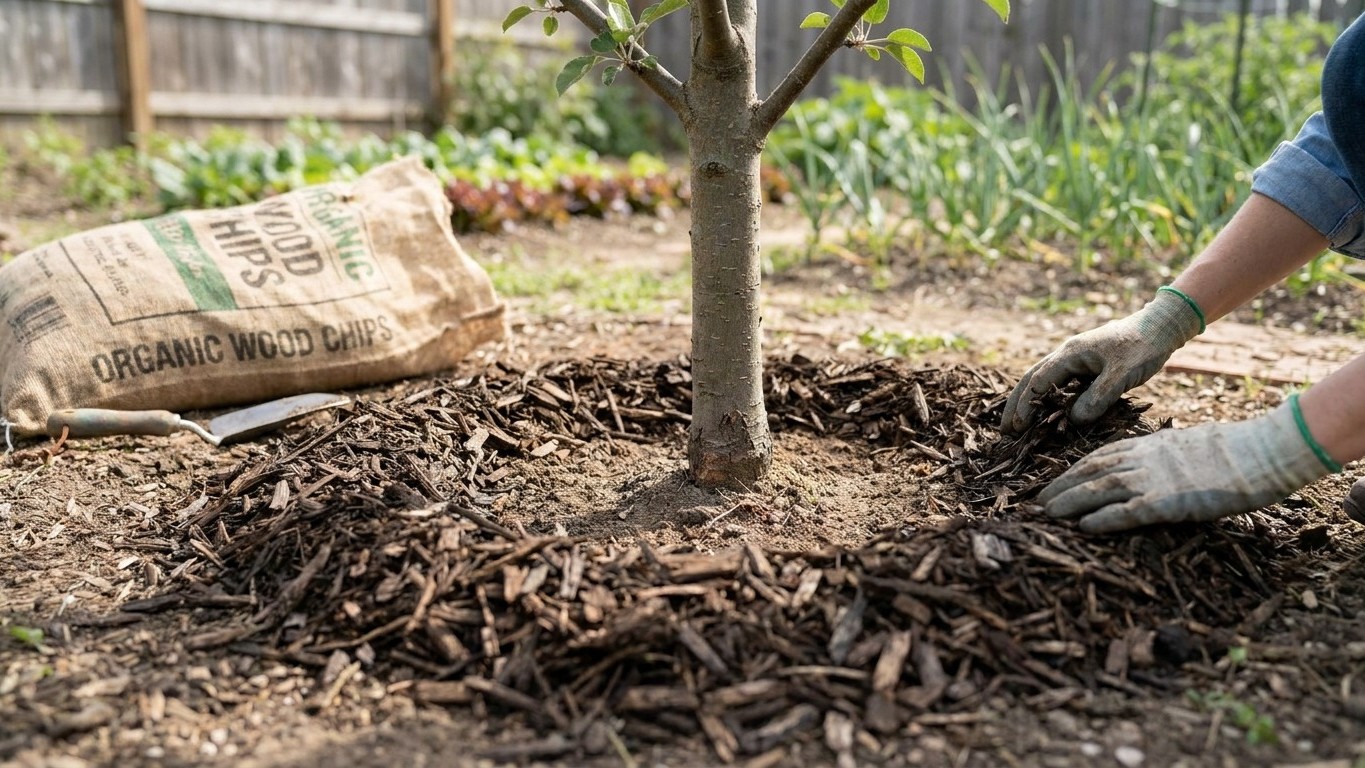

Mulch doesn’t kill an apple tree. Piling it against the trunk does, by keeping bark wet enough to rot and giving voles a hidden tunnel to the graft. Keep the mulch in a flat ring pulled back from the trunk so bark stays dry, widening as it reaches toward the canopy edge, and top it up as it thins rather than piling a new layer over old, matted mulch.
Why it matters
A mulched apple tree holds moisture through dry stretches far better than bare soil does, and it keeps weeds from competing with the feeder roots that sit in the top layer of soil, right where mulch does its work. Roots under a steady blanket of organic matter don’t swing between soaked and baked the way exposed soil does after a hard rain followed by a week of sun, and a root system spared that stress puts more of its energy into growing fruit instead of recovering from it.
Mulch also solves a problem that has nothing to do with the soil underneath it. It keeps the mower deck and the string trimmer away from the trunk. A nick in the bark at ground level heals slowly on an apple tree, and it opens a door for canker and crown rot organisms that a tree with intact bark would otherwise keep out. This is one of the more common ways home orchards lose young trees, and it has nothing to do with pests or weather.
The stage this belongs to is dormancy, both the first time and every time after. Lay the first ring right after planting, while the tree is still leafless and the disturbed soil around the new roots most needs help holding water (see How to Plant an Apple Tree, and How Deep for how deep that root ball should sit before you ever reach for mulch). In the years after, refresh the ring each dormant season, before the buds swell toward green tip, so it is already doing its job of steadying moisture and temperature by the time roots start pulling hard for spring growth.
None of this makes mulch a substitute for good drainage. A tree sitting in soil that holds water at the root ball will rot with or without mulch on top, so treat mulching as the finishing step after the ground itself is right, not a fix for ground that isn’t (see The Soil an Apple Tree Needs, and Drainage Above All).
When to do it
Dormancy is the anchor stage for mulching, same as it is for planting and most structural work on an apple tree. Soil is easiest to work when it isn’t locked up with root activity, and a ring laid down now settles in before the tree needs anything from the ground beneath it. Wait for a stretch when the ground itself is workable, neither frozen solid nor saturated from recent rain. Mulch spread over cold, waterlogged soil traps that moisture in place instead of letting it drain, and a root system sitting in trapped water through winter ends up worse off than one under bare soil.
What moves the timing from one year to the next is weather, not the calendar. A wet fall that keeps the ground soft into what would normally be dormancy pushes the job later. A dry, early thaw that brings the tree to green tip ahead of schedule means the window to lay mulch without disturbing swelling buds and waking roots closes sooner than usual. Watch the tree’s own stage rather than counting weeks from a date on a calendar, since the same rootstock and variety will hit green tip, pink, bloom and petal fall at different points depending on the season and the site.
A newly planted tree is the exception to all of this. Mulch it immediately regardless of what the calendar or the stage says, because bare roots freshly settled into the ground need the moisture buffer right away and can’t wait for the next dormant season to arrive.
Petal fall is a useful second checkpoint. By then the ring laid down in dormancy has had a full stretch of spring rain to compact and thin, and this is a natural point to walk the orchard and see what needs topping up before summer heat sets in.
How to do it

Clear the area first. Pull back grass, weeds and any old matted mulch down to bare soil in a circle centered on the trunk. Mulch laid straight over turf just gives weeds a head start once they push through, and old, compacted mulch left in place turns into a dense mat that sheds water instead of letting it soak in.
Laying the ring
Spread the mulch material out in an even layer, and taper it down to nothing as you get close to the trunk. Leave bare soil showing in a ring around the trunk itself, wide enough that the bark stays dry and visible. This is the single detail that separates mulch that protects a tree from mulch that kills it: the trunk and the root collar at its base should never be buried. If you can’t see bark at ground level once you’ve finished, it’s piled too high or too close.
Widen the ring outward toward the edge of the canopy as the tree grows, rather than building a permanent circle sized for a young tree. Roots spread out roughly in step with the branches above them, and a mature tree’s feeder roots reach well past where the trunk sits, so a ring that stops short of the canopy edge is only mulching part of the root zone.
Depth matters less than most guides suggest, and less than trunk clearance does. A layer that still lets you see soil particles through it when you part it with a finger is doing its job. A layer thick enough to feel like walking on a mattress is doing the opposite: it holds enough water against itself that the soil underneath can go anaerobic, which is its own way of killing roots without the mulch ever touching bark.
Choosing the material
Wood-based mulches, compost and straw all work, and each behaves a little differently once it’s down.
| Material | How it behaves | Watch for |
|---|---|---|
| Wood chips | Breaks down slowly, holds moisture well once it has settled | Fresh, undecomposed chips can tie up nitrogen in the topsoil they touch |
| Shredded bark | Packs looser than chips and sheds heavy rain better | Floats and drifts downhill on sloped ground |
| Compost | Feeds soil biology fastest, breaks down within a season | Needs topping up more often than wood-based material |
| Straw | Cheap, light, and easy to pull back for a trunk check | Mats down and can shed water instead of absorbing it |
Rake back whatever is left of the old layer before adding new material on top. Mulch added over an existing mat just thickens the problem instead of refreshing it, and the tree gets none of the benefit of a clean, breathable layer against the soil.
What goes wrong
Volcano mulching, a cone piled up against the trunk, is the mistake that shows up most often and does the most damage. Bark that stays wet against a mound of mulch through summer softens, and once it’s soft, canker and collar rot organisms move in faster than the tree can wall them off. The damage is often invisible from outside until the leaves on one side of the canopy start wilting the following season, by which point the rot has already girdled part of the trunk underneath.
Signs the ring has gone wrong
- Bark at soil level stays dark and soft well after rain has passed and the rest of the trunk has dried
- Small tunnels or fresh chew marks appear at the base once the mulch is pulled aside
- New growth nearest the trunk wilts even though rainfall has been normal
Rodents are the second common failure, and they use exactly the same mound that rots the bark. Voles and mice tunnel into mulch piled against a trunk and spend the winter gnawing bark at ground level, sheltered from both weather and predators by the mulch itself. A tree girdled this way over one winter can be dead by the following spring, and the damage is usually only found once someone finally pulls the mulch back to look.
Mulch spread too deep smothers roots even without ever touching the trunk. Feeder roots need oxygen as much as they need water, and a thick, wet layer above them can push the soil underneath into the same low-oxygen state that overwatering causes. This hits hardest on the more dwarfing rootstocks, whose root systems tend to run shallower and closer to the surface than a full-size seedling tree’s.
Mulch made from diseased prunings, especially anything pulled off an apple tree with visible canker or fire blight symptoms, can carry those pathogens right back to the base of a healthy tree. Compost pruning waste separately, or send it out with municipal yard waste, rather than chipping it straight back into the mulch ring.
What changes where you are
How wide a mulch ring needs to grow over the life of the tree depends on rootstock, not variety, and rootstock is also what sets the tree’s mature size. USU Extension’s figures for home garden apples put a tree on M.9 rootstock at 8 to 12 feet tall at full size, while the same variety grafted onto MM.111 reaches 30 to 35 feet and seedling rootstock runs 35 to 40 feet.
| Rootstock | Mature height (USU Extension) |
|---|---|
| M.9 | 8-12 feet |
| G.11 | 12-15 feet |
| M.26 | 12-15 feet |
| G.30 | 18-20 feet |
| M.7 | 18-20 feet |
| M.106 | 25-30 feet |
| MM.111 | 30-35 feet |
| Seedling | 35-40 feet |
A ring sized for a tree on M.9 rootstock will be far too small once a seedling-rooted tree of the same variety fills out, so check which rootstock is on the nursery tag before deciding how much room to leave for the ring to expand into over the years. This is one more reason the ring should widen gradually rather than being fixed at planting time.
Climate changes how fast mulch behaves once it’s down more than it changes the technique itself. Regions with heavy winter rain keep mulch wetter for longer, which raises the stakes on keeping it off the trunk. Regions with hard freeze-thaw cycles heave mulch and soil together, sometimes exposing roots that were covered the previous fall. Rodent pressure, rainfall pattern and how many weeks of real dormancy the tree gets all vary by state and even by county, so check with your own state’s extension service for the specifics that apply to your ground, the same starting point covered in Growing Apples.
Common questions
Can I use fresh wood chips right off a tree service truck?
Yes. Fresh chips work fine as mulch, and the nitrogen tie-up people worry about only happens in the thin layer of soil the chips actually sit on, not throughout the root zone. Keep them off the trunk the same as any other mulch, and skip chips from a tree that came down because of disease if you know the reason.
How often do I need to top up the mulch?
There’s no fixed schedule, since it depends on the material and how much rain and foot traffic it takes. Check it each dormant season and again around petal fall, and add more wherever you can see bare soil showing through in patches.
Is it okay to mulch all the way up to the graft line?
No. The graft union needs to stay visible above the mulch and above the soil line itself. Burying it lets the top variety start rooting on its own above the graft, which quietly erases the whole reason the tree was grafted onto that particular rootstock in the first place.
Will mulch attract pests to my apple tree?
It can, mainly voles and mice looking for winter shelter, which is exactly why the ring should never mound up against the trunk. A flat ring pulled back from the bark gives rodents far less cover than a mounded one does, and it’s worth checking with your state extension for which rodents and borers are actually a problem in your area.