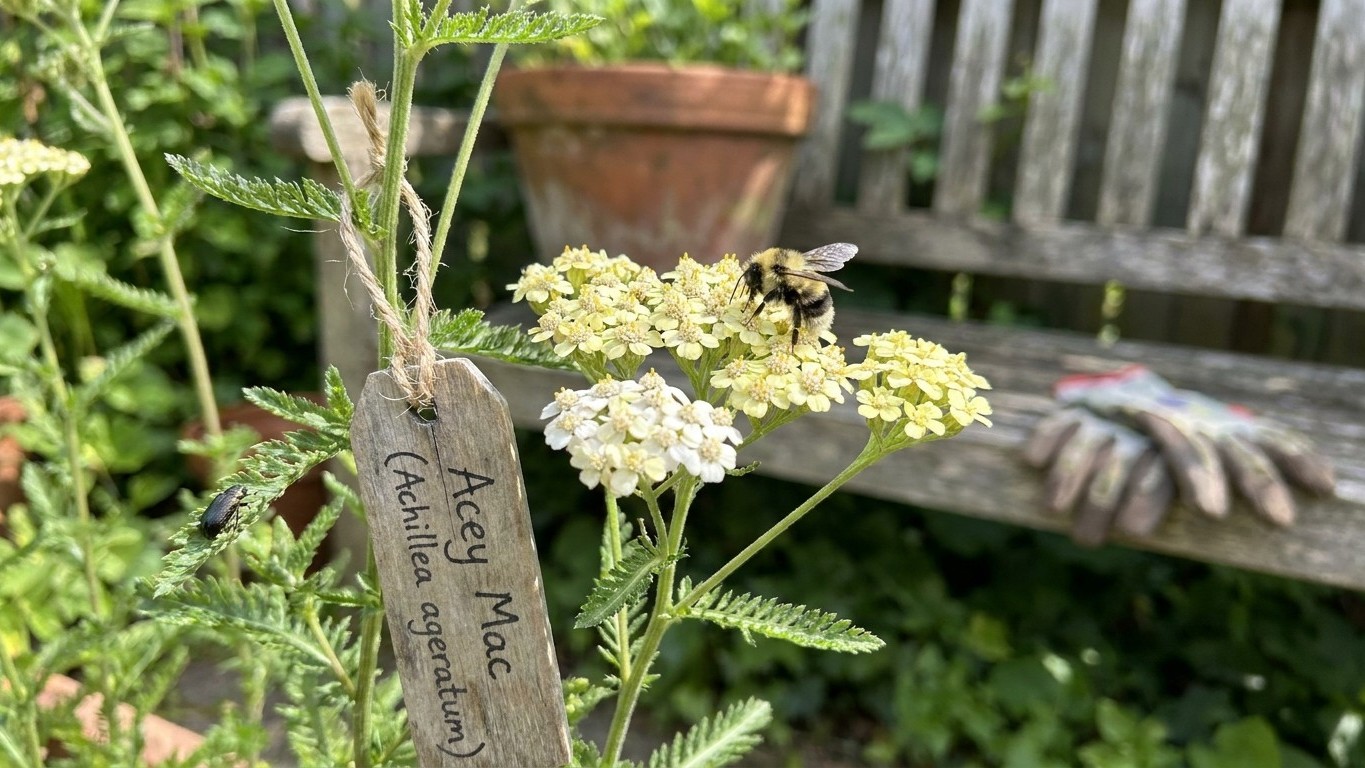

Acey Mac won’t set fruit alone, and no pairing list exists to tell you what will. What’s documented is the bloom window — Early — plus the zone range, 4 through 8, and a harvest that lands late September into mid-October. That bloom slot is the actual clue: any variety confirmed as an early bloomer where you garden is a real candidate, anything mid or late season is not. So the next move is concrete — plant a confirmed early-blooming apple or crabapple, then watch both trees together this spring to see whether the flowers actually overlap.
The short answer
For Acey Mac specifically, USU Extension’s apple production guide does not name a partner variety. Guessing gets a grower a second tree that never overlaps in bloom, which wastes years for nothing. What the guide does establish is the bloom slot: Early. That is the shelf a partner has to sit on. Any variety documented elsewhere as an early bloomer, whether by a local nursery tag or a county extension chart, is a candidate. Anything documented as mid or late season is not, regardless of how good it looks in a catalogue photo.
USU also places Acey Mac in USDA hardiness zones 4 to 8, so the partner variety chosen also has to survive whatever zone the orchard actually sits in, not just bloom at the right moment. Harvest for Acey Mac runs late September to mid-October per USU, useful for confirming you have the right tree if a label goes missing, though it has no bearing on pollination itself.
On tree count: plant at least two trees capable of fertilizing each other. If Acey Mac’s pollen fertility were documented as sterile, the safe number would jump to three, because a sterile variety can receive pollen but never return the favor, leaving its partner unfertilized.
Why these varieties and not others

Pollination compatibility comes down to timing, not taste or color. Two apple trees have to be shedding pollen and receptive at the stigma in the same window, and that window usually runs a week to ten days depending on the season. Nurseries and extension services sort varieties into bloom groups so that overlap can be predicted without a fresh calendar for every county in the country. The overlap logic behind bloom groups is the same one that underlies all apple pollination, whichever variety happens to be in the ground.
What a bloom group actually promises
Clemson Cooperative Extension describes bloom groups as a relative order rather than a set of calendar dates. An Early group tree in one region might open its flowers in March, and in another region not until a month later, but it still opens before a Midseason variety and after nothing else in the ranking. The order holds even though the actual dates slide with the local frost calendar and that year’s spring weather. That is why a national bloom-group chart still works for a grower who has never seen a frost-date table for their own county: it tells you which varieties move together, not which day to circle on the calendar.
USU places Acey Mac’s bloom in the Early group. Any variety carrying that same relative ranking is a candidate for overlap, wherever the grower lives. But bloom-group membership answers only one question, and it is not the whole compatibility question. It says nothing about whether the partner’s pollen is fertile enough to set fruit, and it says nothing about parentage. Two apples can share a bloom slot and still be parent and seedling, and a variety’s pollen generally cannot fertilize the tree it was bred from. Overlap is necessary. It is not sufficient. A grower who matches two Early-group trees purely off a chart, without separately checking pollen fertility and parentage, can still end up with a garden that flowers beautifully together and sets almost no fruit.
What cannot pollinate it
For Acey Mac, no specific list of varieties that cannot pollinate it, whether by sterile pollen or by parentage, is available. That gap matters enough to say outright rather than paper over with a guess. A named exclusion is either documented or it is not, and inventing one to fill space would send a reader shopping for the wrong tree.
What can be said with confidence is how these exclusions work in general, since the mechanism applies to every apple variety, not only this one. Sterile pollen runs one direction only. A tree with sterile pollen can be fertilized by a neighbor and produce a full crop doing so, but its own pollen cannot fertilize anything else. Two sterile varieties planted together, with nothing else nearby, will bloom together every year and set no fruit between them, because neither side is contributing usable pollen.
The other common exclusion is parentage. A variety bred from another usually cannot be fertilized by that same parent, even when the two share a bloom window and grow beautifully side by side. The genetics that made the seedling distinct in the first place also make its own parent’s pollen a poor or failed match. This shows up often enough in named apple families that catalogues sometimes flag it directly, but for Acey Mac no such parentage note appears in the USU guide used here.
If the tree already in the ground happens to be Akane or Jonathon, don’t assume Acey Mac slots in automatically just because both fall in the Early group. Check what pollinates Akane and what pollinates Jonathon before adding a third variety to a small garden, since each carries its own separate compatibility notes and neither is confirmed here as a match for Acey Mac.
The honest position for a grower shopping for a partner is this: pick any candidate documented as Early-blooming with fertile pollen, plant it, and watch the first two or three bloom seasons before assuming the pairing works. If fruit set stays poor despite full bloom overlap and visible bee activity, sterile pollen or a parentage conflict, neither published here, is the likeliest explanation, and a third variety is the fix rather than moving the same two trees closer together.
How close the second tree has to be

Apple pollen moves on the bodies of bees and other flying insects, not on the wind, so distance matters the way it matters to a bee: however far it is willing to fly between flowers on a cool morning. The general rule for a home garden is the closer the better, ideally the same yard rather than the same street, since foraging range varies widely and a bee working a hedge next door is easy to lose to something closer and more convenient.
A dedicated second tree is not the only source of pollen. A neighbor’s apple across a fence line counts, provided its bloom overlaps. An ornamental crabapple in flower at the same time works just as well and takes far less space than a second full-size apple, since crabapples bloom heavily and carry fertile pollen even though nobody eats the fruit. A single grafted branch of a compatible variety, added onto an existing tree, does the job too, without committing an entire extra planting spot.
None of that matters if the bees are not flying. Cold, wind, or wet weather during the bloom window keeps pollinators grounded, and no amount of tree proximity fixes that. A perfectly matched pair of Early-blooming varieties standing ten feet apart will still set little fruit in a spring where the whole bloom period runs cold and rainy, because the pollen never gets carried across. This happens to be the same weather pattern, and the same bee traffic, that spreads fire blight bacteria between blossoms. USU rates Acey Mac as moderately susceptible to fire blight, which means the bloom window carries a double stake: good bee weather sets the crop, and the same warm, wet conditions that favor bee activity can also favor blight spread if bacteria are already present nearby. Watching bloom weather is worth doing for both reasons, not for pollination alone.
If there is no room for a second tree
A small garden does not have to skip pollination just because there is no room for a second full-size tree. Four options fit into tight spaces, each trading effort for square footage in a different way.
| Option | Space needed | Effort | What it does not solve |
|---|---|---|---|
| Multi-grafted tree | Same footprint as one tree | Buy pre-grafted, or graft yourself | Rootstock still sets eventual size, not the scions, and each variety still needs its own known bloom timing |
| Pollinator branch grafted onto existing tree | None additional | Grafting skill, or a paid graft | Takes a season or two to bloom, so no pollination benefit right away |
| Columnar variety | Minimal, narrow habit | Low, just plant it | Narrow habit doesn’t guarantee compatible bloom timing |
| Flowering crabapple | Modest, many stay compact | Low | Produces no edible fruit worth eating, its only job is pollen |
None of these four choices replaces checking bloom timing first. A multi-grafted tree saves the most space but still needs each scion’s bloom window confirmed against the others on the same trunk, since grafting two varieties together does nothing to force their flowers open at the same time if they were never a match to begin with.
Common questions
Can I use a wild crabapple growing in the hedge instead of buying a named variety?
Yes, if its bloom overlaps with Acey Mac’s. Watch both trees over one spring before relying on it, since wild crabapples vary a lot in exactly when they flower.
Will a single Acey Mac tree ever produce any apples on its own?
Nearly all apple varieties crop better with a compatible partner nearby, and a lone tree can occasionally set a light, unreliable crop from stray pollen carried a long distance by bees. Don’t plan around it.
Does soil pH or fertilizer affect whether Acey Mac gets pollinated?
No. Pollination is about bloom timing and bee activity, not soil chemistry. Soil and feeding affect tree health and fruit size, but they don’t make an unmatched pair of trees bloom together.
How do I know when Acey Mac is actually blooming in my yard, since Early is a relative term?
Check the tree directly each spring rather than going by a calendar date. Bloom groups shift earlier or later with the local climate and that year’s weather, so the only reliable check is watching the flowers open.
Can the second tree just live in a large pot instead of going in the ground?
Yes. A potted apple or crabapple blooms and produces pollen the same as one planted in soil, and moving the pot into a warmer or colder spot can nudge its bloom to line up with a tree that’s slightly out of sync.