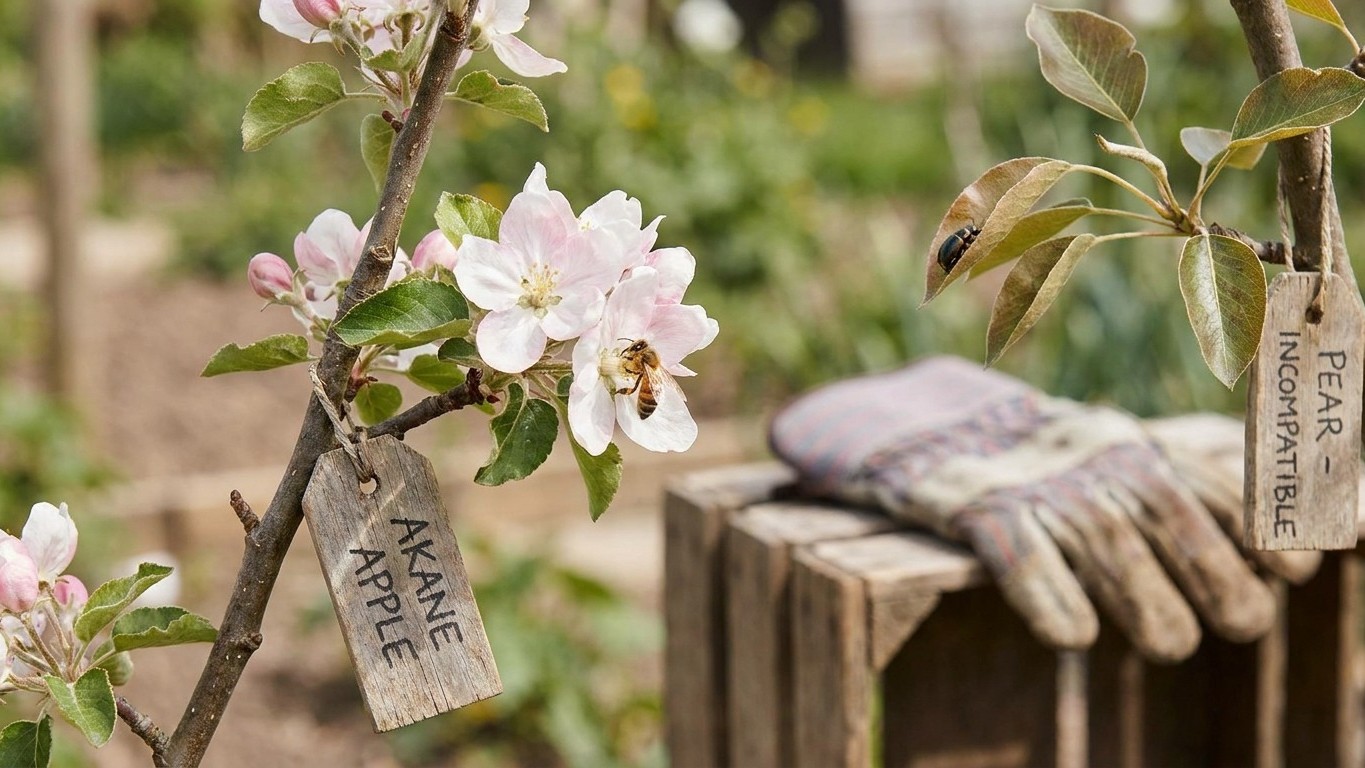

In your own yard, what actually pollinates Akane is any apple that blooms at the same time and can hand over pollen that works, not just something the tag calls a “pollinator.” The straight answer: nobody has published a named match for Akane, so you’re matching bloom timing yourself rather than copying a list. Before you buy anything, walk out and check when your candidate tree actually flowers against Akane’s own early-to-mid bloom, because a cold snap can shift that window by two weeks and wreck a pairing that looked fine on paper.
The short answer
USU Extension’s guide to Utah home orchards, the only source we have for Akane’s numbers, does not name compatible pollinator varieties for this apple. That gap is worth stating plainly rather than filling with a guess, because a partner list that sounds authoritative but isn’t published is worse than no list at all. What USU does confirm is Akane’s bloom season, early to mid, and its hardiness range, zones 4 through 8. Any variety that flowers in that same early-to-mid window, checked against your own climate rather than someone else’s, is a reasonable starting point for a partner.
Nearly all apple varieties crop better with a compatible partner nearby, and Akane is no exception even though its own pollen fertility isn’t documented in the source we’re using. That matters for the two-tree-or-three-tree question. If a partner variety carries fertile pollen, two trees, Akane and the partner, can pollinate each other and both set fruit. If the partner you pick turns out to have sterile pollen, meaning it accepts pollen from others but produces none of its own, you need a third tree to pollinate that partner, since Akane can’t feed it back on its own. Because Akane’s pollen status isn’t published here, treat any variety you’re considering as something to verify with the nursery before you rely on it as your only second tree. For the mechanics that apply to every apple regardless of variety, Apple Pollination covers bloom windows, self-fruitful exceptions and how bees actually do the work.
Why these varieties and not others

Pollination compatibility comes down to timing, not taste or color. Two apple trees have to be shedding pollen and receptive to it at the same moment, and that overlap is what nursery catalogs mean when they sort varieties into early, mid and late bloom groups. Clemson Cooperative Extension describes bloom groups as a relative order rather than fixed calendar dates: an early-blooming variety opens before a mid-season one in any given place, but the actual date shifts with a cold spring in one region versus an early one somewhere warmer. USU places Akane in the early-to-mid window, which tells you where it sits relative to other apples, not the day it will actually flower in your yard.
What bloom-group overlap does not guarantee
Matching bloom groups gets two trees flowering at the same time. It doesn’t tell you whether the pollen that changes hands actually works. A variety can flower right alongside Akane and still carry sterile pollen, meaning it accepts pollination but can’t provide any in return. Overlap also says nothing about parentage. Two varieties that share a bloom window can still be parent and seedling of each other, and a parent’s pollen doesn’t fertilize its own offspring even when the flowers open on the same afternoon. None of that is specific to Akane. It’s why a tag that just says “blooms early” isn’t the same as a confirmed pairing, and it’s why growers weighing options for other apples run into the same two questions: does the timing actually overlap, and is the pollen fertile. Anyone comparing what pollinates Arkansas Black alongside Akane for the same garden should check each variety separately rather than assuming one list covers both trees.
What cannot pollinate it
This is the part worth reading before you buy a second tree, and it’s also where guessing does the most damage. USU Extension’s guide does not name a variety with sterile pollen in Akane’s bloom group, and it does not list a parent-child exclusion for Akane either. Rather than fill that gap with a plausible-sounding name, the honest answer is that compatibility beyond the bloom-window rule is not published for this variety in the source we’re working from.
That doesn’t mean no exclusions exist, only that nobody has documented them for Akane specifically in USU’s home-orchard guide. Two general exclusions apply to every apple variety and are worth checking before you plant a partner on faith. A handful of varieties are triploid, carrying an extra set of chromosomes and producing pollen that can’t fertilize anything, including Akane, even though the triploid tree itself can be pollinated normally by a diploid neighbor. Nurseries usually flag triploid varieties in the catalog description, so that’s a quick check before you commit a planting spot to one. Separately, a variety bred directly from another cannot fertilize its own parent regardless of how closely their bloom dates line up, so if a catalog lists a variety’s parentage, cross-check it against anything else already in your yard.
One practical trap is worth flagging directly. Akane is also sold under the name Tokyo Rose (USU). A grower who plants an Akane and what they think is a second variety called Tokyo Rose has actually planted the same tree twice, and one Akane cannot pollinate another Akane no matter how many blossoms open at once. Check the tag against the variety, not just the label name, before you count a second tree as a genuine partner.
How close the second tree has to be

Apple pollen doesn’t travel on the wind. It moves on bees and other insects, which turns the distance question into a practical one: how likely is a bee to visit both trees on the same trip. Closer is always better. A partner in the same garden, ideally within sight of Akane’s own canopy, gets far more reliable visits than one three properties over, even if both fall technically within a bee’s foraging range.
The partner doesn’t have to be a tree you planted on purpose. A neighbor’s apple tree blooming at the same time counts, as long as bees are actually working both. An ornamental crabapple flowering in that same early-to-mid window does the job too, and crabapples are often planted purely for looks, so a grower might already have one doing pollination work without realizing it. A grafted branch of a compatible variety onto Akane’s own trunk works as well, since it puts a second bloom source inside the same tree rather than across the yard.
None of that helps if the weather doesn’t cooperate. Cold or wet conditions during bloom keep bees from flying, and no amount of proximity or partner choice fixes that. A well-matched partner planted right next to Akane still sets no fruit if a cold, rainy stretch during that early-to-mid bloom window keeps pollinators grounded. That’s weather risk, not a planning failure, and it’s one reason a single bad spring doesn’t necessarily mean the partner variety was wrong.
If there is no room for a second tree
A small garden doesn’t rule out fruit, but it narrows the options, and each one trades convenience for effort.
- A multi-grafted tree carries two or more varieties on one trunk, giving bloom overlap without a second planting hole. It doesn’t solve the fertility question on its own. If the grafted varieties happen to include a triploid or a parent-child pair, the tree still can’t pollinate itself properly.
- A pollinator branch grafted onto an existing Akane, using scion wood from a compatible variety, adds a second bloom source to a tree you already own. It takes a season or two of growth before that branch flowers reliably, so it’s not an instant fix.
- A columnar apple variety takes up very little ground space and can serve as a compact second tree along a fence or border. Rootstock, not the columnar habit, still governs how tall it eventually grows, so check the rootstock before assuming it stays small.
- An ornamental crabapple planted nearby flowers reliably and needs less room than a full second apple tree, and many are chosen partly for bloom timing. It won’t add to the harvest basket, but it will do the pollination work if its bloom lines up with Akane’s early-to-mid window.
None of these fixes is free. A multi-graft tree needs careful pruning to keep each variety in balance rather than letting one take over. A grafted-in branch needs a grower comfortable with basic grafting technique. A crabapple solves pollination but adds nothing to what you actually pick. Choose the option that matches how much orchard work you want to take on, not the one that sounds easiest on paper. Growers weighing the same small-garden tradeoffs for what pollinates Lodi face an identical set of choices, since space constraints don’t change from one variety to the next.
Common questions
Can two Akane trees pollinate each other?
No. Planting two trees of the same variety, even if one is labeled Tokyo Rose, still leaves you with one genetic variety, and most apples don’t set a reliable crop from their own pollen. You need a genuinely different variety flowering at the same time.
Is Tokyo Rose a different pollinator option for Akane?
No. USU Extension lists Tokyo Rose as the same variety sold under a different name, not a separate cultivar. Buying both under their different names doesn’t give you a second pollen source.
How do I know if a variety I’m buying has sterile pollen?
Check the catalog description for a triploid designation, since triploid varieties are the common source of sterile pollen and nurseries usually flag it. If it isn’t mentioned, ask the nursery directly before you count on that tree as your only partner.
My Akane set some fruit even though I didn’t plant a second tree, how?
A neighbor’s apple tree or a nearby ornamental crabapple blooming at the same time can pollinate Akane without you planting anything on purpose. Bees don’t respect property lines, so pollen can arrive from further away than you’d expect if the timing lines up.
Where do I find Akane’s actual bloom date for my area?
USU Extension only gives a relative window, early to mid season, not a calendar date, and that date shifts with local climate. Your county extension office or a few seasons of watching the tree yourself will tell you more precisely than any general guide can.