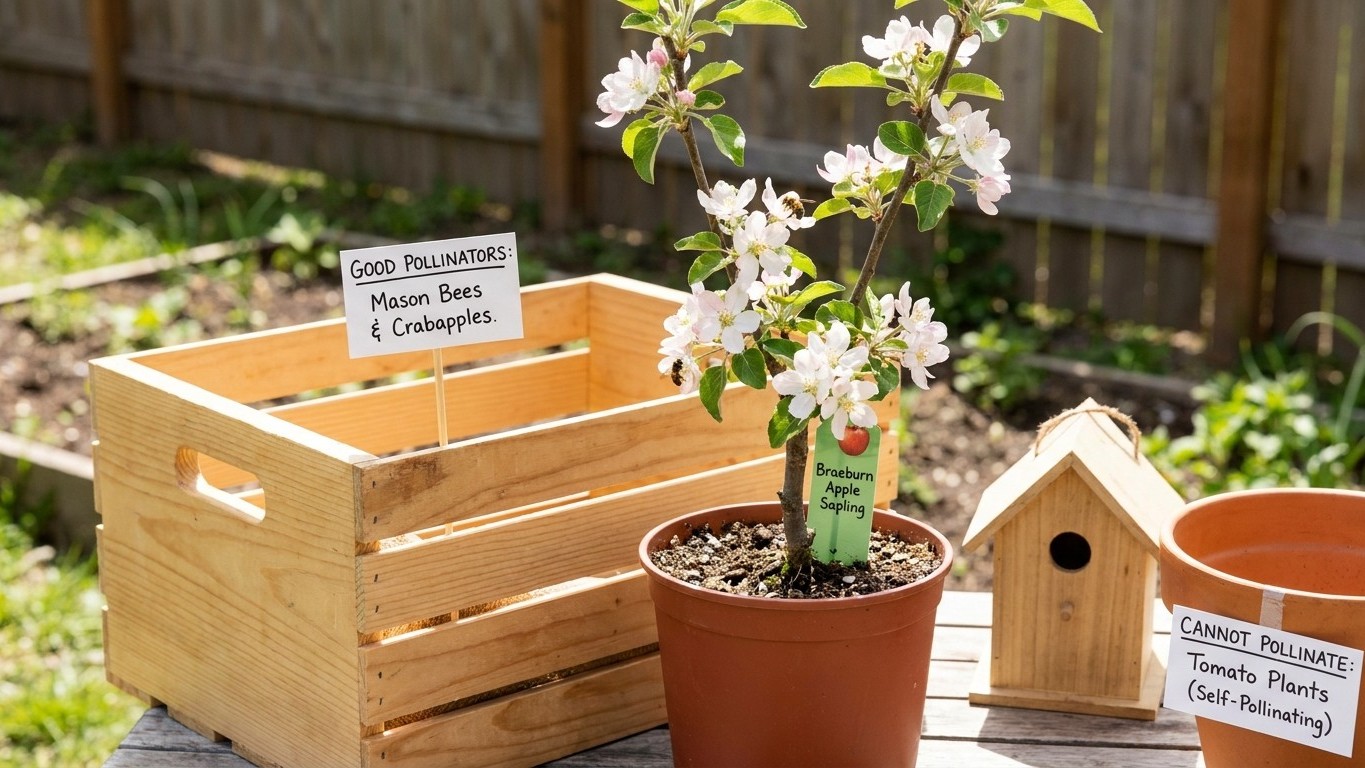

Standing over a Braeburn that never fills out, the question is simple: what do I need to plant next to it? Another apple tree, one that flowers in that same early stretch of the season — that’s the whole answer. Braeburn won’t set a full crop alone, and it won’t set one next to just any tree either; the bloom timing has to line up almost day for day, or the bees have nothing to carry between them. So before you buy anything, check the bloom season label on the tag and make sure it reads Early, same as your Braeburn.
The short answer
USU Extension’s guide to apple production for Utah does not name specific pollen partners for Braeburn. That gap is worth stating plainly rather than guessing a variety that sounds right, because a wrong guess means a tree that blooms weeks apart from Braeburn and never overlaps with it at all.
What the same source does confirm is Braeburn’s bloom season: Early. That rating is the filter to use when picking a partner. Any apple variety catalogued as an early bloomer in your climate is a candidate. A late-blooming variety, or one two full groups removed from Early, finishes flowering before Braeburn opens, or starts after Braeburn has already dropped its petals, and bees will not carry pollen between trees that are not in flower on the same days.
How many trees to plant
How many trees that takes depends on pollen fertility, and USU’s Utah guide does not state whether Braeburn’s own pollen is fertile or sterile. The rule used across pomology: two trees are enough if both partners produce fertile pollen, because each tree can pollinate the other. If one of the two carries sterile pollen, a third tree is needed, because a sterile variety can receive pollen and set fruit but cannot return the favor to its neighbor. Extension variety tables such as those from USU Extension and Clemson Cooperative Extension HGIC 1350 list only four pollen-sterile apple varieties—Jonagold, Mutsu, Stayman, and Winesap—and Braeburn is not among them, so a third tree is only necessary if the partner variety you choose happens to be one of these sterile types. Planting three early-blooming varieties instead of two removes the guesswork entirely, at the cost of one more tree’s worth of space.
Why these varieties and not others

Bloom timing is the whole mechanism. Two apple varieties can only pollinate each other if their flowers are open on the same days, because pollen moves tree to tree on the backs of bees, not through the air. Clemson Cooperative Extension groups apple varieties into bloom groups that rank flowering order relative to each other, from earliest to latest in a season. Braeburn sits in USU’s Early bloom category.
That ranking is relative, not fixed to a date. The order holds from one climate to the next even though the actual calendar dates it lands on shift with the growing region. A tree rated Early stays ahead of a Mid or Late variety whether it is growing at the cold end of USU Extension’s stated hardiness range of zones 5 to 8 or the mild end, even though the exact week differs between those two gardens. This is why bloom group, not a specific date, is the figure worth matching when shopping for a partner.
What bloom group overlap does not promise
Matching bloom groups gets two trees flowering in the same stretch of days. It promises nothing else. A variety in the same bloom group as Braeburn can still carry sterile pollen, meaning it accepts pollen and sets fruit but produces none capable of fertilizing another tree in return. Overlap also says nothing about parentage. If one candidate variety was bred directly from the other, meaning it is literally the seedling offspring of that variety, the two are frequently incompatible regardless of how well their bloom windows line up, because a tree’s genetics reject pollen too close to its own line. Neither exclusion shows up on a bloom chart. Both require checking the variety’s specific breeding and fertility notes separately from its bloom timing. For a related case where this same two-part check matters, see how Cameo’s pollination requirements play out with its own bloom group and parentage.
What cannot pollinate it
This is the question a bloom chart alone cannot answer, and it is exactly where USU’s Utah guide runs out of published detail for Braeburn. Compatibility exclusions beyond bloom timing are not documented for Braeburn.
That does not mean exclusions don’t exist. Two general mechanisms rule out an otherwise well-timed partner in apples, and both are worth checking before you buy.
- Sterile pollen: some varieties, often bred as triploids, produce pollen that cannot fertilize any other tree even though the tree itself accepts pollen and fruits normally. Two such varieties planted together, with nothing else, set no fruit at all.
- Parentage: a variety bred directly from another is its seedling offspring, and a seedling frequently cannot be fertilized by its own parent even when the two flower at the same time.
Checking for both takes two separate lookups, since neither shows up on a bloom chart. A nursery tag or catalogue description usually flags a triploid or sterile-pollen variety directly, though sometimes only in the fine print rather than the headline description. Parentage is listed in a variety’s breeding history, which most extension variety guides publish alongside disease ratings and hardiness. Until Braeburn’s fertility status and any parentage links are documented by a source like USU, the safest approach for a small planting is the one already mentioned: add two other early-blooming varieties rather than relying on a single, unverified pair. A grower comparing Braeburn against a variety with its own documented exclusions, such as what pollinates Northern Spy, will notice how much a named exclusion narrows the decision compared with Braeburn’s open question mark.
How close the second tree has to be

Pollen for apples moves on bees, not on wind, so distance is a practical question, not a chemistry one. The closer the second tree sits to Braeburn, the more of the bee traffic that visits one will also visit the other during the same foraging trip. Same garden beats same street, and same street beats a partner three properties away that the local bee population may never cross.
A dedicated second apple tree is not the only thing that works. A neighbor’s tree blooming in the same early window counts, provided bees regularly move between the two yards. An ornamental crabapple flowering at the same time as Braeburn can do the same job, since crabapples are apples for pollination purposes and many varieties bloom early. A single grafted branch of a compatible variety, added to an existing tree, also puts a pollen source close enough that no separate tree is needed at all. For the wider mechanics of how bees, bloom timing and tree spacing interact across apple varieties in general, apple pollination covers the parts that apply no matter which variety is planted.
What no partner can fix
None of this works if bees are not flying. Cold or wet weather during the bloom window keeps bees in the hive, and a well-matched partner tree sitting fifteen feet away does nothing if no bee visits either tree that week. This is a timing risk that no amount of variety planning solves, because it is weather on the days that matter, not the trees themselves. A gardener who has already matched bloom groups and still gets a poor set most years should look at bloom-week weather before adding a third variety.
If there is no room for a second tree
A small garden does not have to skip pollination altogether. Four options exist for a single-tree space, and each solves the space problem differently while leaving a different amount of work behind.
| Option | What it does | What it does not solve |
|---|---|---|
| Multi-grafted tree | Carries two or more varieties, including a partner, on one trunk | Each grafted variety still needs its own pruning attention so one does not shade out another |
| Pollinator branch graft | Adds a compatible variety’s wood directly onto the existing Braeburn tree | Needs grafting skill and clean cuts, since an infected tool can carry disease into the wound |
| Columnar variety | Gives a second variety in a narrow footprint, sometimes under two feet wide | Still counts as a full second tree for spacing purposes between it and Braeburn |
| Flowering crabapple | Blooms at the same time as many early apple varieties, in a spot already used for looks | Only works if its bloom window is confirmed to overlap with Braeburn’s, not assumed |
The fire blight tradeoff
The graft options carry the most risk where fire blight is already present nearby, since any cut into live wood is an entry point for the bacteria, and Braeburn is rated by USU Extension as Moderately Susceptible to fire blight, not one of the more resistant varieties to be making extra wounds in. Wiping pruning tools with rubbing alcohol or a dilute bleach solution between cuts is the standard precaution, not an optional one, when grafting onto or near a moderately susceptible variety.
None of these four options changes the earlier requirement: whatever variety ends up sharing space with Braeburn, whether by graft, by pot, or by an extra tree, it still has to flower in the same Early bloom window USU Extension records for Braeburn. Space-saving tricks solve the space problem. They do not solve the timing problem, and skipping that check is the most common reason a small-garden pollination plan fails even when the tree itself grows fine.
Common questions
Can I use a crabapple already growing in my yard instead of buying a second apple tree?
Yes, if its bloom window overlaps with Braeburn’s early flowering, since crabapples pollinate apples the same way another apple variety would. Confirm the specific crabapple’s bloom timing with the nursery or grower tag rather than assuming, because ornamental crabapples cover a wide range of bloom seasons.
Does Braeburn need a pollinator partner every year, or just while it’s young?
Every year it flowers, not only during establishment. Pollination happens fresh each spring, so a partner tree that dies, gets removed, or falls out of bloom sync due to hard pruning leaves Braeburn short a pollinator the very next season.
What if I only have room for one Braeburn and nothing else?
Look over the fence before assuming you are stuck. A neighbor’s early-blooming apple tree or ornamental crabapple within bee range can carry the pollination load, since bees routinely cross yard lines that gardeners treat as boundaries.
How do I find out if a variety I’m considering has sterile pollen?
Ask the nursery selling it, or check with your county extension office, since sterile-pollen varieties are usually flagged in catalogue descriptions or extension variety lists. This detail does not appear on a basic bloom chart, so it takes a separate question beyond bloom timing.
When should I expect my Braeburn to actually ripen?
USU Extension lists Braeburn’s harvest as Late October for the Utah home garden conditions its guide covers. Other regions and reference cities can run earlier or later than that, so treat it as a starting point for your own tree’s first few harvests rather than a fixed date.