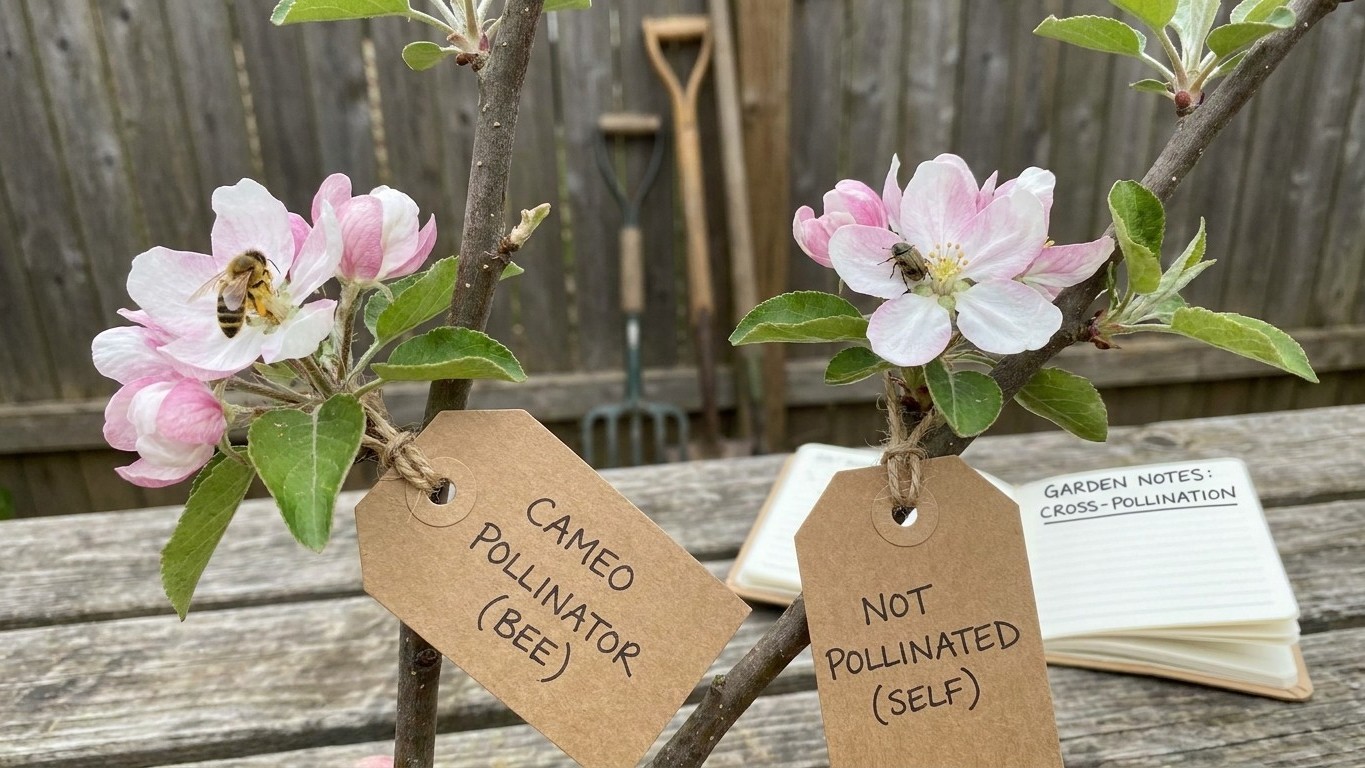

A lone Cameo tree, planted without checking who else is blooming nearby, will flower right on schedule and still leave you with a thin, disappointing crop come October. That’s the costly part nobody warns you about: Cameo has no published roster of approved partners, so growers guess, plant something blooming weeks off the mark, and only discover the mismatch years later when the harvest never fills out. Bloom timing, not a name on a list, is what actually decides whether your Cameo sets fruit.
The short answer
Cameo does not come with a published list of pollination partners in USU Extension’s guide, the source behind every other figure on this page. What USU does publish is the timing: Cameo blooms Mid to Late, is rated for USDA hardiness zones 5-8, and ripens in late October. That timing is the tool you actually have, because a compatible partner is any variety flowering in that same Mid to Late window with fertile pollen, not a specific named cultivar.
You need at minimum two trees for fruit to set reliably: Cameo and one partner that overlaps in bloom. That number climbs to three only if the partner you pick turns out to have sterile pollen, because a sterile variety takes pollen in but cannot hand any back to Cameo. Since our sources do not confirm Cameo’s own pollen fertility either, the safer planting is two known-fertile, overlapping varieties plus Cameo, or a single Cameo paired with one confirmed-fertile partner where you have actually checked the fertility on the nursery tag or catalogue description.
One wrinkle worth knowing before you buy: Cameo is also sold under the name Carousel, per USU. If a nursery tag lists Carousel, that is the same variety, not a second option for a partner tree.
Why these varieties and not others

The reason bloom timing matters more than any specific variety name is mechanical: two apple trees only exchange pollen if their flowers are open on overlapping days, and pollen moves by bee, not by proximity on a nursery shelf, a mechanism covered in more detail in Apple Pollination. Clemson Cooperative Extension describes bloom groups as a relative order, not a calendar of fixed dates. An Early-group variety in one climate can open days apart from a Mid-group variety in another climate. What the ranking captures is the sequence: early bloomers open before mid bloomers, mid before late, in that order almost everywhere apples are grown, even though the actual date on the calendar shifts by climate and by year.
That is why Cameo’s Mid to Late rating from USU is useful even though it is not tied to a date on your calendar. It tells you where in the sequence to look for a partner, whatever the actual week turns out to be where you garden. The same relative-bloom-group logic applies to any two apple varieties you are comparing, including the pairs covered in our pages on What Pollinates Candy Crisp, and What Cannot and What Pollinates Ozark Gold, and What Cannot.
What bloom group overlap does not guarantee
Sharing a bloom group only confirms that two trees’ flowers are open at the same time. It does not guarantee two other things a grower needs to check separately.
- Fertile pollen: some varieties, often ones bred with three sets of chromosomes instead of two, produce pollen that cannot fertilize anything, even while their own flowers accept pollen normally.
- No shared parentage: a variety bred as a seedling of another cannot pollinate that parent, no matter how well their bloom windows line up.
Neither fact shows up on a bloom-group chart. Both have to be checked against the specific varieties involved, which is exactly the gap in Cameo’s case since our sources don’t publish either its pollen fertility or a parentage record.
What cannot pollinate it
Our sources do not name a specific variety with sterile pollen in Cameo’s bloom group, and they do not record a parentage exclusion for Cameo either. That gap is worth stating plainly rather than filling with a guess, because getting this wrong costs a grower a full season of bloom with no fruit to show for it.
What we can say is how these exclusions work in general, so you know what to check before choosing a partner. A triploid variety, one bred with three sets of chromosomes instead of the usual two, produces pollen that is functionally sterile. It can still receive pollen from Cameo and set its own fruit, but it gives nothing back. Two such varieties planted together, with no third pollen source nearby, set no fruit on either tree. If you are choosing a partner from a nursery list, ask specifically whether the pollen is fertile, not just whether the bloom time matches, since nursery tags often print bloom timing prominently and bury or omit fertility entirely.
Parentage exclusion works differently. If a variety was bred as a direct seedling of another, that seedling cannot fertilize its own parent, even with perfectly overlapping bloom. This is not published for Cameo in our sources, so we are not naming a specific parent or offspring to avoid here. What you can do is check the parentage listed in the catalogue description of any candidate partner before you plant it. If Cameo shows up in that lineage, treat the pairing as unreliable and choose a different second tree.
Beyond bloom timing, fertility, and parentage, there is no fourth category of exclusion documented for apples generally. If a candidate partner clears those three checks and flowers Mid to Late alongside Cameo, per USU’s rating, it is a reasonable bet even without a named endorsement.
How close the second tree has to be

Pollen moves on bees, not on wind, so distance matters only in the sense that it changes how many bee trips it takes to move pollen from one tree to the other. The practical answer is the closer the better: two trees in the same garden work more reliably than one tree relying on a neighbor’s tree a few properties away, because every extra fence line and driveway is a chance for a bee to visit something else first.
The partner does not have to be a second Cameo-sized apple tree planted on purpose. A neighbor’s apple tree flowering at the same time counts, and so does an ornamental crabapple in bloom on the same schedule, since crabapples produce pollen bees will carry to a nearby apple tree without complaint. A single grafted branch of a compatible variety, added onto Cameo’s own trunk, does the same job in even less space.
What no amount of proximity fixes
Distance and partner choice both stop mattering if bees are not flying. Cold or wet weather during the bloom window keeps bees in the hive, and no pollinator variety, however close or however fertile, compensates for a week of rain when the flowers are open. That risk is part of why USU’s Mid to Late rating matters in the first place, since bloom timing determines which stretch of local spring weather the flowers have to get through.
If there is no room for a second tree
A small garden still has four real options, each with a real limit attached.
- Multi-grafted tree: several varieties grafted onto one trunk, so bloom overlap happens within a single tree. It solves the space problem but not the fertility one, since each grafted variety still needs its own bloom-group match checked.
- Pollinator branch grafted onto the existing Cameo: a single scion of a compatible variety added to Cameo’s own tree. Cheap in space, but it takes a couple of seasons to grow enough flowers to matter.
- Columnar variety: a narrow, upright tree bred to take up little width, useful where the limit is horizontal space rather than tree count. It still needs its own bloom-group match to be useful as a partner.
- Ornamental crabapple: often smaller and cheaper than a second full apple tree, and effective as a pollen source if its bloom lines up with Cameo’s Mid to Late window. It will not give you a second harvest of eating apples, since crabapple fruit is a different thing entirely.
None of these four removes the need to check fertility and bloom timing individually. They only change where the second tree’s flowers physically sit, not whether they do the job Cameo actually needs done.
Common questions
Can Cameo pollinate itself?
Not reliably. Nearly all apple varieties, Cameo included, crop better with a compatible partner planted nearby rather than standing alone.
Does Carousel count as a second variety for pollination?
No. Carousel is the same tree sold under a different name, per USU, so planting a tree labeled Carousel next to one labeled Cameo does not add a partner. You still need a genuinely different variety.
My Cameo bloomed fine but set almost no fruit. Why?
Check three things in order: whether a partner variety was actually in bloom at the same time, whether the weather during that overlap kept bees from flying, and whether the partner’s pollen is confirmed fertile rather than assumed fertile.
Will a wild apple tree down the road work as a pollinator?
It can, if its bloom overlaps with Cameo’s Mid to Late window and its pollen is fertile, but a wild seedling’s bloom timing and fertility are unknown until you watch it for a season. Treat it as a bonus, not your only plan.
Can I plant two Cameo trees instead of a variety and a partner?
No. Two trees of the same variety bloom at the same time but do not solve the pollination problem, since a variety’s own pollen does not reliably fertilize its own flowers well enough to set a full crop. You still need a genuinely different, overlapping variety.