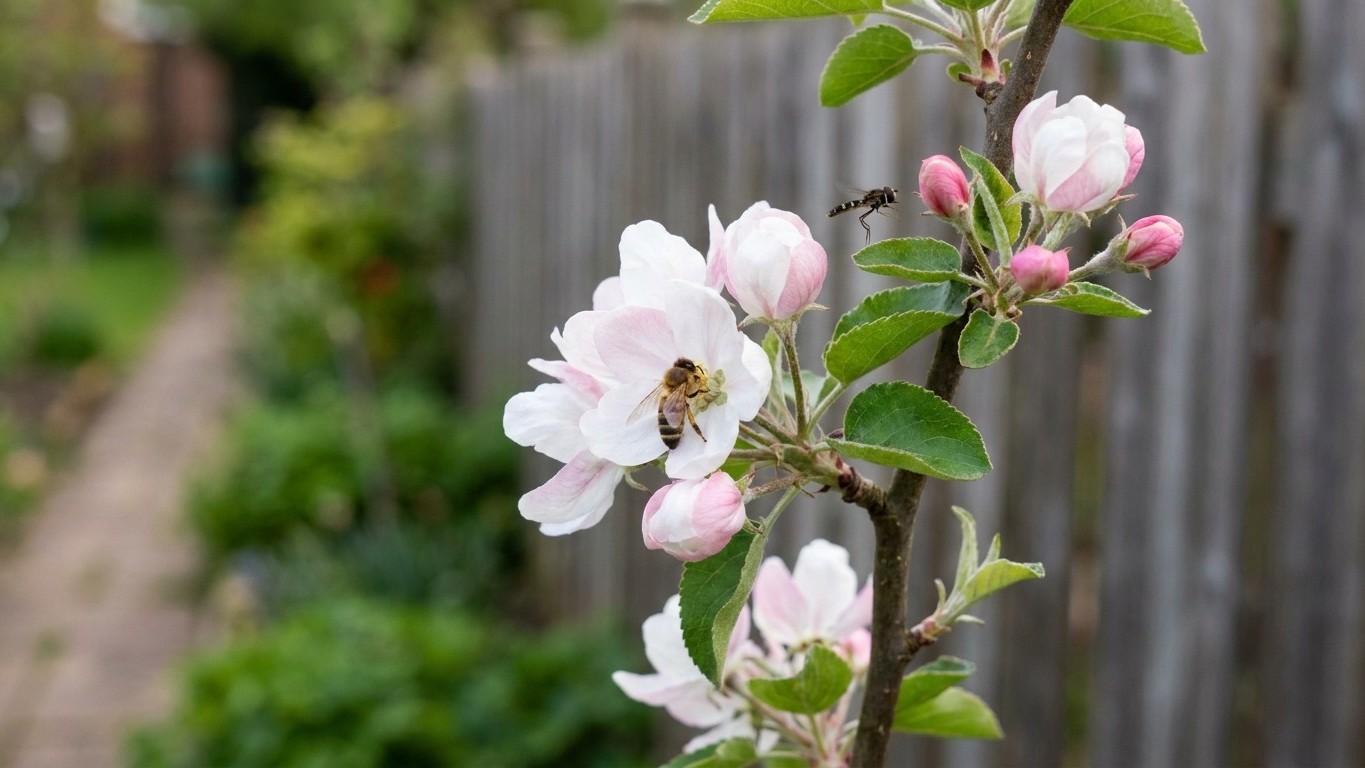

Cortland won’t set fruit alone, and no published list tells you exactly which tree to plant beside it. What you can trust is the timing: Cortland blooms Mid-season, so its partner has to open flowers in that same window, and whether you need two trees or three depends on whether that partner’s pollen is even fertile. Walk out and watch when the candidate tree actually flowers in your yard before you plant anything, because that’s the detail no tag gets right for your specific spot.
The short answer
USU Extension’s guide does not publish a list of pollination partners for Cortland. That is not a gap in this article, it is a gap in the source record: the same USU listing that gives Cortland’s bloom timing, hardiness range and harvest window simply stops short of naming which varieties cross with it. Treat any partner name you see elsewhere as a claim to verify, not a fact to plant on.
What USU does confirm is that Cortland blooms in the Mid season, within the same listing that puts the tree’s hardiness at zones 4 to 7 and its harvest in September. A compatible partner has to open its flowers on roughly that same calendar, or the bees moving between the two trees have nothing to carry.
The number of trees you actually need depends on a detail no plant tag spells out: whether the second variety’s pollen is fertile. Plant two trees if the partner produces viable pollen, since Cortland and the partner can then fertilize each other directly. Plant three if the variety you were about to choose turns out to have sterile pollen, because a sterile variety accepts pollen but never returns any, and it takes a third tree to complete the exchange. Nursery catalogs usually flag sterile varieties, sometimes labeled “triploid,” and it is worth reading that line before you buy rather than after.
Why these varieties and not others

Apple breeders sort varieties into bloom groups, usually running early to late across a season, and USU places Cortland in the Mid group. Clemson Cooperative Extension explains that this placement is a relative order rather than a fixed calendar date: two varieties in the same bloom group open their flowers close together wherever they are grown, but the actual date on the calendar shifts from one climate to the next. A Mid-season apple in a cool valley may flower well after the same variety planted in a warmer spot nearby, and both are still “Mid” relative to the early and late varieties around them. The same bloom-group logic applies to other varieties too. If you are also weighing a planting of Crimson Crisp, What Pollinates Crimson Crisp, and What Cannot walks through how its own bloom placement affects partner choice, since Crimson Crisp’s needs differ from Cortland’s Mid window.
What the bloom group tells you
This is the entire function of a bloom group: it tells you two trees will likely have open flowers at the same time, so bees have something to carry between them. Nurseries print the group on the plant tag or catalog page, sometimes as a number and sometimes as a word like Early, Mid or Late. Match that label rather than the specific date printed underneath it, because that date came from one trial location and will drift once the tree is in your own yard.
What it doesn’t guarantee
A shared bloom group says nothing about pollen fertility, and it says nothing about parentage. Two varieties can flower in perfect unison and still fail to set fruit on each other, either because one of them has sterile pollen or because one was bred directly from the other. A seedling cannot fertilize the parent tree it came from, no matter how well the bloom dates line up, because it carries too much of that parent’s own genetic makeup to act as a distinct pollen source. Overlapping flowers are a starting point for compatibility, not proof of it.
What cannot pollinate it
This is where a lot of apple guides quietly invent an answer, and where this one will not. USU Extension’s guide does not name a variety with sterile pollen sharing Cortland’s Mid bloom group, and it does not list a parentage exclusion for Cortland. That means the two specific failure modes this page would normally flag, a parent-and-seedling pair that cannot fertilize each other, and a sterile-pollen partner that leaves both trees fruitless, are simply not documented in the source this page relies on.
Not documented is not the same as safe
That absence is not the same as saying no such exclusion exists. It means the exclusion has not been published in the reference this page draws from, and stating one anyway would be a guess dressed up as fact. If you come across a specific claim elsewhere that a named variety cannot pollinate Cortland, ask which university extension or breeding program stands behind it, and whether that source names Cortland specifically rather than apples as a category.
The general mechanism still applies, even without a Cortland-specific case to hang it on. Two varieties bred one from the other will not cross-pollinate, because a seedling shares too much of its parent’s genetic makeup to act as an independent pollen source for it. A variety with sterile pollen, sometimes marked triploid on a nursery tag, can receive pollen from Cortland but cannot send any back, so a garden planted with only Cortland and one sterile variety, and nothing else nearby, sets fruit on neither.
Fire blight susceptibility, which USU Extension also credits to Cortland, does not change any of this pollination arithmetic, but it is worth weighing when you pick a partner variety anyway. Planting two susceptible trees close together gives the disease more targets in one spot, even though it changes nothing about whether their flowers can fertilize each other. Until a Cortland-specific exclusion turns up in a published extension source, the practical rule is to plant a second Mid-blooming variety that is not a known parent or offspring of Cortland and is not marked sterile on its own tag, and to treat anything more specific as unverified.
How close the second tree has to be

Pollen for apples moves on bees, not on wind, which makes distance a practical question rather than a botanical one. The closer the second tree, the more reliably bees carry pollen between the two, and a partner in the same garden bed does the job better than one three properties away. Honeybees and native bees such as mason bees will cross a street if they have to, but every extra stretch of distance is a chance for a bee to visit a different flower source instead and never make the trip to Cortland at all.
What else does the job
The second tree does not have to be one you planted yourself. A neighbor’s Mid-blooming apple over the fence line counts, provided its flowers are open at the same time as Cortland’s, which is the same bloom-group question covered above. An ornamental crabapple flowering on that schedule also works. Some growers graft a single pollinator branch onto an existing tree, which puts a second variety’s flowers within a few feet of Cortland’s own without a second trunk taking up ground, an approach covered in more general terms in the Apple Pollination guide.
None of that helps if the weather turns against the bees during bloom. Cold, wind or rain keeps bees in the hive at exactly the moment Cortland’s flowers are open and receptive, and no partner tree, however close or however well matched, compensates for pollinators that never fly. A grower who did everything right on variety choice can still lose the crop to a single bad week of weather during bloom.
If there is no room for a second tree
A small garden still has options, though each one solves part of the problem rather than all of it. The cost is usually effort rather than money: more grafting cuts, more pruning discipline, or a longer wait before the second variety’s flowers count for anything.
- Multi-grafted tree: two or three varieties grafted onto one trunk, putting a compatible partner’s flowers within inches of Cortland’s own, at the cost of careful annual pruning so no single variety shades out the rest.
- Pollinator branch graft: a single compatible variety grafted onto your existing Cortland, which takes one growing season to take and several more before it flowers reliably enough to help.
- Columnar apple: a narrow upright variety that needs little more ground than a fence post, useful only if its own bloom group actually lines up with Cortland’s Mid season rather than opening early or late.
- Ornamental crabapple: many flower heavily, some overlap with Mid-season apples closely enough to serve as a working partner, and one small crabapple can pollinate more than one full-size apple tree nearby.
Each option changes where the second set of flowers comes from, not the underlying arithmetic behind it. You still need two compatible bloom windows open on the property at the same time, whether that second window comes from a full tree, a grafted branch, or a crabapple. Prima faces a version of the same puzzle in its own bloom window, and What Pollinates Prima, and What Cannot walks through how a small-garden grower might solve it there.
Common questions
Will my Cortland tree fruit at all if I only plant one?
Nearly all apple varieties, Cortland included, crop better with a compatible partner nearby, and USU Extension’s guide does not report Cortland setting a full crop alone. A lone tree may still produce some fruit if a neighbor’s apple or a flowering crabapple happens to be within bee range, but that is luck rather than a plan.
Can a wild or seedling apple tree pollinate my Cortland?
It can, if its flowers are open at the same time as Cortland’s Mid bloom, but wild seedlings don’t come with a documented bloom group. Watch when it actually flowers relative to your Cortland for a season before counting on it as a partner.
Does the pollinator variety need fire blight resistance too?
Not for pollination itself. Fire blight resistance and pollen compatibility are separate traits, and USU Extension’s fire blight susceptibility rating for Cortland has no bearing on which varieties can fertilize its flowers. It is still worth considering, since two susceptible trees planted close together give the disease more targets in one place.
My other apple tree is also labeled “Mid” but from a different catalog. Is that the same thing?
Not necessarily. Bloom-group labels are assigned by whoever publishes the catalog or extension guide, and different sources don’t always use the same cutoffs for early, mid and late. Treat a shared label as a reason to check flowering dates directly rather than as proof on its own.
How long after planting will I see fruit from the pollination pairing?
That depends on the size and age of the trees you plant, not on the pollination arrangement itself, and USU Extension’s guide does not give a fruiting timeline for Cortland. A grafted pollinator branch in particular needs a few seasons to establish before its flowers are reliable enough to count on.