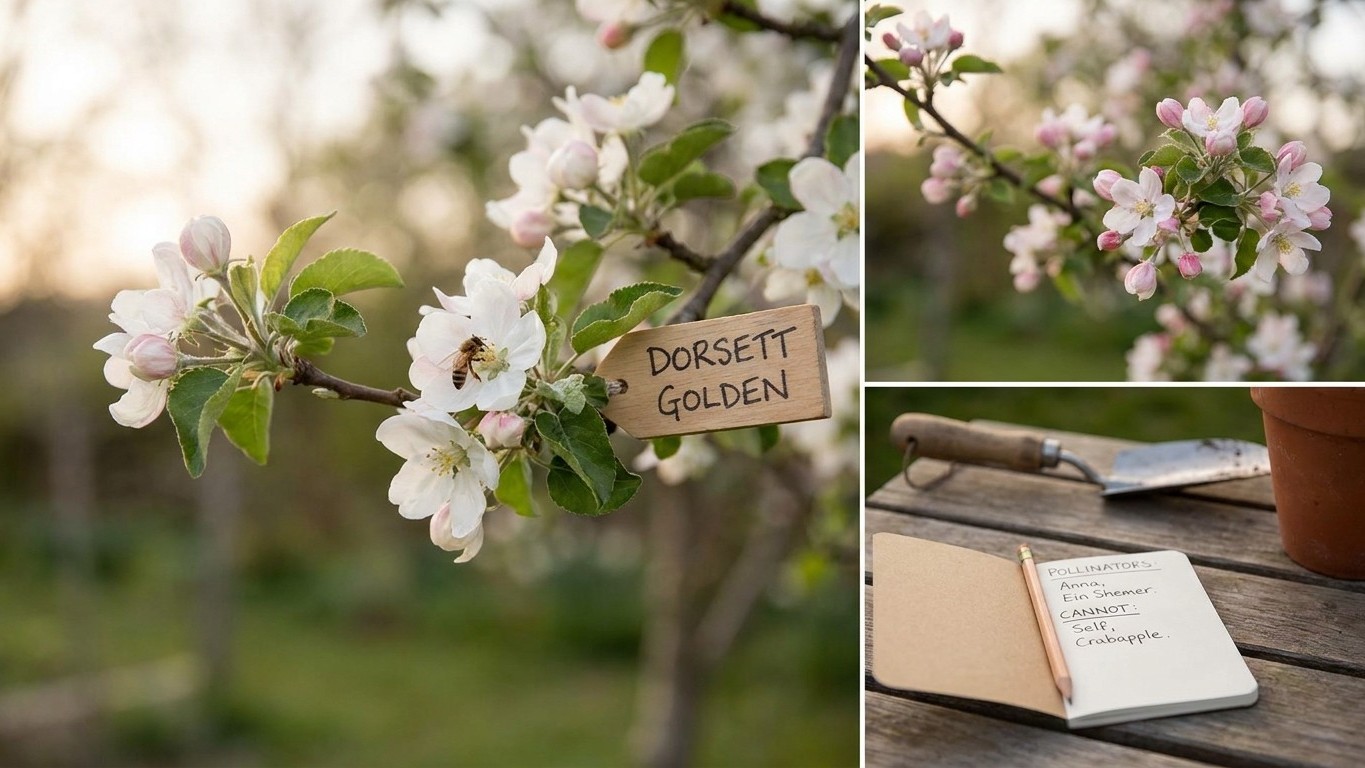

Dorsett Golden is pollinated by Anna, and Clemson Cooperative Extension’s HGIC 1350 places both in bloom group A, meaning they flower at the same point in the season. Plant one Anna apple within the same yard, ideally within sight of the Dorsett Golden, and you have a working pair. If you already have a mature apple tree of unknown variety nearby, check its bloom timing against this before assuming it will do the job.
The short answer
The variety that pollinates Dorsett Golden is Anna. Both are listed in bloom group A by Clemson’s HGIC 1350 and by UGA’s C740, which means their flowers open in the same window relative to other apple varieties, whatever the actual calendar dates turn out to be in your climate. That shared timing is the entire reason the pairing works. Neither publication credits Dorsett Golden with sterile pollen, so the standard rule applies here.
You need two trees, not three. A variety with sterile pollen can accept fertilization from a partner but can’t return the favor, which forces a grower into a three-tree arrangement so the sterile variety still gets a working pollinizer nearby. Nothing in the Clemson or UGA material flags Dorsett Golden or Anna as pollen-sterile, so a straightforward two-tree planting, one Dorsett Golden and one Anna, is the baseline setup.
What this means for a real yard
In practice, this is one Dorsett Golden and one Anna, planted close enough that bees move between them on the same afternoon. A single Dorsett Golden on its own will usually still produce some fruit in most seasons, since nearly all apple varieties crop better with a compatible partner rather than failing outright without one, but the difference between a light scattering of fruit and a full crop is exactly this second tree. If you’re setting up an orchard corner from scratch, it’s worth reading the general mechanics on Apple Pollination before you buy, since spacing and rootstock choice both affect how well two trees actually work together once they’re in the ground.
Why these varieties and not others

The mechanism is simple once you see it: two apple varieties can only pollinate each other if their flowers are open at the same time. Apple breeders and extension services sort cultivars into bloom groups for exactly this reason, and Clemson Cooperative Extension assigns both Dorsett Golden and Anna to bloom group A. That grouping is a relative order, not a fixed date. In a warm-winter region the group A bloom might arrive weeks earlier than it would somewhere colder, but the order of who blooms before whom stays consistent. So the practical use of the bloom group isn’t “these bloom in early March,” it’s “these two bloom together, whenever that turns out to be.”
What bloom group A does not tell you
Sharing a bloom group does not guarantee compatibility on its own. Two things still have to be true beyond timing. First, the pollen has to actually be fertile: some apple varieties, sitting in the same bloom group as everything around them, produce pollen that is functionally useless for fertilizing another tree, though nothing in the Clemson or UGA material suggests that problem with Anna. Second, there’s no rule against a shared bloom group crossing genuine relatives, but that’s a separate issue from bloom timing itself, and one that only matters if a source explicitly identifies a parent-and-offspring pair.
Neither of the sources behind this page states a parentage relationship between Dorsett Golden and Anna, so that concern doesn’t apply to this particular pair. What the bloom group actually buys you is narrower and more useful than it sounds: it tells you the two trees won’t miss each other by flowering weeks apart, which is the single most common reason a newly planted “pollinator” tree fails to do its job.
What cannot pollinate it
This is the part most planting guides skip, and it’s the part that actually saves you a wasted season. Neither Clemson’s HGIC 1350 nor UGA’s C740 lists a variety with sterile pollen sitting in bloom group A alongside Dorsett Golden and Anna, so there’s no documented trap here of two trees that bloom together but still can’t fertilize each other. That’s worth stating plainly, because it’s not always the case with other apple pairings, and it’s exactly the kind of detail that ruins a two-tree planting when it does apply.
The other common trap is planting two trees of the same variety and calling it a pollinator pair. Two Dorsett Golden trees will bloom in perfect unison with each other, but genetically identical trees are poor pollinators for one another, and self-pollination in apples is generally weak. If you’re short on space and considering two of the same tree instead of a true partner, that’s the wrong move. A single Anna does more work than a second Dorsett Golden ever will.
Where the published data stops
Beyond Anna, compatibility for Dorsett Golden isn’t published in the sources behind this page. That’s not the same as saying no other variety works. It means no extension bulletin has put a specific name to it, and guessing at one here would be irresponsible. If you’re comparing this to other low-chill apples you might already be growing, it’s worth checking the equivalent pages for Earligold and Red Delicious, since their documented partners sometimes overlap with what’s already blooming in a mixed home orchard, even when Dorsett Golden itself isn’t named alongside them.
How close the second tree has to be

Apple pollen moves on bees, not on wind, which makes distance a practical question rather than a technical one. The closer the two trees are, the more consistently bees move between them in a single foraging trip. Same yard beats same street. Same fence line beats opposite corners of a large lot. There’s no published distance limit in the sources behind this page, so the safest approach is to plant Anna within easy sight of the Dorsett Golden rather than trusting a bee to cross a long open stretch reliably.
A tree doesn’t have to be your own to do the job. A neighbor’s Anna apple, a flowering crabapple blooming at the same time, or even a single grafted branch of a compatible variety on an existing tree can all carry pollen the same way a dedicated second tree would. What none of them can fix is weather. Cold, wet, or windy conditions during bloom keep bees from flying, and when that happens it doesn’t matter how perfectly matched the two varieties are or how close together they’re planted. No partner variety compensates for a stretch of bad bloom-week weather, because the problem isn’t the trees, it’s the absence of the insect doing the actual work between them.
If there is no room for a second tree
A small yard doesn’t rule out a working pollinator pair, but it changes the shape of the solution.
- Multi-grafted tree: several varieties grafted onto one trunk, so Dorsett Golden and Anna share root space in the footprint of a single tree.
- Pollinator branch graft: an Anna scion grafted directly onto an existing Dorsett Golden, which solves the bloom-timing problem without a second trunk but does require basic grafting skill.
- Columnar apple variety: a narrow-growing tree that fits where a full-spread second tree wouldn’t, though it still needs to be a bloom-group match to do any good.
- Flowering crabapple: useful if it blooms at the same time as Dorsett Golden, since crabapples are common bee draws in a mixed orchard, but timing has to be confirmed locally rather than assumed.
Each option trades effort for space. A multi-grafted tree solves the space problem outright but costs more up front and needs more careful pruning to keep each variety from shading out the others. A graft onto an existing tree is cheap but depends on the graft actually taking, which isn’t guaranteed on a first attempt. None of these options changes the underlying requirement: something with compatible, fertile, same-timed bloom still has to be present and reachable by bees. A columnar tree or a crabapple that blooms weeks off schedule solves nothing just because it’s physically nearby.
Common questions
Can Dorsett Golden pollinate itself if I only plant one?
Not reliably. A single Dorsett Golden will often set some fruit, since most apple varieties aren’t completely self-sterile, but self-pollination tends to be weak and inconsistent from year to year, which is why a same-bloom-group partner like Anna makes such a visible difference.
Will a crabapple in my yard count as a pollinator?
It can, if it’s blooming at the same time as your Dorsett Golden. Crabapples are frequent bee visitors and many varieties are compatible pollen donors for full-size apples, but you need to confirm the bloom timing matches locally rather than assume it from a nursery tag.
Do I need a male and female apple tree?
No, apple trees don’t have separate male and female individuals. Every apple flower carries both parts, and the issue is genetic compatibility and simultaneous bloom between two varieties, not sex.
How many years until Anna actually blooms enough to help?
That depends on the rootstock and the age of the tree at planting rather than the variety alone, so there’s no single answer to give here. A young whip generally takes longer to flower heavily than a tree that’s already a couple of years into its growth, regardless of what’s grafted onto it.
Can I use a different low-chill apple I already have instead of Anna?
Anna is the pairing documented by Clemson’s HGIC 1350 and UGA’s C740, and anything else is a guess until you’ve watched both trees bloom side by side for a season.