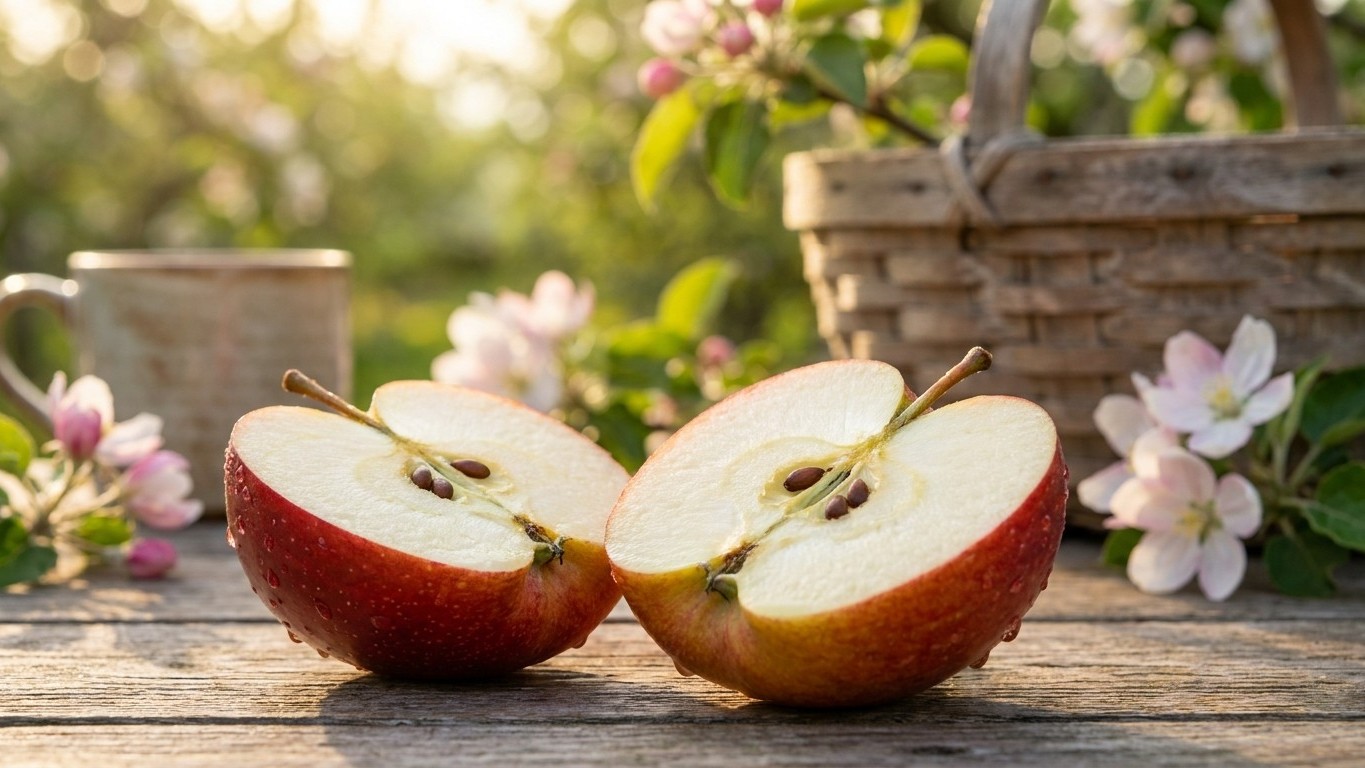

Anna is a low-chill apple bred for warm-winter climates, prized for a sweet-tart, crisp bite that punches above its weight for a variety that doesn’t need much cold. It flowers early (Bloom Group A) and needs a compatible partner nearby, most reliably Dorsett Golden, to set a full crop. Here’s what that means for your yard.
What Anna actually is

- When it ripens: early, in step with its early-flowering Bloom Group A
- What it tastes like: sweet-tart and crisp, unusually good for a low-chill apple
- What it’s good for: fresh eating
- How long it keeps: a shorter shelf life than a supermarket-bred keeper apple
Anna doesn’t carry a second name at the nursery or the grocery store the way Mutsu sometimes shows up as Crispin, or Pink Lady sells as Cripps Pink. It’s marketed under its own name, so what you plant is what you’ll bite into. That bite, according to Clemson HGIC and UGA extension material, is sweet-tart and crisp, a combination that’s genuinely notable for a variety bred to skip most of winter’s cold.
The kitchen use is fresh eating, and the reason matters more than the label. A dessert apple like Anna is chosen for how it tastes and crunches straight off the tree, not for how its flesh behaves under heat. Pie apples need acidity that survives baking and flesh dense enough to hold a slice shape after twenty minutes in a 400-degree oven; a fresh-eating apple is optimized for the opposite experience, texture and flavor at room temperature, not structural survival in a pie dish. That’s the physical reason you don’t swap one for the other and expect the same result.
Storage is the tradeoff for that early ripening. Anna won’t sit in a refrigerator drawer the way a late-season, cold-storage-bred apple will. Plan to eat or process it within a few weeks of picking rather than treating it like a winter keeper.
Will it grow where you are
Hardiness zone
No specific USDA hardiness zone range is published in the sourced material for Anna, and that’s not really the limiting factor for this variety anyway. Apple trees in general tolerate a wide swing of winter cold, so the question for Anna isn’t “is my winter cold enough to kill the tree.” It’s the opposite question entirely.
Winter chill
Anna needs 250 to 300 chill hours, according to UF/IFAS extension guidance for north and north-central Florida. That’s a low number as apples go, which is exactly why Anna exists: it was bred to fruit reliably where winters are too mild for standard northern apple varieties to ever break dormancy properly. If you garden in the Deep South, the Gulf Coast, coastal California, or similar mild-winter regions, Anna belongs on your short list precisely because most classic apple varieties don’t accumulate enough cold hours where you live. If you’re in a region that reliably delivers 800, 1,000, or more chill hours a winter, Anna isn’t a poor performer, it’s simply not solving a problem you have; higher-chill varieties will usually serve you better.
What to Plant Beside It
Nearly all apple varieties crop better with a compatible partner nearby, and Anna is no exception. The sourced pairing for Anna is straightforward:
- Dorsett Golden
Both varieties sit in Bloom Group A, meaning they’re among the earliest to flower in a given climate. Remember that bloom group is a relative order, not a fixed calendar date; in a warm year both might open in late January, in a cooler one closer to March, but the sequence between them holds steady from year to year in the same yard. That overlap in timing is what makes them workable partners in the first place, since pollen only matters if two trees are actually blooming at the same time.
No sterile-pollen designation is noted for Anna in the sourced facts, and no parent-seedling exclusion is documented for this particular pairing either, so there’s no known reason Dorsett Golden and Anna can’t pollinate each other in both directions, as far as the available sources indicate. If you’re planning a small orchard with just these two trees, that’s useful news: you’re not required to plant a third variety purely to break a one-way pollen relationship, the way some varieties demand. For a deeper look at how bloom timing, pollen compatibility, and self-fertility interact across apple varieties generally, our apple pollination guide walks through the mechanics in more detail.
Growing it well
Disease exposure
No specific fire blight rating for Anna appears in the sourced material, so treat any claim of a precise resistance score with skepticism until you find it in a regional extension publication. What is worth knowing: fire blight infects blossoms during bloom, and Anna’s early flowering (Bloom Group A) means it’s often blooming during whatever early-spring rain and humidity your region delivers. In warm, humid climates, that timing can raise blossom-blight exposure regardless of the variety’s inherent resistance, simply because the flowers are open earlier in the wetter part of the season. Local extension offices track regional fire blight pressure and are a better source for current risk than a generic variety rating.
Habit and thinning
Detailed data on Anna’s growth habit and tendency toward biennial bearing (heavy crop one year, light the next) isn’t part of the sourced facts here, so it’s better left unstated than guessed at. What does follow from the facts you do have: a variety marketed for fresh eating benefits from thinning, since crowded fruit clusters produce smaller apples with less of the sweet-tart flavor the variety is known for. Thinning to one apple per cluster, done a few weeks after bloom, is standard practice across most apple varieties and there’s no reason to skip it with Anna.
Picking it and keeping it
Because no specific harvest-date figure is published in the sourced material, judge ripeness with your hands rather than a calendar square. The standard sequence works for Anna the same way it does for most apples:
- Lift and twist a fruit gently upward; a ripe apple separates from the spur with little resistance
- Cut one open and check the seeds; ripening apples show brown to dark-brown seeds rather than pale green ones
- Check the ground color, the background shade behind any blush; it should shift from green toward yellow as the fruit matures
Storage
Anna is not a long-keeper. Refrigerate it as soon as it’s picked and plan to eat or process it within a few weeks rather than months. If you’re used to storing a late-season apple in a cool basement or root cellar through winter, don’t expect the same result here; Anna’s short storage window is part of the tradeoff for ripening so early in a warm climate.
Common questions
Does Anna apple need a pollinator to produce fruit?
Nearly all apple varieties crop better with a compatible partner nearby, and Anna follows that pattern. Dorsett Golden is the sourced, compatible pairing, and both bloom in the same early group (Bloom Group A), which keeps their flowering windows overlapping.
Can I grow Anna apple in a cold-winter climate?
You can, but you’re solving the wrong problem. Anna was bred for regions with only 250 to 300 chill hours a winter, according to UF/IFAS. In a region with far more winter chill than that, standard higher-chill apple varieties will typically outperform it.
What does Anna apple taste like compared to a standard grocery apple?
Sweet-tart and crisp, a flavor profile considered good for a low-chill variety, many of which trade flavor complexity for the ability to fruit in mild winters.
Is Anna apple good for baking or pies?
It’s classified for fresh eating, not baking. Pie apples need flesh that holds its shape and acid that survives oven heat; a fresh-eating apple like Anna is bred for a different eating experience and won’t hold a slice shape the same way through a long bake.
How long does Anna apple stay fresh after picking?
Plan on a shorter window than a typical grocery-store keeper apple, more like a few weeks refrigerated rather than months in cold storage.