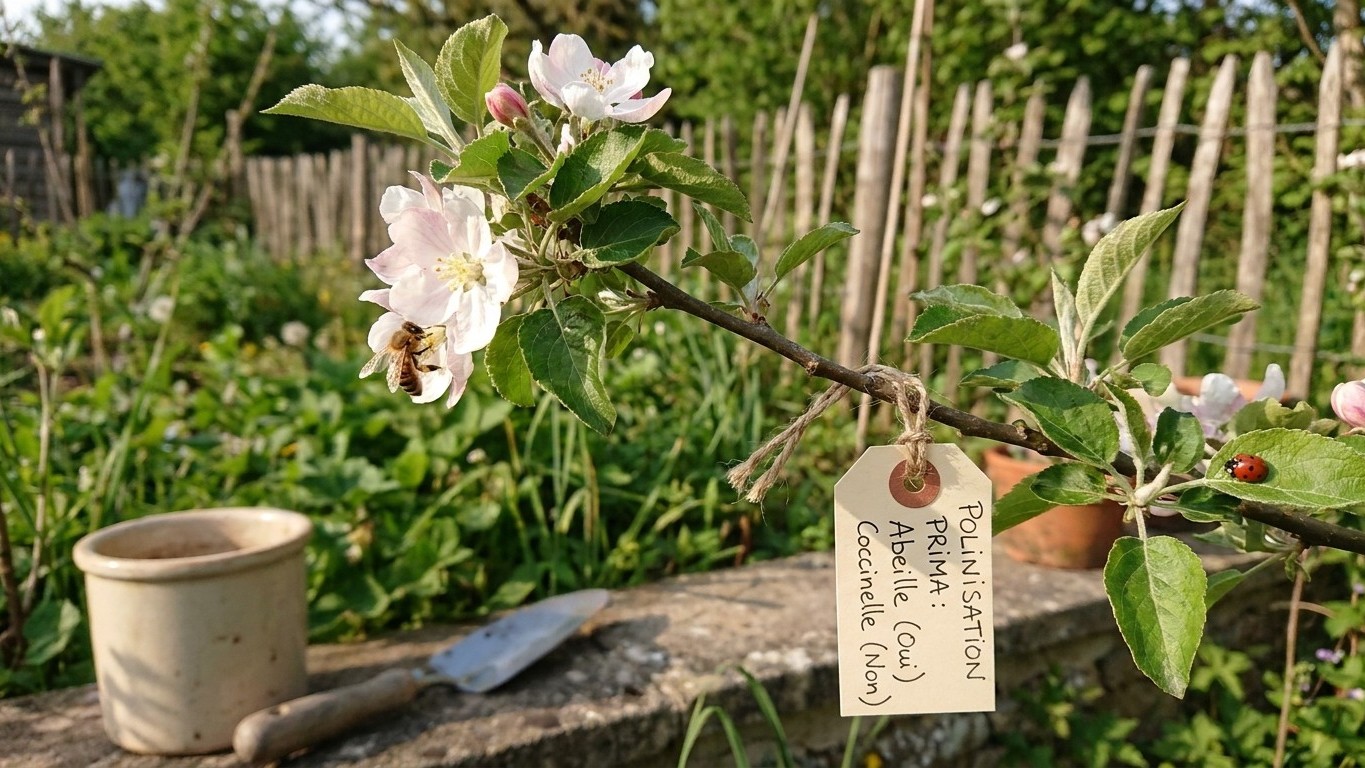

Prima needs another apple tree blooming at the same late point in the season, and right now you don’t know which one to plant next to it. That’s the honest answer: nobody’s published a named partner for Prima, so the job is matching bloom timing yourself instead of copying a list. Before you buy a second tree, look up its catalog listing and check whether its pollen is fertile — that one detail decides whether two trees will actually be enough, or whether you’ll need a third.
The short answer
Most apple varieties need cross-pollination from a second, compatible variety to set a full crop, a requirement covered in general in our guide to Apple Pollination. For Prima specifically, USU Extension’s Apple Production for the Utah Home Garden gives a late bloom season, a hardiness range of zones 4 to 7, and resistance to fire blight, but it does not name a pollination partner for this cultivar. That gap is worth stating plainly rather than filling with a guess: no source used here lists a specific compatible variety for Prima, so naming one “correct” partner would be invented, not documented.
Working with a late bloom window and no named partner
What the late bloom rating does tell you is the window to work in. Prima needs a second apple variety flowering at the same time, in the late part of the local bloom sequence, not an early or mid-season tree that has already finished blooming before Prima opens. The working rule is two trees, both blooming late, unless one of them turns out to have sterile pollen.
Sterile pollen changes the math. A variety with sterile pollen can accept pollen and set fruit, but its own pollen cannot fertilize anything else, Prima included. If the tree planted next to Prima turns out to be one of those varieties, the garden needs a third tree carrying fertile pollen to complete the loop, because two trees that both depend on outside pollen leave each other unfed.
Since USU’s Utah-focused publication does not report Prima’s own pollen fertility either, the practical move is to check the catalog description of whatever late-blooming variety is being considered as a partner, look for a note on pollen sterility, and buy accordingly rather than assuming compatibility from bloom time alone.
Why these varieties and not others

Apple varieties are sorted into bloom groups, and a bloom group is a relative order rather than a fixed calendar date, according to Clemson Cooperative Extension. Two trees in the same bloom group open their flowers close enough together that a bee working one tree still finds open blossoms on the other, even though the actual date that overlap happens shifts from one climate to the next and even from one year to the next in the same orchard. What stays constant is the order: an early-group variety always blooms ahead of a mid-group variety, and a mid-group variety always blooms ahead of a late one, wherever it is planted.
Same bloom group is not the same as compatible
Prima sits in the late bloom group, according to USU Extension. That places a boundary around which varieties are even worth considering as a partner: anything blooming early or mid-season is out, because its flowers close before Prima’s open or open before Prima’s are ready. But a shared bloom group only gets a variety through the door, it does not finish the job. Two late-blooming varieties can overlap in flower and still fail to produce fruit together, for two separate reasons.
The first is pollen fertility. A variety with sterile pollen can flower right alongside Prima and never fertilize a single blossom, because its pollen grains cannot complete fertilization in any partner, not just Prima. The second is parentage. A seedling variety cannot be fertilized by the tree it was bred from, no matter how closely their bloom times line up, because pollen from a parent and the genetic material already present in its own offspring do not combine to produce viable seed the way pollen from an unrelated tree does. Overlapping bloom is necessary for pollination to happen at all, but it is not sufficient on its own, and neither fertility nor parentage is something a grower can see by watching the blossoms open.
What cannot pollinate it
The honest answer here is narrower than a grower wants. USU Extension’s Apple Production for the Utah Home Garden does not publish a list of varieties with sterile pollen that share Prima’s bloom group, and it does not report a parentage relationship for Prima either. Naming a specific “do not plant this with Prima” variety without a documented source would be a guess dressed up as fact, and guesses are exactly what get an orchard into trouble years later when the trees are already in the ground.
Bloom timing and pollen fertility, not a named exclusion
What can be said with confidence is the mechanism, even without a named example. Nearly all apple varieties crop better with a compatible partner nearby, Prima included, so pairing it with nothing at all is the surest way to get a thin harvest. Any early or mid-season variety is excluded on bloom timing alone, since a flower that has already dropped its petals before Prima opens contributes nothing, regardless of how good that variety’s pollen is. A late-blooming variety with sterile pollen is excluded on a different basis: it can be fertilized by Prima, but it cannot return the favor, so a garden holding only Prima and one sterile-pollen late bloomer still sets little to no fruit unless a third, fertile-pollen tree is added.
A parentage exclusion works the same way in principle, wherever it applies: a seedling cannot be fertilized by the parent it came from. That rule matters for plenty of varieties in the wider apple family, but it only becomes useful information once someone documents which parent produced which seedling, and no source used here makes that connection for Prima. Anyone weighing a specific candidate partner for Prima, including a variety already researched for a different tree, such as the one covered in our page on What Pollinates Priscilla, and What Cannot, should check that variety’s own published bloom group and pollen fertility rather than assume Prima’s compatibility carries over.
How close the second tree has to be

Pollen moves on bees, not on wind, so the real question is how far a foraging bee is willing to travel between two trees while still carrying a useful pollen load. Closer is always better, the same garden rather than the same street, because a bee that starts and finishes its trip in one small area is far more likely to carry pollen directly between the two varieties than one working a wider loop with other flowers in between.
What else can do the job
The second tree does not have to be one you planted on purpose. A neighbor’s apple tree, if it blooms at the same time and is close enough for bees to move between the two properties, does the same work as a tree in your own yard. An ornamental crabapple flowering on the same late schedule works too, since crabapples produce fertile pollen that apple varieties can use even though nobody eats a crabapple’s fruit. A grafted branch of a compatible variety, added onto an existing tree, also counts, because the flowers on that branch open independently of the rootstock they’re grafted onto.
None of that matters if the weather during bloom keeps bees from flying. Cold or wet conditions while both trees are in flower shut pollinators down, and no amount of partner planning fixes a week when bees simply did not leave the hive. That is one more reason to plant the partner close by rather than a modest walk away: a short break in bad weather still leaves a narrow window for bees to move between two nearby trees, and that window shrinks fast as distance increases.
If there is no room for a second tree
A small garden does not rule out fruit, it just changes which trick does the work instead of a second full-size tree. Four options cover most cases, each with a real tradeoff.
Comparing the options
| Option | Effort | What it does not solve |
|---|---|---|
| Multi-grafted tree (several varieties on one trunk) | Buy once, no extra planting space | Still depends on the grafted varieties actually sharing a compatible bloom group and fertile pollen |
| Pollinator branch grafted onto the existing tree | Moderate, needs a grafting attempt or a pre-grafted whip from a nursery | Only as reliable as the graft union, and a failed graft supplies no pollen at all |
| Columnar variety planted alongside | Low space, but still a second tree and root zone to maintain | Still needs checking for bloom timing and pollen fertility like any other partner |
| Ornamental crabapple in the same bed or nearby | Low, crabapples are widely sold and tolerate tight spots | Produces no apples of its own, it exists purely to supply pollen |
A multi-grafted tree solves the space problem outright, since the second variety lives on the same trunk, but it is only as good as the varieties the nursery chose to graft together, and that choice is rarely documented with the same rigor as a straight, single-variety tree. A pollinator branch grafted into an existing tree works the same way in miniature. It can turn one tree into its own partner setup, provided the graft takes and the added variety actually flowers on the local schedule, something worth checking against a page like our guide to What Pollinates Candy Crisp, and What Cannot if that variety happens to be the one under consideration.
A columnar variety is still a second, separate tree with its own bloom group and pollen fertility to check before assuming it will do the job. An ornamental crabapple is the simplest fix in a truly tight space, since most nurseries carry a compact form and its only role is timing its bloom to match the apple tree it is meant to support, not producing fruit of its own.
Common questions
Can two Prima trees pollinate each other?
No. Two trees of the same variety carry genetically identical flowers and pollen, so one cannot fertilize the other any more than a flower can fertilize itself across a fence. This is separate from the parentage exclusion discussed above, which involves two different but related varieties, not two copies of the same one.
Will my Prima tree ever set fruit with nothing else planted nearby?
Some fruit is possible if a stray pollen source exists that you haven’t accounted for, such as an unnoticed apple or crabapple a bee visited before arriving at Prima. Relying on that is not a plan, and nearly all apple varieties, Prima included, crop far better with a documented compatible partner planted deliberately nearby.
How do I know if my chosen partner actually has sterile pollen?
Check the nursery catalog or the extension publication for that specific variety before you buy it, since sterility is a published characteristic of the cultivar, not something visible on the tree. If no source mentions it either way, treat the partner as unconfirmed and keep an eye on whether fruit set improves once both trees are mature enough to flower.
Can a flowering crabapple replace a second Prima-compatible apple tree?
Yes, provided the crabapple blooms in the same late window Prima does. Many ornamental crabapples are bred for an early flower display rather than to match a late apple’s bloom, so the variety matters as much as the fact that it’s a crabapple at all.
Why does my Prima tree bloom but drop most of its flowers without fruiting?
That pattern usually points to a pollination gap rather than a tree health problem, especially if no compatible late-blooming partner is close enough for bees to reach reliably. Cold, wind or rain during the bloom period can produce the same symptom even with a good partner in place, since it simply keeps bees from moving between the two trees during the narrow window both are in flower.