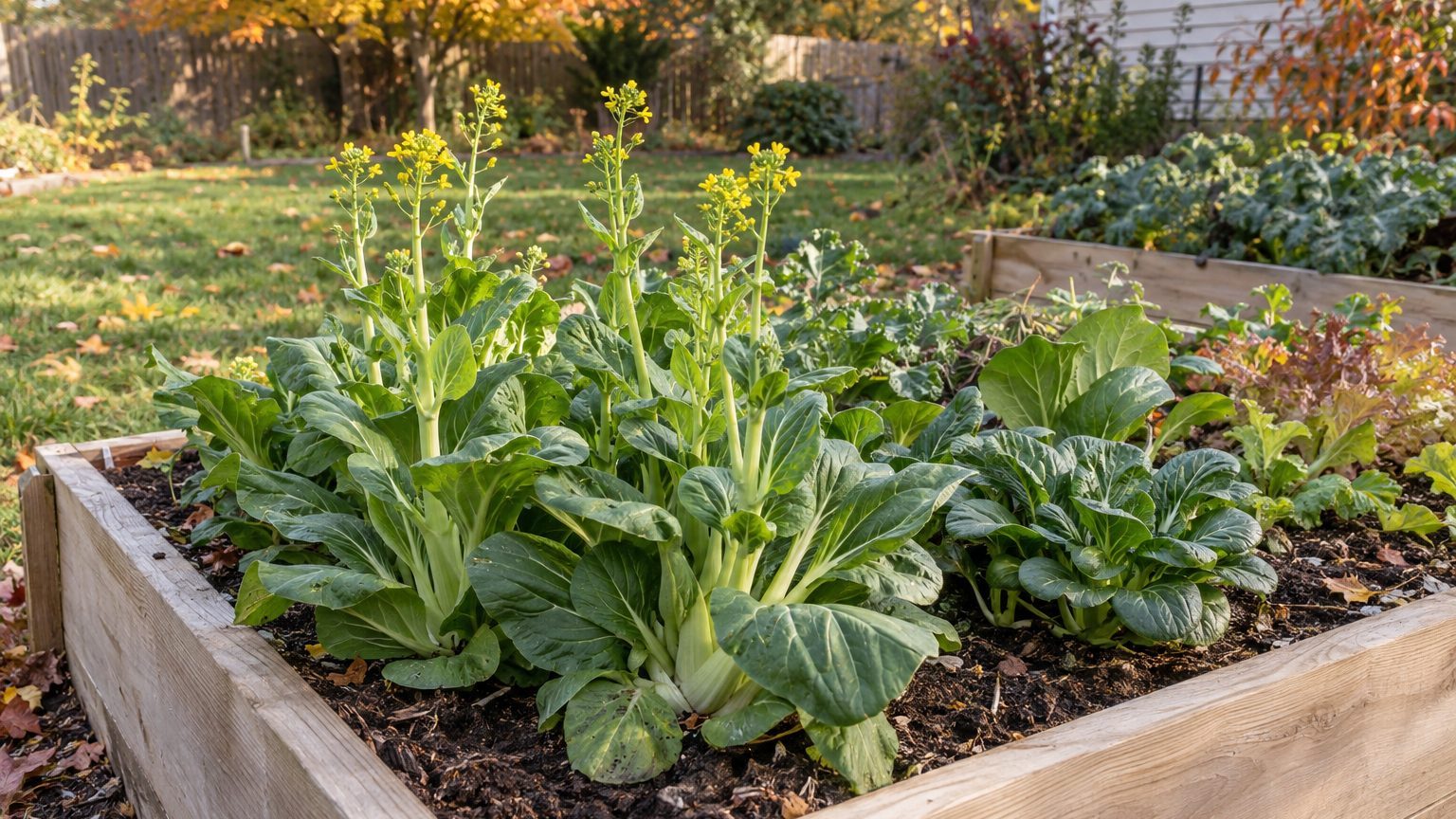

Asian greens bolt when heat, long days, or a cold snap push them to stop making leaves and start making seed. Once the center of a bok choy or tatsoi starts stretching upward, you can’t reverse it. You can still eat the plant, though, and you can change the planting dates so the next round doesn’t do the same thing. This page covers both. For the broader picture on varieties, sowing, and harvest, start with Growing Asian Greens: Fast, Cold-Hardy, and Prone to Bolting.
What actually flips the switch
Bolting is the plant’s reproductive program kicking in. Most Asian greens belong to the mustard family (the same family as broccoli and radishes), and they are biennial or annual crops that want to flower the moment conditions suggest their window is closing. Three signals do most of the work: day length, temperature, and stress.
Day length comes first. Bok choy, tatsoi, komatsuna, and mustard greens are all long-day responsive, which means that as daylight stretches past roughly 13 to 14 hours, they speed toward flowering. At about 40 degrees north latitude (think Philadelphia, Columbus, or Denver), that window runs from early May into early August. A spring sowing that goes in late is racing against a clock you can’t see.
Temperature adds pressure from both directions. Hot weather, generally once daytime highs sit in the 80s°F, speeds things along and turns leaves bitter at the same time. Cold does something less intuitive. Young plants held at temperatures below about 50°F for a week or two can be tricked into thinking winter has passed, and they flower when the weather warms. Napa cabbage is especially prone to this, which is why an early-March sowing under a cold snap so often ends in a row of stubby plants with flower stalks and no heads.
Stress is the third trigger, and the one gardeners can control most easily. Drought, root disturbance at transplant, crowding, and nutrient swings can all nudge a plant toward flowering early. A seedling that sits root-bound in a cell pack for three extra weeks has already been through a mild version of this before it ever reaches the bed.
How to tell it’s happening
The first sign is usually subtle. The center of the plant looks taller and looser than its neighbors, and the leaves emerging from it are narrower and more pointed than the broad ones lower down. Within a few days, a thick central stem rises and a cluster of tight green buds appears at its tip. Those buds resemble miniature broccoli.
The leaves tell you something too. In plants that are bolting, the older outer leaves often turn tougher and sharper in flavor, because the plant is redirecting energy and producing more of the compounds that give mustards their bite. Mizuna and mustard greens, already peppery, can become unpleasantly hot.
What to do once a stalk is rising
Harvest, and do it soon. A bolting plant is not a dead plant. The leaves are still food, and the flower stalk is the best part of it.
Bok choy, tatsoi, mizuna, and mustard greens all produce edible flower buds and yellow blossoms, with a flavor somewhere between broccoli rabe and mild mustard. Cut the stalk while the buds are still tight and green, about 4 to 8 inches down, and sauté it in a hot pan with garlic and a splash of soy sauce. Once the yellow flowers open fully, the stalk turns woody at the base, so trim it more aggressively or peel the lower stem. Choy sum, one of the best-known Asian greens, is grown for its flower stalks in the first place, so you are eating the same thing a market would sell.
Pinching the stalk off sometimes buys a few extra days of leaf harvest, but it won’t stop the process. The plant will send up another stalk from a side shoot, and each one is smaller. Treat pinching as a way to stretch a harvest, not a rescue.
If the whole bed is bolting at once, harvest the entire planting and deal with it. Blanch and freeze the leaves, or cook them down in soups and stir-fries where the bitterness is balanced by fat, salt, or acid. Raw salads are where bolted leaves disappoint. For handling the harvest once it’s in the kitchen, Keeping Asian Greens After Cutting covers how to hold greens at their best for the longest stretch.
Resist the urge to leave a bolting row standing “just a bit longer.” Past the bud stage, the leaves decline fast, and the bed is occupied by plants you won’t eat. Pull them, compost them (before they set seed, which spreads easily), and use that space for something that can take the season’s conditions, such as bush beans or a late sowing meant for fall.
Prevention that works
Almost every bolting problem comes down to sowing at the wrong time for the crop. The easy fix is to shift your calendar rather than fight the plants.
Favor fall over spring. Sow in late summer, roughly 6 to 8 weeks before your average first frost, so the plants mature as days shorten and nights cool. Short days and cool air are exactly what Asian greens prefer. In much of the country, from the Midwest to the Mid-Atlantic, a fall crop of bok choy, tatsoi, and komatsuna is more reliable than anything sown in April. In the Deep South and parts of the Southwest, the cool season is the main season, with sowing from October through February.
In spring, sow as soon as the soil can be worked, and don’t start seeds indoors so early that plants spend weeks in cold conditions. Use row cover on cold nights, since fabric can add a few degrees of protection and keep young plants out of the temperature range that triggers premature flowering. Choose varieties labeled “slow-bolt” or “bolt-resistant” for spring and early summer plantings. These are bred to tolerate a wider range of day length, though they delay bolting rather than prevent it.
Succession sowing is the other major tool. Instead of one large planting, sow a short row every 10 to 14 days. If one batch bolts, the next is already coming along. It also fits how people actually eat these crops, since a 10-foot row of bok choy all ready the same week is more than most households can use.
Several smaller habits make a measurable difference:
- Water evenly, about 1 inch per week including rain, and mulch with straw or shredded leaves to keep roots cool.
- Use 30 to 40 percent shade cloth on the west side of beds from late spring through summer, since afternoon sun does the most damage.
- Direct sow where possible. Brassicas dislike root disturbance, and transplants stalled by shock bolt sooner.
- Harvest on schedule. Baby leaves of most Asian greens are ready in 20 to 30 days, well ahead of bolting.
Harvesting young is the least-appreciated defense. If you pick plants at the baby stage, they are gone before day length or heat can push them over the edge. That strategy depends on tighter planting, and Spacing Asian Greens: Baby or Full Size explains how to set up rows for either approach so crowding doesn’t become its own stress trigger.
Seed saving and the upside of a bolted bed
Gardeners who let a few plants bolt on purpose get something useful in return: seed. Bok choy, tatsoi, napa cabbage, and several other Asian greens are all Brassica rapa, so they cross-pollinate freely with each other and with turnips. If you grow more than one of these in the same garden and want seed that comes true, isolate them by a wide margin or save seed from just one type per year.
Let the strongest, latest-bolting plants flower, because those are the ones carrying the trait you want. Seed pods turn from green to tan over several weeks, and they shatter easily, so cut the stalks when most pods are yellowing and finish drying them in a paper bag indoors. Saving from the plants that held off the longest, year after year, gradually shifts a home-grown strain toward better bolt tolerance for your particular climate.
Pollinators also love the flowers. A few bolted plants left in a corner of the garden bring in small native bees and hoverflies right when many other crops aren’t yet blooming, and hoverfly larvae eat aphids that would otherwise be your problem later in the season.
One last caution on timing: plants that bolt in the fall, after a stretch of unseasonable warmth, are common in October and November. A late warm spell can push them to flower even though days are shortening, which shows that heat alone is enough to do it. If your fall crop starts stretching during a warm October, harvest it and move on rather than waiting for the flowers to finish.