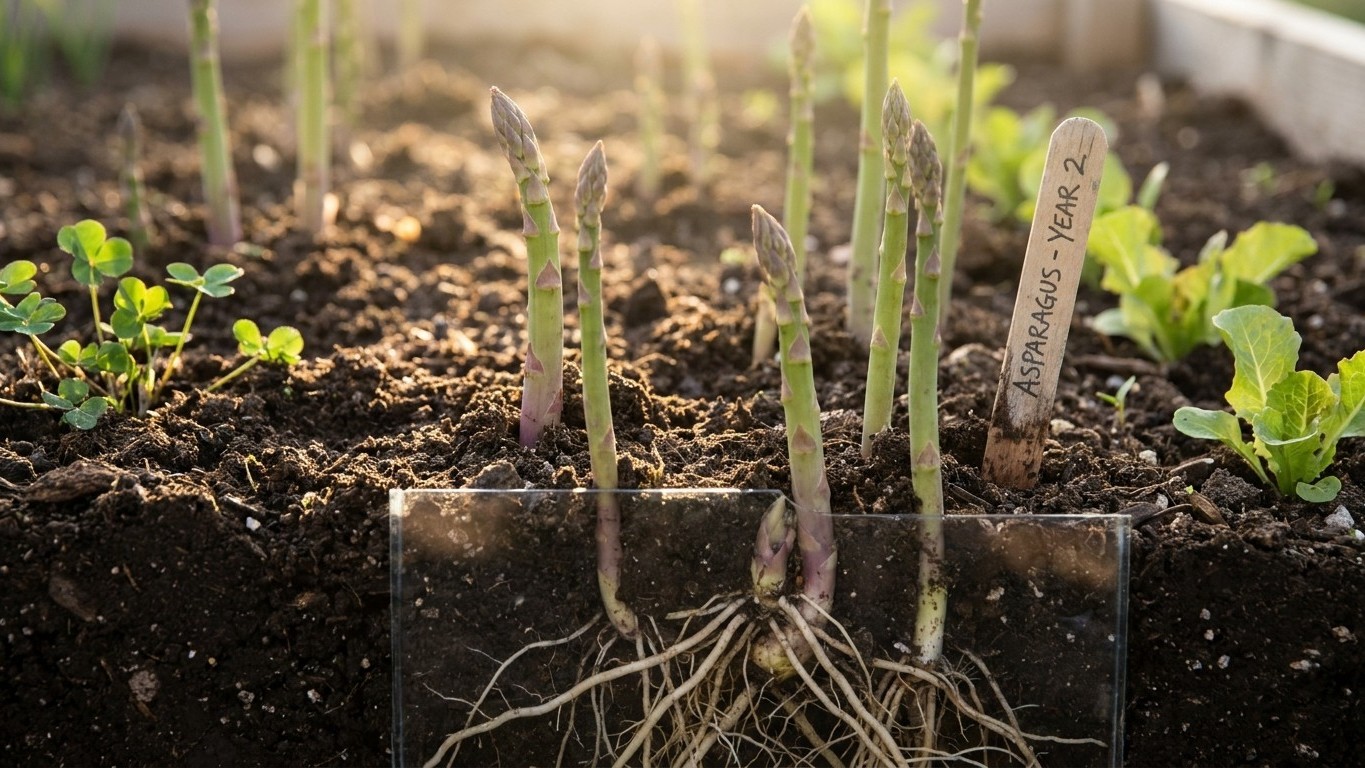

Utah State University Extension is direct about it: do not harvest asparagus until year 3 after planting. Skip year 1 and year 2 entirely. The plant needs that time to build an underground root system strong enough to feed itself. Cut too early and you weaken a bed that’s supposed to produce for 10-15 years.
The short answer
The rule from Utah State University Extension isn’t a suggestion, it’s a threshold: no spears come off the bed in the first two seasons, full stop. The plant is putting every bit of energy into its crown and root system underground, and every spear you’d be tempted to cut in year 1 or year 2 is fern-in-waiting, the very tissue that photosynthesizes and refills the storage roots for next spring. Take it early and you’re stealing from a fund that hasn’t finished depositing.
Year 3 is when harvest finally opens, and even then it’s limited. Utah State University Extension specifies that plants may be harvested for up to 4 weeks in that third year, with spears cut at 9 inches tall, right at ground level. That’s a short window compared to what comes later. Year 4 stretches the harvest to 6 weeks. From year 5 onward, the bed can support up to 8 weeks of cutting each spring.
Notice the pattern: the harvest window grows year over year, not because someone picked round numbers, but because the crown’s carbohydrate reserves are literally getting bigger underground. A 2-year-old crown and a 6-year-old crown are not the same size, and the harvest schedule tracks that difference directly.
There’s a second piece to this that trips up a lot of home growers: even within an approved harvest window, you don’t cut until the spears run out. The stopping signal is a physical one, not a calendar one. Stop harvesting when the majority of spears are smaller than a pencil in diameter. When the bed starts sending up thin, pencil-width spears instead of thick ones, that’s the plant telling you its reserves are running low for the season. Let the rest grow into fern from that point forward.
Put the two rules together and you get the actual discipline behind asparagus growing: wait years before you touch it, then within any given harvest year, stop watching the calendar and start watching spear diameter. Get the sequence backwards, cutting early or cutting a full 8-week season your bed can’t yet support, and you shorten the productive life of a planting that’s supposed to keep feeding you for over a decade.
What actually decides it
Root reserves, not plant age by itself
The real currency here is carbohydrate storage in the crown and root system, not simply how many years have passed. Each spear you allow to grow into full fern captures sunlight and sends sugars down into the roots. Each spear you cut instead removes tissue before it can do that job. That’s why the first two years are cutting-free: the young root system hasn’t built enough reserve capacity to survive losing spears, and why the harvest window lengthens as the crown matures, because a bigger root system can afford to give up more spears before it runs short.
The pencil test as a built-in feedback loop
Asparagus doesn’t hide how it’s doing. Utah State University Extension’s stopping rule, majority of spears smaller than a pencil, works because spear diameter is a direct readout of stored energy. Thick spears mean the crown still has plenty banked. Thinning spears mean it’s dipping into its last reserves for the season. This is why the guidance never converts into a week count: a bed in rich soil with steady moisture might hold thick spears longer than one under stress, and a date on a calendar can’t account for that, but the spears themselves can.
Depth and timing of planting
How the crown goes into the ground in year 1 shapes how well it establishes before harvest ever starts. Clemson Extension describes setting crowns 15 to 18 inches apart and 6 to 8 inches deep, but the crown isn’t buried at that full depth on planting day. It sits in an open trench, and soil gets pulled over the crowns gradually, about 2 inches every two to three weeks, until the trench fills in and the crowns end up 6 to 8 inches deep. Filling the trench all at once instead of gradually is one of the more common ways a new bed gets off to a weak start, because the emerging spear has to push through less resistance early on while the root system is still forming.
How to do it
- Dig the trench and set the crowns. Space crowns 15 to 18 inches apart, in a trench roughly 6 to 8 inches deep, following Clemson Extension’s spacing.
- Backfill gradually, not all at once. Pull soil over the crowns in stages, about 2 inches every two to three weeks, until the trench is filled and the crowns sit at their full 6 to 8 inch depth.
- Let the bed grow undisturbed for its first two seasons. No spears are cut in year 1 or year 2, per Utah State University Extension. All growth becomes fern that feeds the roots.
- Begin harvest in year 3, for up to 4 weeks. Cut spears once they reach about 9 inches tall, at ground level.
- Extend harvest in year 4, to 6 weeks. Same cutting method: 9-inch spears, cut at ground level.
- From year 5 onward, harvest for up to 8 weeks each spring, the longest window the plant supports.
- Watch spear diameter throughout every harvest window. Regardless of which year’s time limit applies, stop harvesting as soon as the majority of spears are smaller than a pencil in diameter.
- Let remaining and later spears grow into full fern once harvest ends for the season, so the crown can rebuild its reserves for next year.
What goes wrong
- Cutting spears in year 1 or year 2. The bed hasn’t built enough root reserve to spare any spears yet. Remedy: leave every spear alone until year 3, no exceptions, and let it grow into fern.
- Filling the planting trench all at once. Burying the crown at full 6 to 8 inch depth on day one is a common way to lose a new bed. Remedy: backfill in stages, about 2 inches every two to three weeks, per Clemson Extension, until the trench is full.
- Harvesting past the pencil-diameter signal. Continuing to cut once spears have thinned drains reserves the plant needs for next year. Remedy: stop the moment most spears are pencil-thin or smaller, and let the rest grow to full height.
- Treating the weekly harvest limits as flexible. Cutting longer than 4 weeks in year 3, 6 weeks in year 4, or 8 weeks in year 5 and after overrides the schedule the crown’s maturity can support. Remedy: track the season and stop at the published limit for that year, even if spears still look thick.
- Choosing a variety based on assumed flavor or yield differences. Named varieties like Jersey Giant and Jersey Knight are all-male types, while UC 157 F1 and Purple Passion are male/female types; no flavor or yield ranking for these is published here. Remedy: select based on the sex type suited to your bed management, not on unverified claims about taste or productivity.
- Expecting the bed to keep producing indefinitely without decline. An asparagus planting is expected to produce spears for 10-15 years, not permanently. Remedy: plan for eventual replanting rather than treating the original bed as a one-time, lifelong investment.
Common questions
Can I harvest a few spears in year 2 if the bed looks strong?
Utah State University Extension’s guidance is that harvest doesn’t begin until year 3. The source doesn’t describe an exception for vigorous-looking beds in year 2.
How do I know when to stop cutting each spring?
Stop when the majority of spears are smaller than a pencil in diameter, per Utah State University Extension. This is a physical signal from the plant, not tied to a specific week or date.
Why does the harvest window get longer each year?
Because the root system’s stored reserves grow as the crown matures. Year 3 supports up to 4 weeks of harvest, year 4 up to 6 weeks, and year 5 onward up to 8 weeks, reflecting a bigger underground reserve capacity each year.
Is there a difference in flavor or yield between all-male and male/female varieties?
That information isn’t published in the sourced guidance here. All-male types include Jersey Giant and Jersey Knight; male/female types include UC 157 F1 and Purple Passion, but no comparative flavor or yield data is available from these sources.