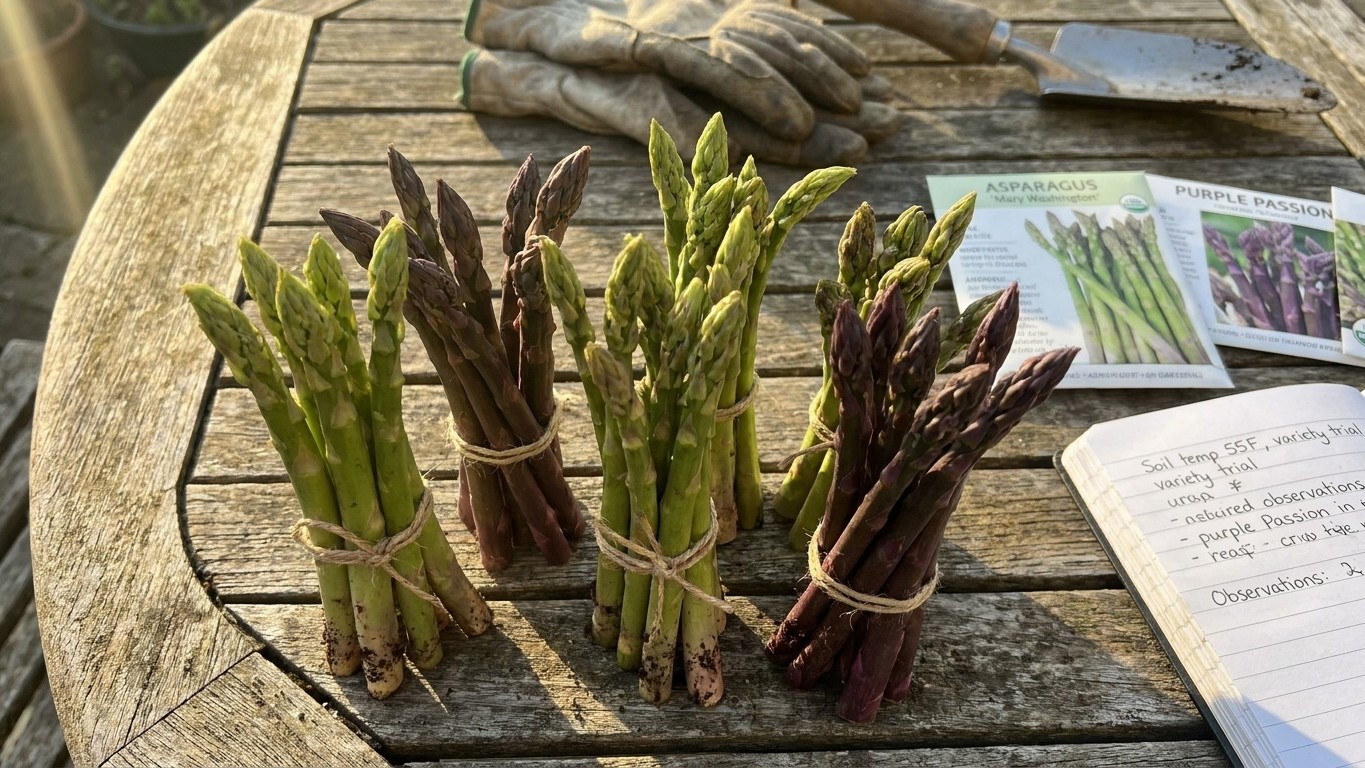

Utah State University Extension names exactly four asparagus varieties in its guidance: two all-male hybrids, Jersey Giant and Jersey Knight, and two male/female varieties, UC 157 F1 and Purple Passion.
The short answer
Utah State University Extension’s publication Asparagus in the Garden lists Jersey Giant and Jersey Knight as all-male varieties. It lists UC 157 F1 and Purple Passion as male/female varieties.
Not here.
What actually decides it
Why sex matters in an asparagus bed
Asparagus plants are either male or female, and that split shows up in the bed over years. Female plants spend energy producing berries and seed. That energy comes out of the same reserve pool the plant would otherwise put into next year’s spears. All-male varieties like Jersey Giant and Jersey Knight remove that competition by design, since every plant in the row is male. Male/female varieties like UC 157 F1 and Purple Passion keep both sexes in the mix.
Why the crown depth isn’t fixed on planting day
Separately from variety choice, how deep a crown sits changes over the course of a season, and that’s a mechanism gardeners often get backwards. Clemson Extension instructs gardeners to “set the crowns 15 to 18 inches apart and 6 to 8 inches deep.” That sounds like a single planting depth. It isn’t. The same source adds a second instruction: “continue to pull soil over the crowns (about 2 inches every two to three weeks) until the trench is filled, and the crowns are 6 to 8 inches deep.” The crown starts shallow, in an open trench, and reaches that 6 to 8 inch depth gradually, as soil is pulled over it in small increments while spears emerge. Filling the trench all at once at planting time skips the mechanism the plant needs, which is why beds planted that way often struggle.
Why the pencil test replaces a calendar
The other mechanism worth understanding is how harvest ends each season. Clemson Extension states: “Stop harvesting when the diameter of the spears has been reduced to pencil-size and allow the spear to grow to full height.” The signal comes from the plant, not a date on a calendar. When spears start coming up thin, the crown is running low on stored energy and needs the fern that follows to rebuild those reserves for next year. A calendar date can’t account for a warm spring that pushes growth early or a cool one that delays it, but the pencil-sized spear shows up regardless of the weather that season.
How to do it
- Pick a category, not a favorite. Decide between an all-male variety (Jersey Giant or Jersey Knight) and a male/female variety (UC 157 F1 or Purple Passion), understanding that no flavor, yield, or hardiness data separates them in the source guidance.
- Dig the trench and set the crowns. Space crowns 15 to 18 inches apart, in a trench 6 to 8 inches deep, per Clemson Extension.
- Cover lightly at first. Don’t fill the trench at planting. Set the crown in the open trench and add only a shallow layer of soil to start.
- Pull soil over the crowns gradually. Add about 2 inches every two to three weeks, continuing until the trench is filled and the crowns reach the full 6 to 8 inch depth.
- Wait through the first two growing seasons. No harvest happens until year 3.
- Harvest lightly in year 3. Take spears for about 4 weeks, then stop and let the fern grow.
- Extend the harvest window in year 4. Harvest for about 6 weeks that season.
- Extend again in subsequent years. Harvest for about 8 weeks once the bed is fully established.
- Watch the spears, not the date, to know when to stop each season. Stop harvesting when spear diameter shrinks to pencil-size, and let remaining spears grow to full height, per Clemson Extension.
What goes wrong
- Filling the trench all at once at planting. Burying the crown at the full 6 to 8 inch depth on day one skips the gradual backfill the plant needs. Instead, cover shallow at first and add about 2 inches every two to three weeks until the trench fills and the crown reaches that depth.
- Harvesting before year 3. Pulling spears in year 1 or 2 robs the crown of the reserves it needs to establish. Wait until year 3, then take a short 4-week harvest, followed by 6 weeks in year 4 and 8 weeks in later years.
- Ignoring the pencil-size signal. Continuing to harvest after spears have thinned to pencil-size drains the crown right when it needs to rebuild energy through the fern. Stop as soon as most new spears come up pencil-thin, and let them grow out fully instead.
- Expecting a flavor or yield difference between the four named varieties.
- Spacing crowns too close or too shallow. Crowding crowns tighter than 15 to 18 inches apart, or setting the trench shallower than 6 to 8 inches, cuts against the spacing Clemson Extension lays out. Stick to that range rather than tightening it to save space.
Common questions
Does Utah State University Extension say which of the four varieties yields more?
No.
Is Purple Passion an all-male variety?
No. Utah State University Extension lists Purple Passion as a male/female variety, alongside UC 157 F1.
Can I harvest asparagus in the first year after planting?
No. Harvest doesn’t begin until year 3, starting with about 4 weeks, then 6 weeks in year 4, then 8 weeks in following years.
How do I know when to stop cutting spears each season?
Stop when the spears have thinned to pencil-size in diameter and let the remaining spears grow to full height, per Clemson Extension’s guidance. There’s no fixed week number attached to this rule; the spear itself is the signal.