
Three years of zero harvest, then a slow climb: 4 weeks, then 6, then 8. That’s the deal Utah State University Extension lays out for asparagus, and it’s the reason so many gardeners plant a bed once and then eat from it for a decade and a half. The commitment is real, but so is the payoff: “Expect the plant to produce spears for 10-15 years.”
The short answer
Utah State University Extension is blunt about the timeline, and the instruction isn’t a suggestion: “Do not harvest asparagus until year 3 after planting.” That’s not a typo and it’s not overly cautious advice from a nervous extension office. It’s the minimum time an asparagus crown needs to build the root system that will feed it for the next decade and beyond, a timeline that starts the moment you handle Planting Asparagus Crowns, though the crown’s productivity over those years also depends on the variety you started with, a decision covered in All-Male or Not. Cut spears before that window closes and you’re stealing energy the plant hasn’t banked yet, which is exactly Why You Do Not Cut Asparagus for Three Years.
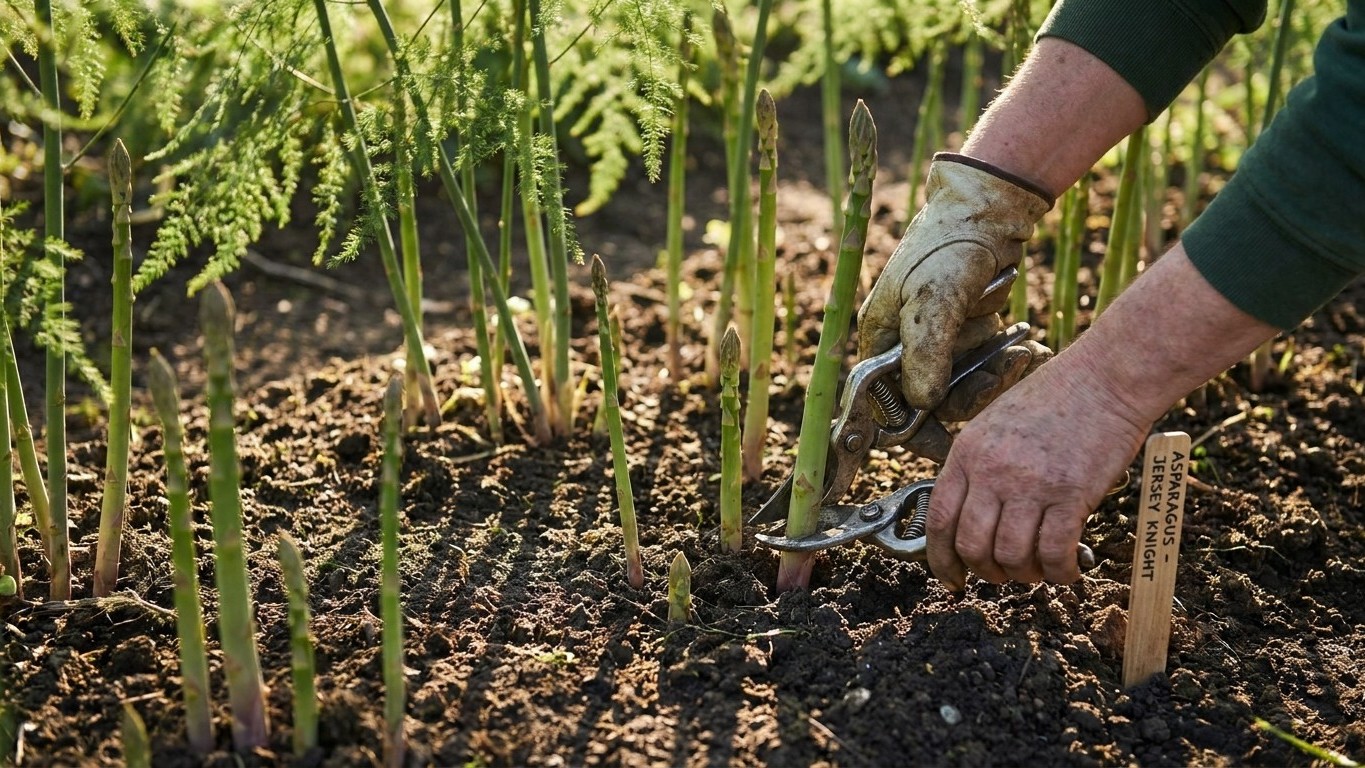
Once year 3 arrives, the harvest doesn’t open all at once. Plants “may be harvested for up to 4 weeks” that first cutting season, taking “9 inch tall spears at ground level.” The following year, the window stretches to “Harvest for 6 weeks.” From year 5 onward, an established bed can be cut for “up to 8 weeks” each spring, a progression known as Four Weeks, Then Six, Then Eight. Each season, the stopping point isn’t a date circled on a calendar. It’s a physical signal, the guideline known as When to Stop Cutting Asparagus: “Stop harvesting when the majority of spears are smaller than a pencil in diameter.” When the spears thin out to that size, the crown is telling you it’s running low on reserves and needs its fern foliage to recharge for next year.
Add it up and here’s the arithmetic behind the fifteen-year decision: three unproductive years, followed by a harvest window that grows from a month to nearly two months, sustained for “10-15 years” total. That’s the actual return on the investment. A well-managed asparagus bed isn’t a seasonal crop you replant. It’s closer to a fruit tree, something you plant once and then manage for its entire productive life.
The number that trips people up isn’t the 10-15 years. It’s the first three, when the bed looks like a modest patch of ferny stalks and produces nothing edible. Gardeners who dig it up in frustration during year two are throwing away the exact investment that would have paid off the following spring, often after misreading normal early struggles as signs of failure, a mix-up covered in What Goes Wrong With an Asparagus Bed. Patience isn’t optional here. It’s the entire mechanism.
What actually decides it
Root reserves, not spear count
Asparagus spears aren’t the plant, they’re the visible tip of a crown that spends most of the year underground, storing carbohydrates in its roots. Every spear cut in spring is energy the crown had banked the previous summer through its fern growth, which is why knowing What to Do With Asparagus Ferns in Autumn matters just as much as the spring harvest itself. That’s why year 1 and year 2 harvests are forbidden outright, and why even a mature bed has a hard stop each season. Cut too aggressively, too early, and the crown never accumulates enough reserve to push next year’s growth.
The pencil test as a biological signal
The stopping rule for harvest isn’t tied to a week number, because Clemson Extension frames it the same way Utah State does: “Stop harvesting when the diameter of the spears has been reduced to pencil-size and allow the spear to grow to full height.” The spear diameter is the plant reporting its own energy status in real time. A date-based rule would fail in a cool spring or a warm one; the pencil rule works regardless of the calendar, which is exactly why it’s the standard across territories.
Drainage over everything else
Utah State University Extension notes that “most soils will do provided they are well drained.” Asparagus crowns sitting in standing water rot before they ever establish, which makes drainage the single soil factor that determines whether a bed survives its first season at all. The bed also wants “fertile, well-drained soil enriched with organic matter and phosphorus,” since phosphorus supports the root development that everything else depends on.
Irrigation that changes with age
Watering isn’t constant across the bed’s life. For the first two years, the schedule calls for water “1-2 inches every other week.” After year 3, irrigation drops “to every 3 weeks.” An established root system can reach further and store more, so it needs less frequent attention, but that total is a baseline to weigh against your own local rainfall and heat, not an instruction to run the hose on autopilot regardless of conditions.
How to do it
- Choose your starting point. Utah State University Extension outlines two routes: planting 1-year-old crowns directly, or starting from seed, where you’d “plant seed in January for transplanting in April.”
- Dig the furrow. Plant 1-year-old crowns “in 8 inch deep furrows in early spring,” spacing them “12 inches apart” with “rows 4 feet apart.” Clemson Extension’s guidance runs slightly wider: crowns “15 to 18 inches apart and 6 to 8 inches deep.”
- Set the crown, don’t bury it yet. Cover the crowns with “2 inches of soil” at planting, leaving the rest of the furrow open.
- Backfill gradually, not all at once. Fill the remaining furrow depth “by cultivation during the year adding 2 inches of soil every other month.” Clemson describes the same gradual process: “continue to pull soil over the crowns (about 2 inches every two to three weeks) until the trench is filled, and the crowns are 6 to 8 inches deep.” Dumping a full 8 inches of soil on a crown at planting time is one of the fastest ways to smother it before it establishes.
- Feed the bed. Work in “a complete fertilizer (16-16-8) using about 1 pound per 100 square feet,” along with “1/2 pounds of high phosphate (11-52-0) fertilizer per 100 square feet of furrow.”
- Water on the young-bed schedule. For the first two years, water “1-2 inches every other week” while the root system develops.
- Hold off on harvest through year 2. No cutting, no matter how tempting the spears look.
- Begin harvest in year 3, cutting “9 inch tall spears at ground level” for up to 4 weeks, then stopping once most spears run pencil-thin.
- Extend the window in later years, moving to 6 weeks in year 4 and up to 8 weeks from year 5 on, always governed by the pencil-diameter signal rather than the date.
- Switch the irrigation schedule after year 3, reducing watering to every 3 weeks as the established root system takes over.
What Goes Wrong
- Harvesting in year 1 or 2. The bed looks ready, the spears look edible, but cutting before year 3 robs the crown of the reserves it needs to survive. Remedy: mark the planting date and don’t touch a single spear until the third spring, no exceptions.
- Filling the furrow all at once. Backfilling the full 8 inches (or the 6-8 inch Clemson depth) at planting time buries the crown before it can push through. Remedy: cover with only 2 inches at first, then add soil gradually, “2 inches every other month” or “about 2 inches every two to three weeks,” letting the emerging spears guide the pace.
- Harvesting past the pencil point. Continuing to cut once spears go thin strips the crown of the fern growth it needs to recharge for next season. Remedy: stop the moment the majority of spears are pencil-diameter, and let the rest grow to full fern height.
- Planting in poorly drained soil. Crowns sitting in wet, heavy soil rot before establishing, no matter how much fertilizer goes in. Remedy: confirm drainage before planting, since “most soils will do provided they are well drained” is the one non-negotiable soil condition on record.
- Watering on the wrong schedule for the bed’s age. Sticking with the young-bed watering routine of every other week long after year 3, or cutting water too early on a young bed, both work against the root system’s needs at each stage. Remedy: water 1-2 inches every other week for the first two years, then shift to every 3 weeks once the bed matures past year 3.
- Choosing a variety based on flavor or yield claims. Utah State University Extension names four varieties by sex only, all-male types (Jersey Giant, Jersey Knight) and male/female types (UC 157 F1, Purple Passion), with no published comparison of taste or yield between them. Remedy: don’t chase marketing claims not backed by the extension source; select based on sex type and availability rather than unverified performance claims.
| Variety | Sex type |
|---|---|
| Jersey Giant | All-male |
| Jersey Knight | All-male |
| UC 157 F1 | Male/female |
| Purple Passion | Male/female |
Common questions
Can I harvest a few spears early just to taste them?
Utah State University Extension doesn’t leave room for a partial harvest. The instruction is to not harvest until year 3 after planting, full stop, with no allowance for a light sampling in year 1 or 2.
How do I know exactly When to Stop Cutting each season?
Watch the spears, not the calendar. Stop once the majority come up thinner than a pencil, and let the remaining spears grow out into full fern. Clemson Extension frames the same rule: stop when spear diameter drops to pencil-size and allow the spear to reach full height.
Does soil pH matter for asparagus?
That’s not addressed in the sourced guidance here. What is specified is that the soil needs to be well drained and enriched with organic matter and phosphorus; pH isn’t part of the published recommendation.
Will the harvest length keep growing after year 5?
The published schedule tops out at up to 8 weeks from year 5 onward. There’s no indication the window keeps expanding beyond that; the pencil-diameter rule continues to govern when to stop each season regardless of how many years the bed has been producing.