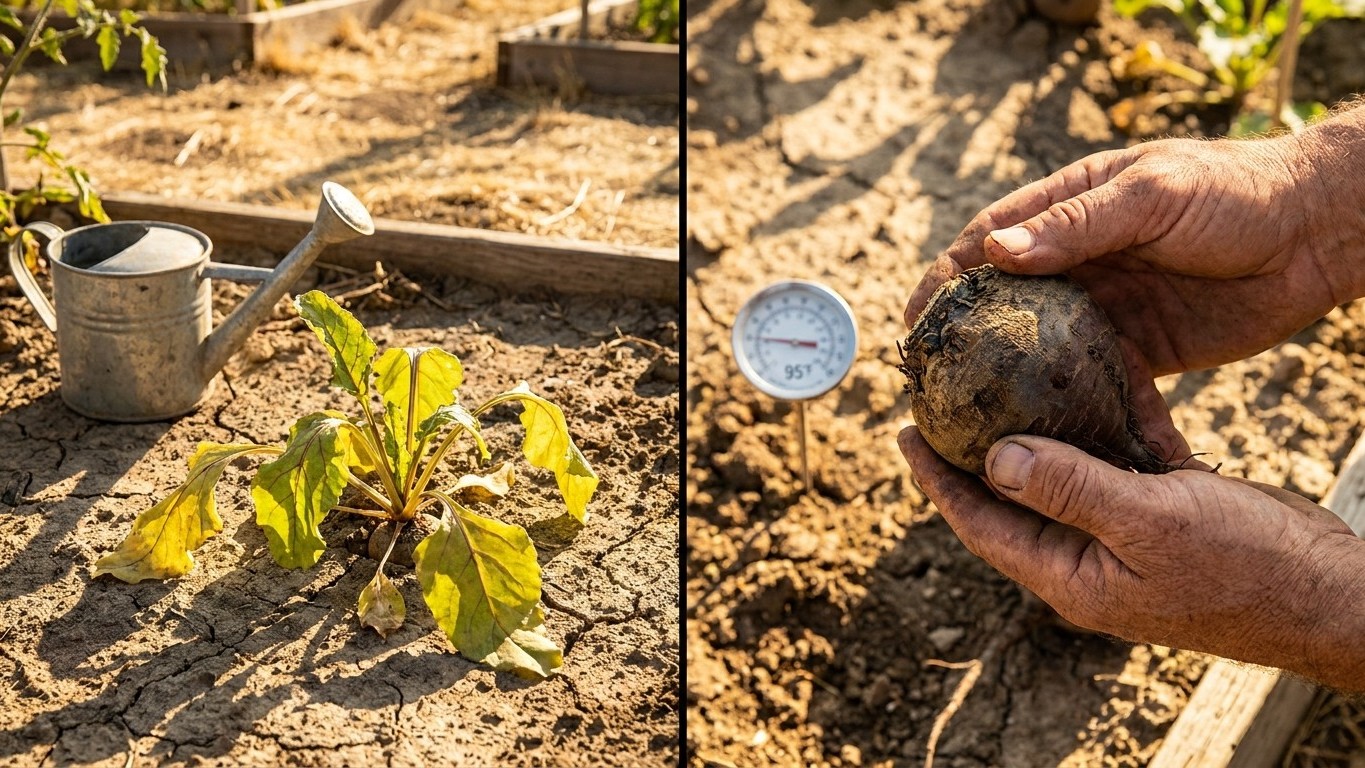

A woody beet almost always traces back to heat stress after the root has already formed, not to a single dry week early on. But there’s a second, earlier failure that gets confused with it: water stress in the first six weeks doesn’t make beets woody, it makes them bolt, and a bolted beet never builds a proper root at all. Utah State University Extension separates the two, and the timing of your dry spell is what tells you which one you’re looking at.
The short answer
Utah State University Extension, in its guide Beets in the Garden, lays out two distinct failure points for beets, and gardeners routinely lump them into one vague complaint: “the beets didn’t do well.” They’re not the same problem, and they don’t happen at the same time.
The first is bolting. USU Extension states plainly that water stress during the first six weeks causes premature flowering. A beet seedling that goes thirsty early switches from building a root to building a flower stalk, and that switch doesn’t reverse. You can water the plant perfectly for the rest of the season and it will still push up a seed stalk instead of a root worth eating.
The second is woodiness, and it happens later, closer to harvest, when the root already has some size on it. USU Extension’s language here is specific: hot weather and water stress can cause woody bulbs. This is a texture failure, not a growth failure. The plant is still alive, still making a root, but the tissue toughens under combined heat and dryness. The published fix is just as specific: keep plants well-watered when temperatures go above 85 F.
So if you’re asking which one did it to your patch, look at when the damage showed up. A row of beets that shot up flower stalks and never bulked up was likely stressed in its first six weeks, seedling stage, regardless of how hot the summer got later. A row of beets that grew normal-looking roots but turned tough and fibrous by harvest was likely stressed by heat above 85 F combined with dry soil, closer to maturity.
Both failures share the same root cause, water, but they hit at different growth stages and produce completely different results. One kills the crop’s structure from the start. The other ruins the eating quality of a root that otherwise formed fine. Knowing which stage your dry spell fell in tells you which failure you’re dealing with, and that matters more than knowing the calendar date of the heat wave.
What actually decides it
Two different mechanisms are at work here, both triggered by lack of water, both documented by USU Extension, but operating on different tissue at different points in the plant’s life.
Early thirst bolts the plant
Beets are biennials by nature. Left alone for two years, they’d build a root the first year and send up a flower stalk the second. Stress signals, especially water stress in that critical first six weeks after seeding, can trick the plant into thinking it’s already survived a full season and needs to reproduce now. The plant redirects its energy from root storage to stalk and seed production. Once that switch flips, there’s no undoing it with a garden hose. This is why the first six weeks after seeding matter more than any other stretch of the growing season for root beets specifically. A missed watering during germination or early leaf growth carries more consequence than the same missed watering a month later.
Later heat makes it woody
Once a beet has cleared that early window and is building root mass normally, the second mechanism takes over as temperatures climb. Above 85 F, combined with dry soil, the root’s cell walls thicken and lignify faster than the storage tissue can keep up with. The result is a root that looks fine from the outside but cuts tough and fibrous, with a stringy texture that doesn’t soften much in cooking. This isn’t a growth failure at all, the plant is still sizing up a root, it’s a quality failure in the tissue itself. The remedy USU Extension publishes is narrow and specific: keep the plants well-watered whenever temperatures go above 85 F. There’s no separate threshold given for a lower, milder heat stress, so treat 85 F as the number that matters and don’t improvise a lower cutoff.
The overlap between these two mechanisms is water, but the timing separates them completely. Six weeks in, thirst threatens the plant’s entire structure. Later, near maturity, thirst combined with heat threatens only the texture of a root that’s already there. Diagnosing which one hit your crop means asking not just “was it dry” but “when.”
How to do it
- Sow beet seed directly in the row. Beets don’t transplant well, so there’s no seedling stage grown elsewhere and moved later, the count toward maturity starts at seeding.
- Keep the soil consistently moist through the first six weeks after seeding without exception. This is the window USU Extension identifies as the bolting trigger, so treat any lapse here as higher risk than a similar lapse later.
- Thin seedlings once they’re up and growing, leaving plants 3 inches apart within the row. Beet “seeds” are actually seed clusters that often sprout more than one seedling each, so thinning is necessary even when you sowed at the recommended spacing.
- Space rows 12 to 18 inches apart to give roots room to bulk up and to make room for hoeing or hand weeding without disturbing the row.
- Monitor temperatures as the roots size up. Once readings climb above 85 F, increase watering frequency specifically to counter the woodiness risk, separate from whatever routine watering schedule you’d been running.
- Harvest roots 60 to 80 days from the seeding date, with the exact number depending on the variety planted. Pull a test root if you’re unsure, since the range is wide enough that calendar guessing alone isn’t reliable.
- Store harvested roots at 32 F and 95 percent relative humidity. Under those conditions, USU Extension reports beets keep for 2 to 4 months, making a root cellar or a refrigerator crisper drawer with added humidity the practical options for most home growers.
What goes wrong
- Seedlings go dry in the first six weeks and the row bolts. Once flower stalks appear, there’s no reversing it with better watering afterward. The remedy is entirely preventive: treat the first six weeks after seeding as non-negotiable for soil moisture, since USU Extension identifies this exact window as the trigger for premature flowering.
- Roots turn tough and stringy near harvest. This points to heat above 85 F paired with dry soil late in the season, a separate failure from bolting. The published fix is to keep plants well-watered specifically once temperatures cross that 85 F mark, rather than relying on a general watering routine that doesn’t account for heat spikes.
- Rows come up overcrowded and roots stay small. Beet seed clusters often produce multiple seedlings per cluster, so skipping the thinning step leaves plants competing for space. Thin to 3 inches apart in the row as soon as seedlings are large enough to handle.
- Harvest timing is guessed by the calendar alone. Because maturity runs 60 to 80 days from seeding depending on variety, and the source gives no variety-specific number, pulling a test root partway through that range is more reliable than assuming every planting matures on the same day.
- Stored roots shrivel or rot within weeks. Home storage conditions rarely hit 32 F and 95 percent relative humidity by accident. Without both the cold and the humidity, roots lose the 2 to 4 month storage window and spoil much faster.
Common questions
Does a woody beet mean I underwatered the whole season?
Not necessarily. Woodiness specifically points to heat above 85 F combined with dry soil closer to harvest, a different failure from underwatering earlier in the season. A beet can be woody even if the first six weeks were watered well.
Can a bolted beet still be eaten?
The source doesn’t address edibility directly, but a bolted plant has redirected its energy into a flower stalk instead of root storage, so the root itself typically stays small and underdeveloped compared to a root that never bolted.
How do I know which variety matures fastest?
USU Extension names five varieties, Detroit Dark Red, Red Ace, Early Wonder, Green Leaf, and Golden, but gives no maturity figure, color note, or use for any single one of them. The 60 to 80 day range is given for beets generally, with variety cited as the reason for the spread, not tied to a specific name.
Is 85 F the only temperature threshold I need to watch?
That’s the only figure USU Extension publishes for this crop. No secondary threshold, whether a lower warning temperature or a separate frost-related number, is given in the source, so treat 85 F as the number to track rather than estimating additional cutoffs.