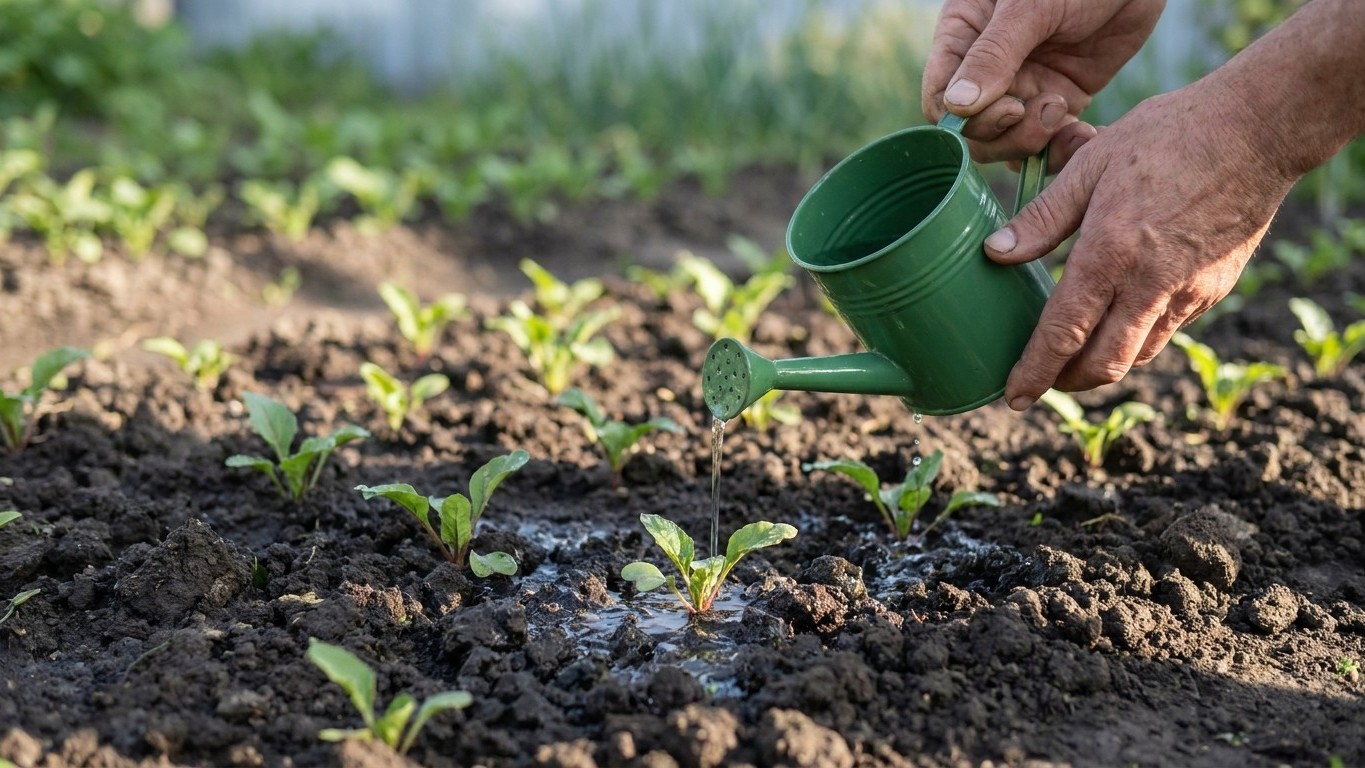

A beet’s root is decided long before harvest, in the six weeks right after the seed goes into cool soil. That’s the stretch where thirst does damage no later watering can fix: the plant skips making a root and bolts to seed instead. Everything else, from soil texture to spacing to the variety you pick, matters less than keeping the row evenly moist during this early stage. Get the six weeks right, and the root follows on its own over the following two months.
The short answer
Utah State University Extension is direct about it: water stress during the first six weeks after seeding causes premature flowering in beets. That single sentence, published in the Extension’s guide to Growing Beets in the garden, is the whole story, and it lines up with a broader explanation of Why Beets Bolt. A beet plant that runs dry while it’s still small reads the drought as a signal to reproduce, not to keep building a root. It bolts. Once that switch flips, the plant channels its energy into a flower stalk, and the root stays thin and stops thickening no matter what happens afterward.
The practical version, detailed further in a dedicated guide to Sowing Beets: from the day seed goes into the ground until roughly six weeks later, the soil around beet rows needs to stay consistently moist. Not soaked, not left to crack and dry out between waterings. Consistently damp, the way a wrung-out sponge stays damp. That’s the mechanism behind most good, or disappointing, beet harvests, and it plays out well before the root has grown to any noticeable size.
Beets mature 60 to 80 days from seeding, depending on variety, so that six-week window covers roughly the first half to two-thirds of the crop’s life. Seeds germinate best between 55 and 75 F and take 7 to 14 days just to break the surface, which means growers are often watering a bare-looking row, trusting that seedlings are working their way up underground. Skipping irrigation during that invisible stretch is exactly how a crop bolts before it’s ever fully up.
None of this means the rest of the season is irrelevant. Soil quality, spacing, and heat control still shape the size and texture of the finished root, a subject covered in depth in Beet Soil: What the Root Needs, and the Compost Ceiling, while proper Thinning Beets ensures each root has room to develop fully. Later heat and inconsistent watering can still toughen a root’s texture, as explored in Woody Beets: Heat, Thirst, and Which One Did It, but those factors adjust a harvest that’s already headed in the right direction, and knowing the finer points of Harvesting and Storing Beets ensures that good start pays off at pulling time. Water stress in the first six weeks removes that possibility outright. There’s no fixing a bolted beet with better fertilizer in week ten.
Utah State University Extension names five Beet Varieties gardeners commonly grow: Detroit Dark Red, Red Ace, Early Wonder, Green Leaf, and Golden. The guide doesn’t attach a season, a color trait, or a particular use to any of them beyond their names, so the six-week rule applies the same no matter which one goes into the ground.
What actually decides it
Water shows up twice in a beet’s life as a problem, and it’s not the same problem both times. Growers tend to lump every watering issue under “keep it moist,” but the Extension’s guidance splits it into two distinct failures that happen at two different moments, with two different results.
Early thirst: bolting shuts the root down for good
In the first six weeks, a dry spell tells the young plant that conditions are unsafe for a long growing season. Its response is to skip ahead: instead of investing in a swelling taproot, it starts building a flower stalk. This is bolting, and it’s a one-way decision. Once the plant has committed to flowering, no amount of water added later reverses it. The root that should have thickened stays skinny and woody, and the plant’s energy goes upward into seed production instead. This is why the guidance singles out the first six weeks specifically, rather than describing beets as simply “needing regular water” for the whole season.
Later heat: woody roots, not a bolted plant
After that early window, a different kind of water stress causes a different kind of damage. Beets grow best when temperatures stay at or below 85 F. When heat climbs past that point and the soil also runs dry, the root doesn’t stop forming, but it toughens. The published remedy is to keep plants well-watered specifically when temperatures rise above 85 F. This isn’t the plant abandoning the root; it’s the tissue turning fibrous and tough under combined heat and drought stress, even as it continues to grow in size.
Soil structure: why depth and drainage shape the root’s form
Beets want fertile, well-drained, deep, sandy soils rich in organic matter. In heavier ground, roots meet resistance and grow forked or misshapen simply because there’s nowhere easy to expand. Amending heavy soil with compost loosens it enough for a straight taproot to form, but there’s a ceiling on that fix: no more than 1 inch of composted organic matter per 100 square feet. This is the number gardeners most often overshoot, assuming more compost means better soil. It doesn’t, at least not for this crop.
How to do it
- Check the soil temperature before sowing. Wait until the soil reaches 40 F, timed to about 2 to 3 weeks before the last frost in your area.
- Prepare a bed that drains well and runs deep. Beets want fertile, well-drained, deep, sandy soil rich in organic matter. If the ground is heavy, work in compost, staying under the 1-inch-per-100-square-foot ceiling.
- Sow seed a quarter to a half inch deep. Beet seed clusters are small enough that shallow planting matters for even emergence.
- Water immediately after sowing. Seeds germinate best between 55 and 75 F and take 7 to 14 days to emerge, so the row needs steady moisture even before any green shows.
- Hold that moisture steady for the first six weeks without interruption. This is the window where dryness triggers premature flowering, and it can’t be corrected once it happens.
- Thin seedlings once they’re up. Space plants 3 inches apart within the row, with rows 12 to 18 inches apart, so roots have room to widen.
- Watch the thermometer through summer. Beets grow best when temperatures stay below 85 F; once they climb past that, keep the plants well-watered to head off woody bulbs.
- Harvest by days, not guesswork. Roots mature 60 to 80 days from seeding, depending on variety, so track the sowing date rather than transplant timing, since beets are sown in place.
- Store what you don’t use right away at 32 F and 95 percent relative humidity. Kept there, beets hold for 2 to 4 months.
What goes wrong
- Sowing before the soil is ready. Seed planted into ground colder than 40 F germinates unevenly or rots. Wait for the soil to hit that mark, roughly 2 to 3 weeks before the last frost, rather than sowing by calendar date alone.
- Letting the row dry out in the first six weeks. This is the failure with no fix: the plant bolts, and the root stops developing for the rest of the season. The only remedy is prevention, keeping the bed consistently moist through that entire early stretch.
- Overloading the bed with compost. More organic matter feels like it should help a heavy soil, but going past 1 inch per 100 square feet works against the root instead of for it. Measure the compost layer rather than eyeballing it.
- Ignoring irrigation once summer heat sets in. When temperatures push above 85 F and watering lags, roots turn tough and woody even though they keep growing in size. Step up watering specifically during hot stretches, not just on a fixed schedule.
- Skipping the thin-out. Rows left crowded produce small, crooked roots competing for the same space. Thin seedlings to 3 inches apart, with 12 to 18 inches between rows, as soon as they’re established.
Common questions
How long does it take beets to grow from seed to harvest?
Roots mature 60 to 80 days from seeding, depending on the variety, according to Utah State University Extension. That count starts at seeding, since beets are sown directly in place with no transplant date.
What soil temperature is right for planting beet seeds?
Sow once the soil reaches 40 F, timed roughly 2 to 3 weeks before the last frost, at a depth of a quarter to a half inch.
Why did my beets bolt instead of forming a root?
Utah State University Extension attributes premature flowering to water stress during the first six weeks after seeding. Once a plant bolts, the root stops developing for the remainder of the season, and later watering doesn’t reverse it.
What’s the best way to store beets after harvest?
Store roots at 32 F and 95 percent relative humidity. Under those conditions, they keep for 2 to 4 months.