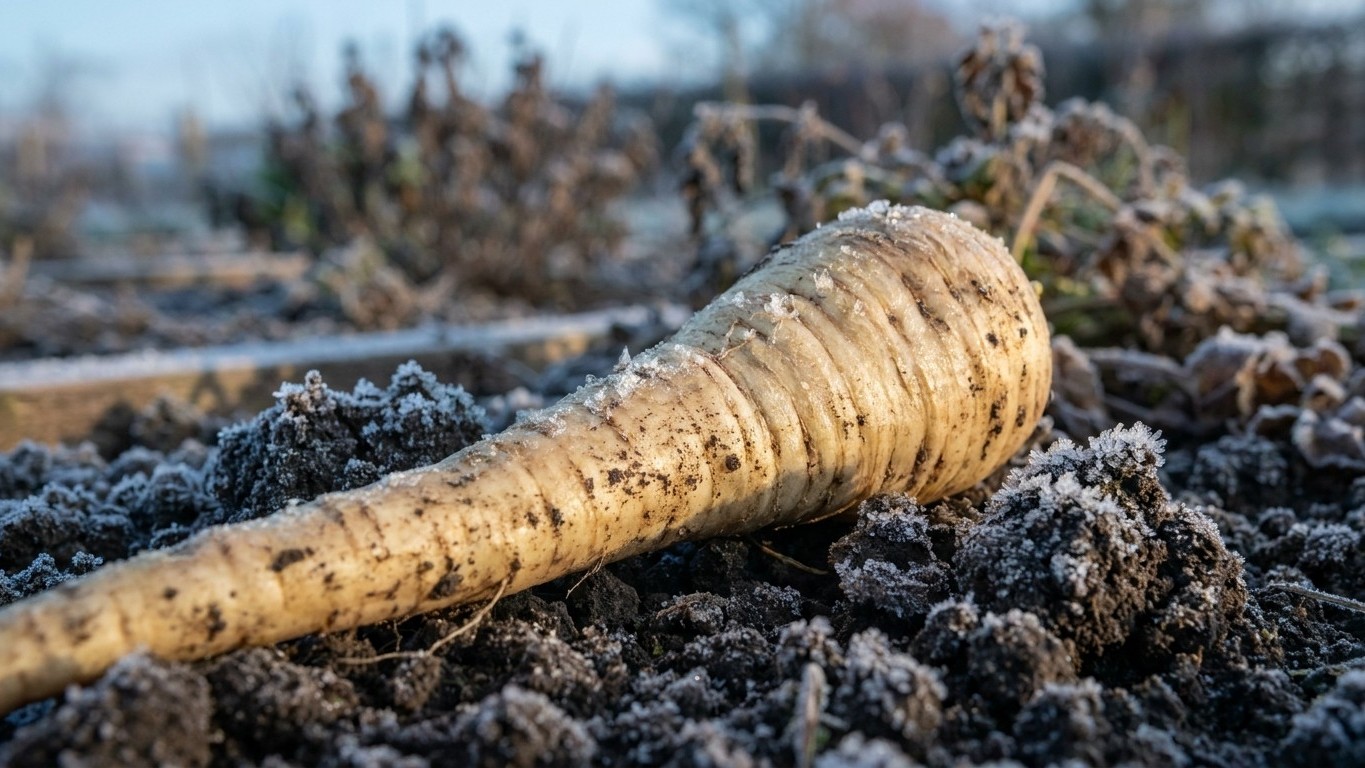

Lift Kansas parsnips after the ground has had several frosty weeks. On the Wichita calendar that means late November at the earliest, and often December. Pull them in October and you get a good root that isn’t sweet. Topped and held cold and damp, they keep four to six months, but only if they stay away from the fruit bowl. The numbers behind those dates, and the places a Kansas garden can trip, come next.
The short answer
Does Kansas deliver several frosty weeks? It does. At Wichita, the reference station in NOAA NCEI’s most recent 30-year Climate Normals, the mean daily minimum of the coldest month is 22.5°F. That is the typical overnight low, not a record, so on an ordinary winter night the thermometer sits nearly 10 degrees under freezing. Utah State University Extension says parsnips taste best after several weeks of cool, frosty weather, because the cold converts stored starch to sugar. A parsnip grown here will sweeten. It won’t just grow.
What decides that is frost exposure, not the hardiness zone number. A zone tells you whether a plant survives the winter, and a parsnip survives almost anywhere. Sweetness depends on how many weeks the roots sit through below-freezing nights, and a comfortable zone can still have a winter without them. The longer mechanism is in Will Parsnips Sweeten in Kansas?
The first fall frost at that station falls between October 23 and November 2 (the 30 to 70 percent probability band for a 32°F freeze, per NOAA NCEI). Count several weeks forward from there and the first sweet digging lands in late November. Those are airport figures for one city, not a statewide guarantee. Suburban and rural gardens usually see the first fall frost one to two weeks earlier, and the last spring frost one to two weeks later. Check your own county’s dates before you plan around these.
Once the roots are out, the storage rules matter more than most gardeners expect. USDA Agricultural Handbook 66 says parsnip roots can be stored 4 to 6 months at 32 to 34°F with 98% relative humidity. It also says parsnips are not chilling sensitive, so cold is not what ruins them. Ethylene is. The roots make almost none themselves (under 0.1 µL per kilogram per hour at 68°F), but even low levels of the gas in cold storage cause bitterness, likely from a buildup of xanthotoxin. Apples and any ripening fruit give off ethylene. Keep parsnips in a separate drawer or a separate room, even at the right temperature.
Two more details from the same handbook. Top the roots after harvest, but do not trim into the crown. And the four-to-six-month figure assumes 32 to 34°F and 98% humidity held steady, which almost no house does. In a typical kitchen, plan on less. The full text is in the USDA handbook.
Does the season fit?
Utah State University Extension puts parsnips at 100 to 120 days from seeding, sown in place about 2 to 3 weeks before the last spring frost. Here is that arithmetic against the Wichita frost window, step by step.
- The last spring frost at the reference station falls between April 4 and April 18, from the same NOAA NCEI freeze probabilities.
- Subtract 2 to 3 weeks. Three weeks before April 4 is March 14, and two weeks before April 18 is April 4. The sowing window runs from mid-March to early April.
- Remember that germination takes 14 to 21 days. A mid-March sowing may show nothing until the end of March or early April. The 100 to 120 days run from seeding, not from the day seedlings appear, so bare soil in the first three weeks is normal. Don’t dig it up and re-sow.
- Add 100 to 120 days. A March 14 sowing is ready between late June and mid-July. An April 4 sowing is ready between mid-July and the first days of August.
- Set that against the first fall frost, October 23 to November 2. Even the worst pairing, an early-April sowing that takes the full 120 days, leaves about 80 days between maturity and the first freeze. Early sowings leave far more.
- Shift for your location. A garden whose last frost runs one to two weeks later, and whose first frost arrives one to two weeks earlier, loses up to four weeks of slack. That still leaves room.
The verdict is that the season fits comfortably. A Kansas parsnip reaches full size in midsummer, well ahead of frost. The long part is the wait afterward, and that wait is what makes the crop worth growing. For the sowing side, including seedbed and spacing, see Growing Parsnips in Kansas.
What goes wrong here
Most Kansas parsnip failures are not about cold or calendar. They come from the soil, the hose, and the kitchen. Utah State University Extension asks for deep sandy soil and says heavy soil must be double dug. What a soil map says about your yard is only a starting point, so push a spade down and see what is there.
- Forked roots from heavy or stony ground. A root that meets clay or a rock splits around it. Double dig heavy beds to the full depth of the root, pull out stones, and sow in place so the taproot never gets disturbed.
- Forked roots from overwatering. This is a separate cause and it can happen in good soil. Constant wetness near the surface encourages a root to branch. Once seedlings are up, water only when the soil below the surface has dried.
- Empty rows in spring. Germination takes 14 to 21 days, and parsnip seed is slow even then. Mark the rows, keep the seedbed evenly moist, and give it the full three weeks before concluding it failed. If seedlings do come up and then vanish, see What Eats Parsnip in Kansas, and When.
- A season that runs out. Sow too late and the roots are still small when hard cold arrives. Stay inside the mid-March to early-April window, moved later if your county’s last frost runs later. Write the sowing date on a stake so you can count the 100 to 120 days.
- A winter too mild to sweeten. At 22.5°F for the coldest month’s average low, Kansas usually delivers. A given winter can still run warm, and lifting too early has the same effect. The result is a fine, firm root that tastes starchy. Wait several weeks past the first frost, dig one, and taste it before you commit the row.
- Bitter roots in storage. If they turn bitter after a few weeks in the kitchen, ethylene from nearby apples or ripening fruit is the likely cause. Move them, and keep the crown intact when topping.
Common questions
Can I lift parsnips before the first frost?
Yes, and they will be edible. By midsummer to early August they have reached full size. But the sweetness comes from several weeks of cool, frosty weather converting starch to sugar, so an October root tastes noticeably flatter than one pulled in late November or later.
Why did my stored parsnips turn bitter?
Ethylene is the most likely cause. USDA Agricultural Handbook 66 says even low levels in cold storage cause bitterness, likely through xanthotoxin. Apples and other ripening fruit are the usual sources. Store parsnips away from them, even in a cold refrigerator.
How long will they really keep at home?
The handbook figure is 4 to 6 months, but it assumes 32 to 34°F with 98% humidity held steady. Few houses manage that. A cold, damp spot gets you closer, and an ordinary kitchen will give you less. Top the roots, leave the crown uncut, and check them every couple of weeks.
I sowed in March and see nothing. Should I re-sow?
Not yet. Germination takes 14 to 21 days, longer in cold soil. Keep the seedbed evenly moist and wait the full three weeks. Re-sowing too soon can leave you with two uneven crops in the same row.