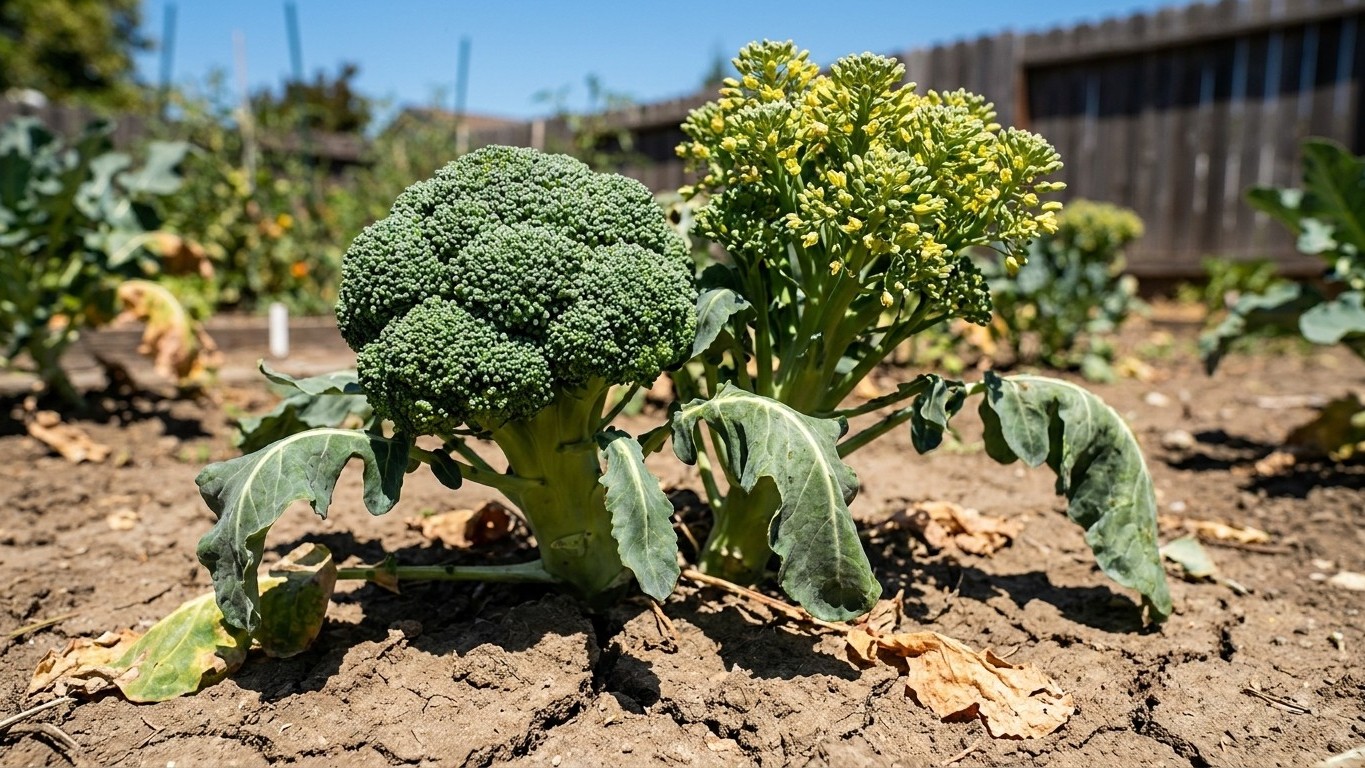

Broccoli heads pop open and turn bitter in summer for one reason: heat. Once temperatures climb past the range broccoli tolerates well, the plant rushes toward flowering, the tight curd loosens into visible yellow buds, and the flavor turns sharp and bitter. Add dry soil to that heat, and the problem gets worse fast. Utah State University Extension has documented this pattern precisely, and the fix starts with timing your planting around it.
The short answer
According to Utah State University Extension’s guide Broccoli in the Garden, broccoli “grows best and produces highest yields when temperatures do not exceed 75 F.” That single number explains almost everything gardeners see go wrong in July and August. Below that threshold, the plant channels its energy into building a tight, dense cluster of flower buds, which is the broccoli head you want to harvest. Above it, the plant switches strategies. It treats the heat as a signal that its growing season is ending, and it accelerates toward reproduction, which means the curd opens up and the individual buds start to elongate and separate.
Here’s the part that trips up a lot of home gardeners: broccoli’s real enemy isn’t cold. The same USU Extension source notes the plant “is not seriously damaged by temperatures down to 28 F.” That’s a genuinely wide cushion, well below freezing, and it’s the opposite of what most people assume when they’re staring at a forecast in March worrying about a late frost. Broccoli shrugs off cold that would wreck a tomato seedling. What it can’t shrug off is a stretch of summer heat, which is exactly why the “bitter broccoli in July” complaint is so common and the “broccoli killed by frost” complaint almost never happens if the plant was already established.
The Extension guide is direct about the outcome of heat exposure: “High summer temperatures reduce growth, decrease quality, and cause loose heads to form, which taste bitter.” Three separate effects, all from the same cause. Growth slows down because the plant’s metabolism shifts away from vegetative bulking. Quality drops because the tight curd structure that makes broccoli pleasant to eat falls apart into a looser, coarser cluster. And the bitterness shows up because the compounds responsible for broccoli’s characteristic sharp taste, the same family of compounds behind its health reputation, concentrate as the buds mature and begin to open toward flowering.
None of this is a disease, a pest, or a nutrient deficiency. It’s a temperature response, and it’s predictable enough that Utah State University Extension treats it as a planning issue rather than a troubleshooting issue. If you know your area’s summer heat pattern, you can plant broccoli to finish its head before that heat arrives, or wait until fall cools things back down.
What actually decides it
Two distinct mechanisms are at work here, and they don’t cancel each other out. A gardener who fixes only one will still see problems if the other is ignored.
Heat above 75°F
The first mechanism is straightforwardly thermal. Broccoli’s ideal growing window sits at or below 75 F, per USU Extension. Once air and soil temperatures push past that line for sustained stretches, the plant’s internal signaling shifts toward reproductive development. The head you’re growing is technically an immature flower cluster, thousands of tiny buds packed tightly together. Heat speeds up the maturation of those buds. They stop being tight and green and start stretching apart, sometimes even showing yellow petals if the head sits in the field too long during a hot spell. This is why a head that looked perfect on Monday can look ragged and loose by the following weekend during a heat wave.
Water stress during head formation
The second mechanism compounds the first. USU Extension notes that heads open and flower in hot weather, and that this tendency is worsened by water stress, which is why the guide recommends keeping plants “well-watered during the heading period.” A broccoli plant running short on soil moisture during the exact window when it’s forming its head experiences a kind of double pressure: heat pushing it toward flowering, and drought stress pushing it toward the same outcome as a survival response. Plants under water stress often accelerate reproduction because producing seed becomes a priority over vegetative growth when resources are limited. That’s true across a lot of plant species, and broccoli is no exception.
These two mechanisms interact rather than simply adding up. A moderately hot day with consistently moist soil may still produce an acceptable head. A moderately hot day layered on top of a dry stretch tends to produce the loose, bitter result faster than either factor alone would. That’s the practical reason irrigation consistency during heading matters as much as picking the right planting window.
How to do it
- Identify your region’s heat timeline. Look at when your area typically starts holding daytime temperatures above 75 F for multiple days in a row. That date, not the calendar month, is the real deadline broccoli is racing against.
- Choose a cultivar based on days to maturity. USU Extension lists Packman at 50 days, Green Comet at 55 days, and Premium Crop at 65 days to maturity. These numbers tell you how much runway you need between transplanting and harvest.
- Do the arithmetic in words, working backward. If your area typically climbs past 75 F by early July and you’re growing Premium Crop at 65 days, count back from that point roughly nine weeks, which lands your transplant date in late April or early May depending on your local calendar. If you’re growing Packman at 50 days instead, that same backward count is only about seven weeks, buying you extra flexibility and a later transplant window.
- Transplant before your last frost, not after it. Because broccoli tolerates temperatures down to 28 F without serious damage, it goes in the ground earlier than frost-sensitive crops like tomatoes or peppers. Waiting for frost to fully pass wastes cool-weather growing days broccoli actually needs.
- Keep soil consistently moist once heading begins. This is the water-stress side of the equation. A steady watering schedule through the heading period, without the plant fully drying out between waterings, reduces the drought pressure that speeds up premature opening.
- Harvest promptly once the head is firm and tight. Don’t wait for “a little bigger.” If a heat wave is forecast, cut the head early rather than risk it opening and turning bitter in place.
What goes wrong
- The head looks loose and ragged instead of tight. This is the direct result of temperatures pushing past 75 F during head formation. There’s no rescuing a head that has already opened; harvest it anyway for eating, since flavor loss is gradual, and plan an earlier transplant date next season using a shorter days-to-maturity cultivar like Packman at 50 days.
- The broccoli tastes sharp or bitter even though the head looked fine at harvest. Bitterness develops as buds mature toward flowering under heat stress, sometimes before the visual signs of opening are obvious. Harvest sooner rather than later once heads reach a good firm size, and don’t let heads sit in the garden through a hot stretch waiting to get “bigger.”
- Plants wilt and heads open faster than expected during a dry spell. This is the water-stress mechanism compounding heat. Keep the soil consistently moist during the entire heading period, since USU Extension specifically ties dry conditions to worsened head-opening.
- Transplants got hit by a late frost and gardeners assume the crop is ruined. It usually isn’t. Broccoli is not seriously damaged by temperatures down to 28 F, so a light spring frost on young transplants is rarely the real threat; heat later in the season is the bigger risk to plan around.
- A summer-sown crop bolts and flowers almost immediately. Broccoli started too late in spring often matures right as summer heat arrives instead of before it. Match the cultivar’s days to maturity against your local date for sustained 75 F-plus weather, and shift later plantings toward a fall crop instead, timed to mature after summer heat breaks.
Common questions
Can a broccoli head that has already opened be saved?
No. Once the head has loosened and buds begin separating, that process doesn’t reverse. Harvest it promptly for the kitchen since it’s still edible, just past its ideal texture and flavor, and treat it as a signal to adjust timing for the next planting.
Does mulching help with the water-stress side of the problem?
Utah State University Extension’s guidance centers on keeping plants well-watered during the heading period specifically. Consistent irrigation is the documented factor; anything that helps maintain that consistency, including moisture-conserving practices, supports the same goal.
Is it better to plant broccoli in spring or fall in hot-summer regions?
Fall plantings, timed so the head matures after summer heat has broken, sidestep the 75 F problem entirely. Spring plantings work fine as long as the days-to-maturity math lands the harvest before summer heat sets in.
Why does broccoli tolerate cold so well but not heat?
USU Extension’s data shows broccoli isn’t seriously damaged by temperatures down to 28 F, while its ideal growing ceiling sits at 75 F. That asymmetry is simply the plant’s biology: cold slows growth without harming quality, while heat actively pushes the plant into premature flowering, which is the opposite failure mode gardeners usually brace for.