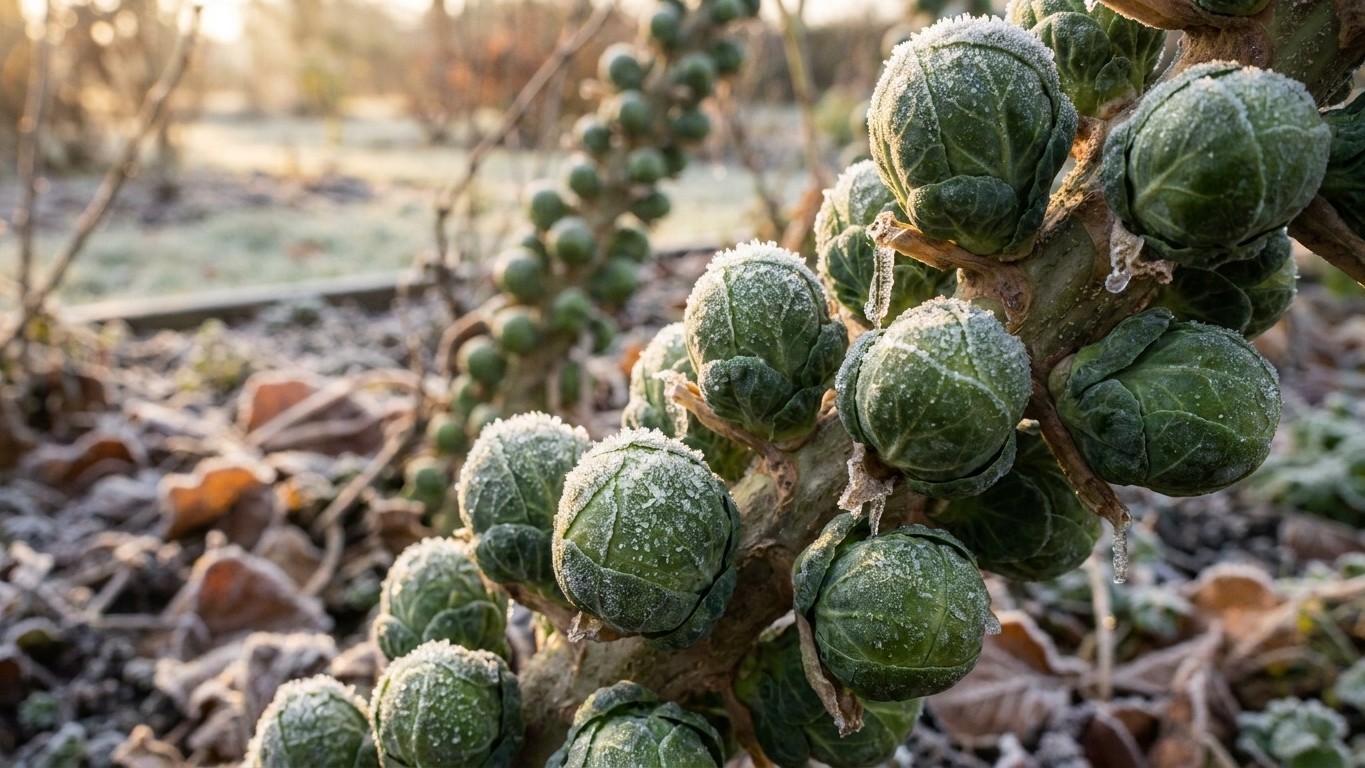

Frost doesn’t damage Brussels sprouts the way it wrecks tomatoes or basil. According to Utah State University Extension, exposure to a few frosts causes the sugars inside the sprouts to become more concentrated, and flavor keeps improving as the fall season progresses. The colder the stretch before harvest, the sweeter the sprout. That’s the whole mechanism in one sentence, but the timing behind it matters just as much as the science.
The short answer
Utah State University Extension is direct about this: Brussels sprouts taste better after they’ve been through a few frosts because those cold snaps concentrate the sugars inside the plant. This isn’t a coincidence of weather. It’s the reason gardeners are told to leave mature stalks standing well into autumn rather than pulling them the moment sprouts look harvest-ready. Exposure to cool-to-cold temperatures is what improves sweetness and flavor, not the calendar date and not how long the plant has been in the ground.
What makes Brussels sprouts unusual among fall vegetables is that they’re planted for this exact outcome. Unlike spring crops that race to beat summer heat, Brussels sprouts are sown in early summer specifically so the sprouts form as temperatures cool heading into autumn. The plant’s entire schedule is built around hitting maturity right when frost season begins, not before it. If you’re timing a planting or a harvest, the number that matters is your own first fall frost date, not a date on a seed packet and not a month pulled from someone else’s growing zone.
Variety choice affects how much runway you need before that frost. Utah State University Extension names three varieties with their approximate days to maturity: Long Island Improved at 90 days, Jade Cross at 100 days, and Diablo at 110 days. A 110-day variety obviously needs to go in the ground earlier relative to your frost date than a 90-day one. None of those day counts describe how sweet the final sprout will taste. They describe when the plant reaches harvestable size. The sweetening happens afterward, once frost starts arriving.
There’s also a ceiling to keep in mind, and it’s lower than gardeners might expect from other cole crops. Brussels sprouts grow best when temperatures don’t exceed 70°F. That’s a tighter window than cabbage or broccoli tolerate, and it’s the reason this crop is planted for a fall harvest instead of a spring one in most regions. Heat above that threshold works against the plant long before frost ever becomes a factor.
What actually decides it
Cold triggers a sugar shift, not just a flavor bump
The Utah State University Extension explanation ties directly to what’s physically happening inside the plant. Frost causes the sugars in Brussels sprouts to become more concentrated. As cold air hits the plant repeatedly through autumn, that concentration builds, which is why the source notes flavor tends to improve as the fall season progresses rather than peaking after a single cold night. One frost starts the process. Several frosts across weeks push it further. That’s also the reasoning behind leaving mature stalks in the garden well into autumn instead of harvesting at first opportunity: exposure to cool to cold temperatures is doing real work on flavor the whole time the plant stands there.
Heat is the opposite force, and it acts earlier
Sweetening from frost only matters if the plant made it to maturity in decent condition, and that’s where the 70°F ceiling comes in. High summer temperatures reduce plant growth, decrease sprout quality, and cause internal tipburn according to Utah State University Extension. Internal tipburn isn’t cosmetic. It affects the sprouts you’re trying to harvest, sometimes before you can even see anything wrong from outside the plant. This is why Brussels sprouts get planted for a fall target rather than a spring one across most climates: the plant needs to spend its main growth period under conditions closer to that 70°F limit, saving the final maturation stretch for the cooler, frost-touched weeks of autumn.
What the source doesn’t specify, and why that matters
Utah State University Extension states that Brussels sprouts are not seriously damaged by temperatures below freezing, but it gives no specific low-temperature figure. That’s a meaningful gap to respect rather than fill in with a guess borrowed from cabbage or broccoli. The practical takeaway is simpler than a number anyway: the plant tolerates freezing conditions well enough that gardeners don’t need to rush the harvest the moment frost shows up. The cold is doing the flavor work, not threatening the crop.
How to do it
- Start the crop early enough in the season that maturity lines up with cooling autumn weather, choosing a variety whose days-to-maturity (90 days for Long Island Improved, 100 for Jade Cross, 110 for Diablo) fits comfortably ahead of your own first fall frost date.
- Watch the stalk rather than the calendar. The cue to look for is lower sprouts beginning to form along the base of the plant, which signals the plant has entered its harvest window.
- Keep an eye on temperature exposure during the growing stretch. Since growth is best when temperatures stay at or below 70°F, plants pushed through hotter stretches may show reduced growth or internal tipburn before sprouts ever reach harvest size.
- Once sprouts have formed, resist harvesting everything immediately. Mature stalks can be left in the garden well into autumn, and that extra time in cool conditions is exactly what improves flavor.
- Harvest after the plant has been through a few frosts rather than before the first one. This is the step tied directly to the sugar concentration effect, and it’s the difference between a bland sprout and a genuinely sweet one.
What goes wrong
- Harvesting the moment sprouts look ready. Pulling stalks before any frost skips the concentration effect entirely. The remedy is patience, not a different variety or richer soil: leave mature stalks standing and let a few frosts pass first.
- Assuming freezing weather will kill the crop. Utah State University Extension is clear that Brussels sprouts aren’t seriously damaged by temperatures below freezing. Panicking and harvesting early to “save” the crop from frost actually removes the exact condition that improves its flavor.
- Internal tipburn showing up despite regular watering and fertilizing. This is a transport problem tied to heat stress above the plant’s 70°F comfort zone, not a shortage of nutrients in the soil. Adding more fertilizer doesn’t fix tipburn that’s caused by high summer temperatures interfering with how the plant moves resources internally; the actual fix is managing the growing window so the bulk of plant development happens in cooler conditions.
- Planting too late relative to the first fall frost. A 110-day variety like Diablo started too close to frost season won’t have time to form sprouts before cold arrives in earnest. Counting backward from your own first fall frost date, using the variety’s days to maturity, prevents this mismatch.
- Expecting sweetness gains from a single frost event. One overnight frost starts the process, but Utah State University Extension notes flavor tends to improve as the fall season progresses, implying sustained cool exposure matters more than one cold snap. Leaving the crop in place through multiple frosts, rather than harvesting right after the first, produces the better result.
Common questions
Does one frost make Brussels sprouts sweet, or do they need several?
Utah State University Extension describes flavor improving as the fall season progresses, which points to repeated cold exposure rather than a single overnight frost doing all the work.
Can Brussels sprouts survive a hard freeze in the garden?
The source states they aren’t seriously damaged by temperatures below freezing, though no specific low-temperature threshold is given, so there’s no need to rush harvest at the first freeze warning.
Why do Brussels sprouts get planted in summer instead of spring like other cole crops?
Because the crop is timed to mature as autumn cools rather than to beat summer heat. High summer temperatures reduce growth and cause internal tipburn, so the plant’s main growth period is aimed at cooler fall conditions instead.
Does variety choice affect how sweet the sprouts taste?
Variety affects days to maturity (Long Island Improved at 90 days, Jade Cross at 100, Diablo at 110), which determines timing relative to frost. The sweetening itself comes from frost exposure, not from the variety selected.