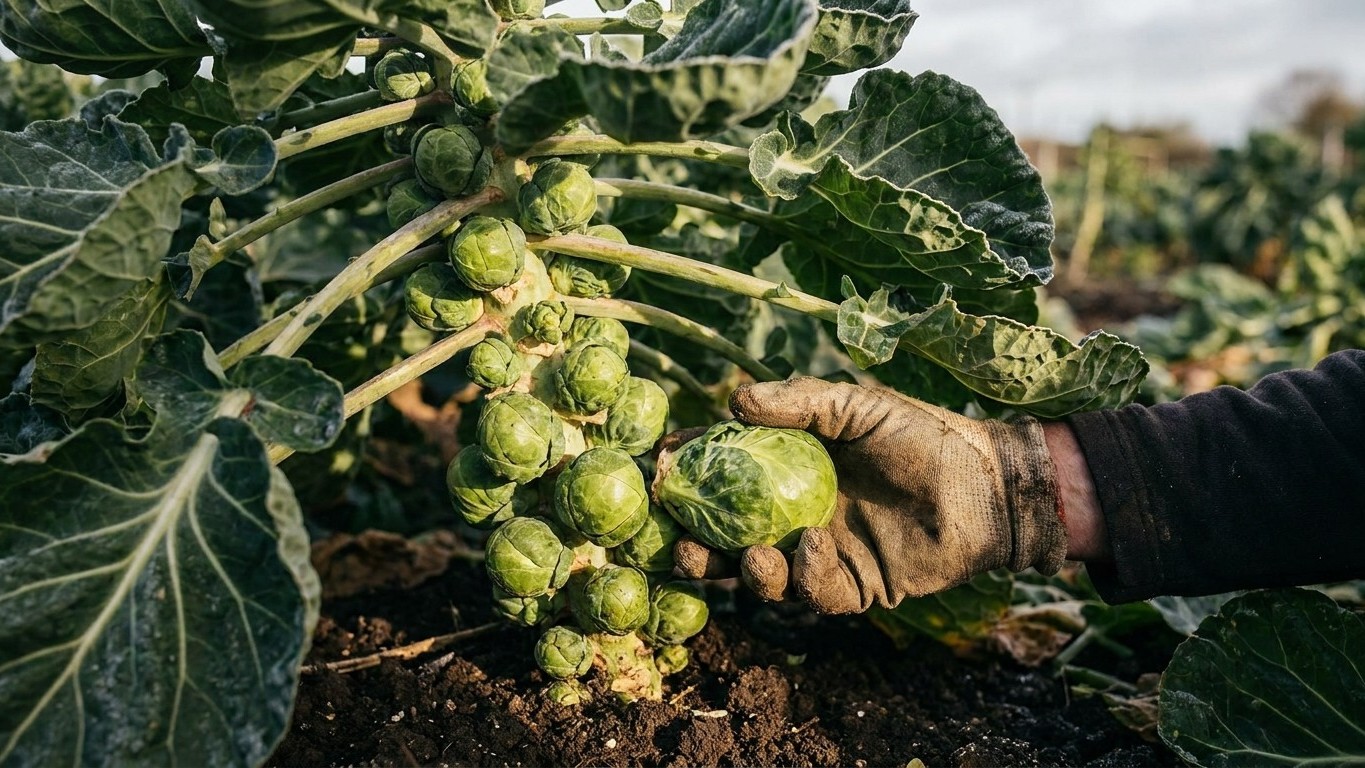

Brussels sprouts ripen from the base of the stalk upward, so the harvest itself works bottom-up: pick the lowest, tightest sprouts first and keep circling back as more mature above them. Once picked, Utah State University Extension notes they hold for 2-6 months at 32 F and 95% relative humidity, longer than almost anything else in the fall garden.
The short answer
Utah State University Extension is the source worth trusting here, and its numbers are specific: stored at 32 F and 95% relative humidity, Brussels sprouts keep for 2-6 months. That range is wide because it depends on how the sprouts were handled between the stalk and the cold storage, but even the low end beats most vegetables coming out of a fall garden.
The picking pattern matters as much as the storage Temperature. A Brussels sprouts stalk doesn’t ripen all at once. The lowest sprouts, closest to the ground, mature first. The ones near the top, closest to the growing tip, mature last. So the harvest isn’t a single event, it’s a sequence: snap off the bottom sprouts as they firm up, leave the upper ones on the stalk, and come back in a week or two for the next batch as they catch up.
This is also, unlike almost every other crop in a home vegetable garden, a summer-sown, fall-harvested plant. Brussels sprouts go into the ground in early summer specifically so the sprouts are still forming when autumn Temperatures start dropping. That’s the whole point of the timing. Don’t count backward from the last spring frost the way you would for tomatoes or peppers. Count forward from your area’s first fall frost date instead, because the sprouts are meant to be maturing and getting harvested right around and after that date, not before it.
Utah State University Extension also flags one storage rule that trips people up: don’t keep Brussels sprouts near apples, pears, or other ethylene-producing fruit, because bitter flavors develop. This isn’t a Brussels sprouts quirk. It’s the same rule that applies to cabbage and lettuce, so if there’s one lesson to take into the kitchen, it’s this: keep your fall brassicas and your fruit bowl in separate parts of the refrigerator, period, regardless of what you’re storing.
Expect a working yield of 5-8 pounds per 10 feet of row. For planning purposes, that source suggests 3-5 plants per person for fresh eating, plus another 5-7 plants per person if you want enough for storage through the winter.
What actually decides it

Why the bottom sprouts mature first
Brussels sprouts form in the leaf axils, the small pockets where each leaf meets the main stalk. The plant grows upward from a single central stem, adding new leaves at the top as it goes, which means the lowest leaves are always the oldest. Sprouts in those older, lower axils have simply had more time to develop, so they reach picking size well before the sprouts near the growing tip. That’s the entire mechanism behind bottom-up harvesting: it isn’t a technique someone invented, it’s just following the order the plant already grows in.
Why cold weather improves flavor
Utah State University Extension notes that Brussels Sprouts Are not seriously damaged by temperatures below freezing, without attaching a specific low number to that tolerance. What the cold does, beyond simply failing to kill the plant, is push the sprouts to convert stored starches into sugars as a kind of natural antifreeze response. The practical result is sprouts that taste noticeably milder and sweeter after they’ve been through a few frosts than they did in early autumn. This is also why rushing the harvest before frost arrives usually means settling for a more bitter sprout than necessary.
Why the temperature ceiling matters
The same source puts this crop’s upper temperature limit at 70 F, a lower ceiling than cabbage or broccoli tolerate. That’s a big part of why Brussels sprouts get sown in early summer instead of spring: the plant needs to spend its sprout-forming weeks in cooling autumn air, not in the heat of midsummer. Heat above that threshold stresses the plant and undermines sprout quality, which is the whole reason the crop’s calendar is built backward from the first fall frost rather than forward from spring planting the way most vegetables are.
Why 32 F and 95% humidity, specifically
Cold slows the sprout’s respiration rate, which is what causes vegetables to soften and lose sugar over time in storage. High humidity, meanwhile, keeps the outer leaves from drying out and shriveling, which is usually the first visible sign that stored sprouts are past their prime. Get either variable wrong, too warm or too dry, and the 2-6 month storage window collapses fast.
How to do it
- Watch the stalk rather than the calendar. Once the lower sprouts begin forming, tight and marble-sized, the harvest sequence has effectively started, even if the upper sprouts are still just tiny buds.
- Let a few frosts pass before the main harvest push. Because temperatures below freezing don’t seriously damage the plant, there’s little upside to picking everything the moment it’s technically ready. The sugar conversion that improves flavor happens during those cold snaps, not before them.
- Snap or cut the lowest sprouts first, twisting or cutting close to the stalk. Leave the upper sprouts in place; they need more time.
- Work back up the stalk every week or two as each new tier of sprouts firms up, repeating the same bottom-to-top order the plant grew in.
- Cool the harvested sprouts as soon as possible after picking. The sooner they reach storage temperature, the more of that 2-6 month window you preserve.
- Store at 32 F and 95% relative humidity, away from apples, pears, or any other ethylene-producing fruit, since that exposure is what turns the flavor bitter.
What goes wrong

- Bitter flavor after storage. This is almost never a growing mistake. It’s a transport and placement problem: the sprouts sat near apples, pears, or other ethylene-emitting fruit somewhere between harvest and the plate. No amount of extra care in the garden undoes that exposure once it happens, the fix is entirely about where the sprouts sit in storage, not how they were grown.
- Shriveled, dried-out sprouts within weeks. Usually a humidity shortfall. A standard refrigerator crisper often runs well below the 95% relative humidity Utah State University Extension calls for. Adding more sprouts to the drawer doesn’t solve it; the fix is sealing them in perforated bags or containers that hold moisture in, not simply storing a larger batch.
- Picking from the top down instead of the bottom up. This produces a mix of oversized, starting-to-loosen sprouts at the bottom and underdeveloped ones higher up, all harvested at once. Since the plant matures bottom-first by nature, working against that order just means picking sprouts before or after their actual peak.
- Running short of sprouts for winter storage. This is a planning shortfall, not a growing failure. Utah State University Extension figures 5-8 pounds per 10 feet of row, with 3-5 plants per person for fresh eating and another 5-7 plants per person if storage is the goal. Falling short usually traces back to under-planting in early summer, not anything that went wrong later.
- A crop that never matures before hard freezes end the season. Often a variety mismatch relative to the first fall frost date. Long Island Improved needs about 90 days, Jade Cross about 100, and Diablo about 110, so a shorter growing window calls for the faster variety, not a different harvest technique.
Common questions
Do all the sprouts on a stalk ripen at the same time?
No. Because the plant grows upward and adds new leaves at the top, the lowest sprouts are always the oldest and mature first. Expect to harvest the same stalk in stages over several weeks rather than all at once.
Should Brussels sprouts be picked before or after the first frost?
Utah State University Extension notes the plant isn’t seriously damaged by temperatures below freezing, and a few frosts tend to improve flavor by pushing the sprouts to convert starches into sugars. There’s rarely a reason to rush the harvest ahead of the first frost.
Can Brussels sprouts be stored in the same drawer as apples?
No. Utah State University Extension warns that storing them with apples, pears, or other ethylene-producing fruit causes bitter flavors to develop. Keep them in a separate part of the refrigerator or storage area entirely.
How long do Brussels sprouts actually keep once harvested?
At 32 F and 95% relative humidity, Utah State University Extension puts storage life at 2-6 months, well beyond what most fall vegetables offer, provided the temperature and humidity targets are both met consistently.