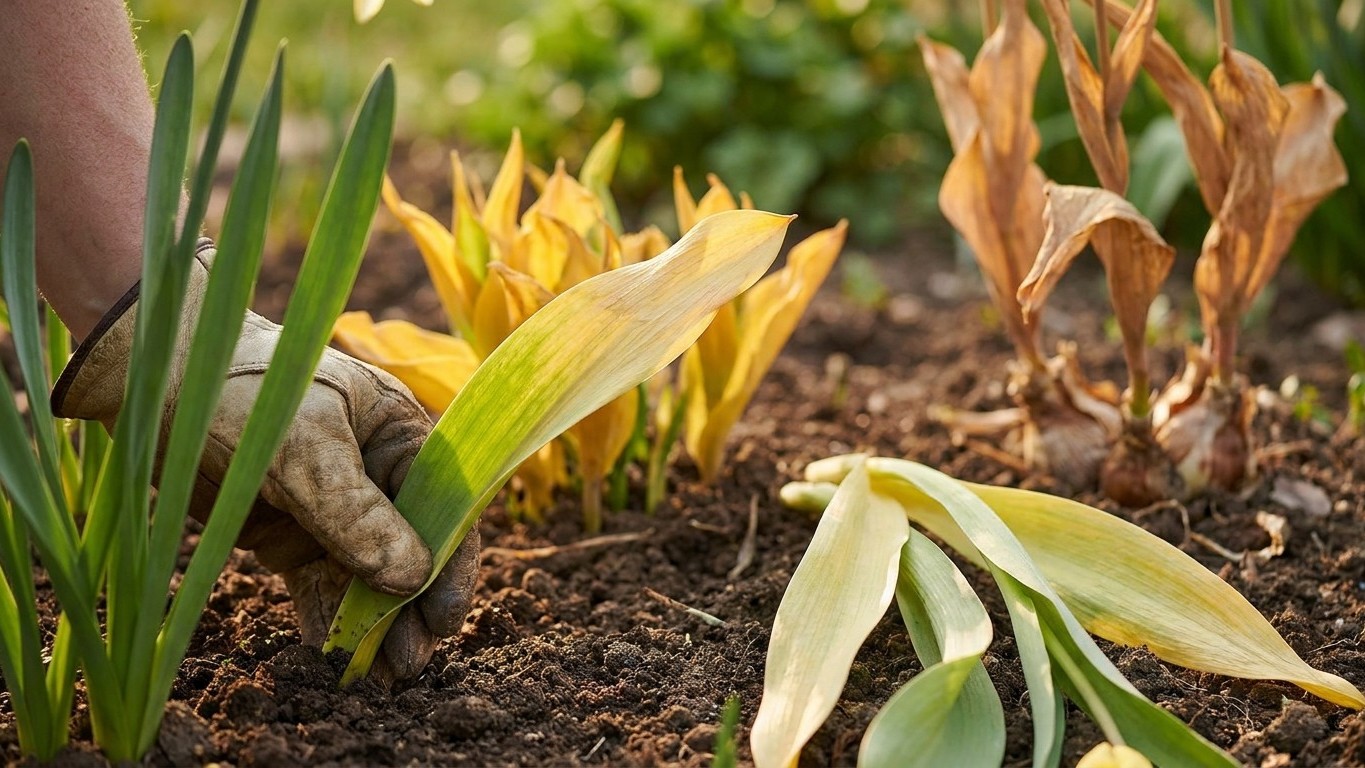

Leave the foliage standing until it turns yellow and pulls away from the bulb with a gentle tug, usually six to eight weeks after the flowers fade. Those leaves are feeding next year’s flower, which is already forming inside the bulb right now. Cut them early and you’re not tidying the bed, you’re erasing next spring.
The short answer
Don’t cut, don’t braid, don’t fold the leaves over and rubber-band them into a neat little bundle. Let them die back on their own, fully, until they’ve gone from green to yellow to brown and come away from the base with almost no resistance. That’s the whole instruction. Everything else people do to bulb foliage, from mowing it down two weeks after the tulips finish to tying it into tidy knots, either slows the process or cuts it off outright.
The reason this matters so much comes down to timing that has nothing to do with how the bed looks. The flower you’ll see next spring is already formed inside the bulb. It was built last summer, sitting dormant underground, waiting on cold and a root system to wake it up. The leaves that follow this year’s bloom are the factory that builds next year’s flower and stores the sugar the bulb needs to push it up. Take the factory offline early and the bulb has nothing to draw on. It might still send up a leaf next spring. It won’t send up a flower.
Why “after blooming” isn’t one single moment
People treat “after blooming” like a date on a calendar, but it’s really a color change. The flower dropping its petals is not the same event as the plant being done. The leaves keep working for weeks past that point, quietly converting sunlight into stored energy and packing it into the bulb. Yellowing is the visible sign that the transfer is finished and the leaf has nothing left to send down. That’s the cue to remove it, not the fading of the bloom itself.
This is also where most of the well-meaning shortcuts go wrong. Braiding or folding the leaves is often sold as a tidiness trick, but bending the foliage crushes the internal channels that move sugar to the bulb, cutting the transfer short even though the leaf still looks green and alive. Mowing a bed of spent foliage on the same schedule as the lawn does the same damage with a machine instead of a hand. The leaf doesn’t need to look good. It needs to finish its job.
What actually decides it
Strip away the yellowing leaves and the tidy garden bed, and there are really only two things happening below ground: a flower that’s already built, and a clock that has to run out before that flower is allowed to open. The bulb you plant in fall isn’t a blank slate that grows a flower from scratch each spring. It’s closer to a shipped package, sealed and complete, with the flower parts already differentiated inside the bulb tissue. What the gardener adds isn’t the flower. It’s the conditions that let it come out.
Those conditions are cold and time. The bulb needs roughly 13 weeks with temperatures below 45 F to satisfy its cold requirement, and it needs those weeks to happen while it still has enough root growth in the ground to take up water once things warm up. Below that 13-week threshold, the outcome isn’t a smaller flower or a later flower. It’s leaves and no flower at all. This is a hard cutoff, not a matter of feeding the bulb more or giving it better soil. A bulb that never got its cold has the leaf-making machinery intact but the flower-triggering mechanism unfired, and no fertilizer schedule reaches around that.
This is the part that lets you reason about almost any spring bulb without needing a name for it. If a bulb blooms in spring, then whatever happened the previous fall and winter, cold exposure and root establishment, already decided whether this spring’s flower shows up. The foliage this year is doing the same job in reverse: banking the energy and letting the bulb rebuild itself so that next fall it goes into dormancy already carrying a formed flower, ready for its own 13 weeks below 45 F. Skip the cold one winter, and you get leaves with no flower the following spring. Cut the foliage short one summer, and you get a weaker bulb heading into that same cold period, sometimes too weak to flower at all regardless of how much cold it gets.
So the sequence runs in a loop: cold and rooting time produce the flower, the flower’s leaves after bloom produce the energy for the next flower, and that next flower again needs its own cold and rooting time before it will show itself. Break either link, cut the foliage or skip the cold, and the loop stalls at leaves.
How to do it
- Let the flower fade naturally. Don’t deadhead the leaves along with the spent bloom. Removing the flower head itself is fine and even helpful, since it stops the plant from spending energy on seed production, but the leaves stay.
- Water as normal through the leaf stage. The foliage still needs moisture to keep photosynthesizing and sending sugar down to the bulb. Letting the bed go bone dry right after bloom cuts the process short almost as fast as cutting the leaves themselves.
- Watch the color, not the calendar. Wait for the leaves to shift from green to yellow to brown rather than counting off a fixed number of weeks. Growing conditions vary from bed to bed, and the leaf itself is the signal.
- Test with a gentle tug. Once the foliage is mostly brown, pull lightly at the base. If it comes away with almost no resistance, the bulb has finished drawing what it needed and the leaf is truly done.
- Remove the dead foliage. Cut or pull it once it’s fully brown, both for the look of the bed and to reduce a place where pests or disease can overwinter.
- Leave the bulb undisturbed in the ground. For bulbs meant to stay put year over year, don’t dig or divide right after this stage. Let the bulb sit through its dormancy and its cold period undisturbed until fall planting or transplanting time.
- Plan any new planting around the six-week window. If you’re adding bulbs to the same bed, get them into the ground about six weeks before the ground freezes, so roots establish before winter locks the soil.
What goes wrong
- Leaves and no flower the following spring. This is the failure that matters most, and it’s not a feeding problem. It means the cold requirement, that roughly 13-week stretch below 45 F, wasn’t met. No fertilizer, no soil amendment, and no amount of sun fixes it after the fact. The only remedy is making sure the bulb gets a full cold period the following winter, which for garden beds usually means simply leaving it in the ground through a normal winter rather than digging it out and storing it somewhere warm.
- Foliage braided or folded down early. This crushes the internal tissue that carries sugar to the bulb, cutting off next year’s flower even though the leaf still looks alive. Stop the practice and let the leaves stand loose until they yellow on their own.
- Mowing or cutting foliage down right after bloom. Treating spent bulb foliage like lawn clippings removes the plant’s only way of storing energy for next year. Skip mowing that section of the bed until the leaves have gone fully brown.
- Bed looking messy and getting “cleaned up” too soon. The impulse to tidy the yard is the single biggest cause of lost blooms the following year. Interplant with later-emerging perennials or annuals that grow up and hide the yellowing foliage, so there’s no visual pressure to cut it early.
- New bulbs planted too late to root before freeze-up. Bulbs need roughly six weeks in the ground before the ground freezes so roots can establish. Planted later than that, they go into winter with a weak root system and struggle even if the cold requirement itself gets met. Get bulbs in the ground on that six-week schedule rather than waiting for a mild stretch late in the season.
- Digging and dividing bulbs too soon after leaves die back. Disturbing the bulb right after dormancy begins interrupts a period where it’s still settling internally. Wait until the recommended digging or transplanting window for that type of bulb rather than acting the moment the foliage disappears.
Common questions
Can I cut bulb foliage back halfway to make the bed look neater?
No. Cutting the leaf at any point before it yellows removes part of the surface area that’s still sending sugar to the bulb, which reduces next year’s flower even if it doesn’t eliminate it entirely. Full yellowing is the signal that the transfer is complete, not a fixed date or a percentage of the leaf.
Does tying the leaves up instead of cutting them solve the problem?
It doesn’t. Braiding or folding foliage bends and compresses the tissue that carries sugar down to the bulb, so the plant’s ability to feed the bulb drops even though nothing has actually been cut. It only looks like a gentler solution.
How do I know if the leaves are done and not just wilting from heat?
Color is the reliable signal. Wilting from heat or dry soil shows as drooping green leaves that perk back up with water. A leaf that’s genuinely finished turns yellow, then brown, and pulls away from the base with almost no resistance. If watering revives it, it wasn’t finished.
If my bulbs bloomed but the flowers were smaller than last year, is that a foliage problem?
It can be. A bulb that had its foliage cut short, mowed early, or shaded out the previous summer enters its cold period with less stored energy, which often shows up as a smaller or weaker flower the following spring rather than no flower at all. Consistent full die-back each year is what keeps flower size steady.