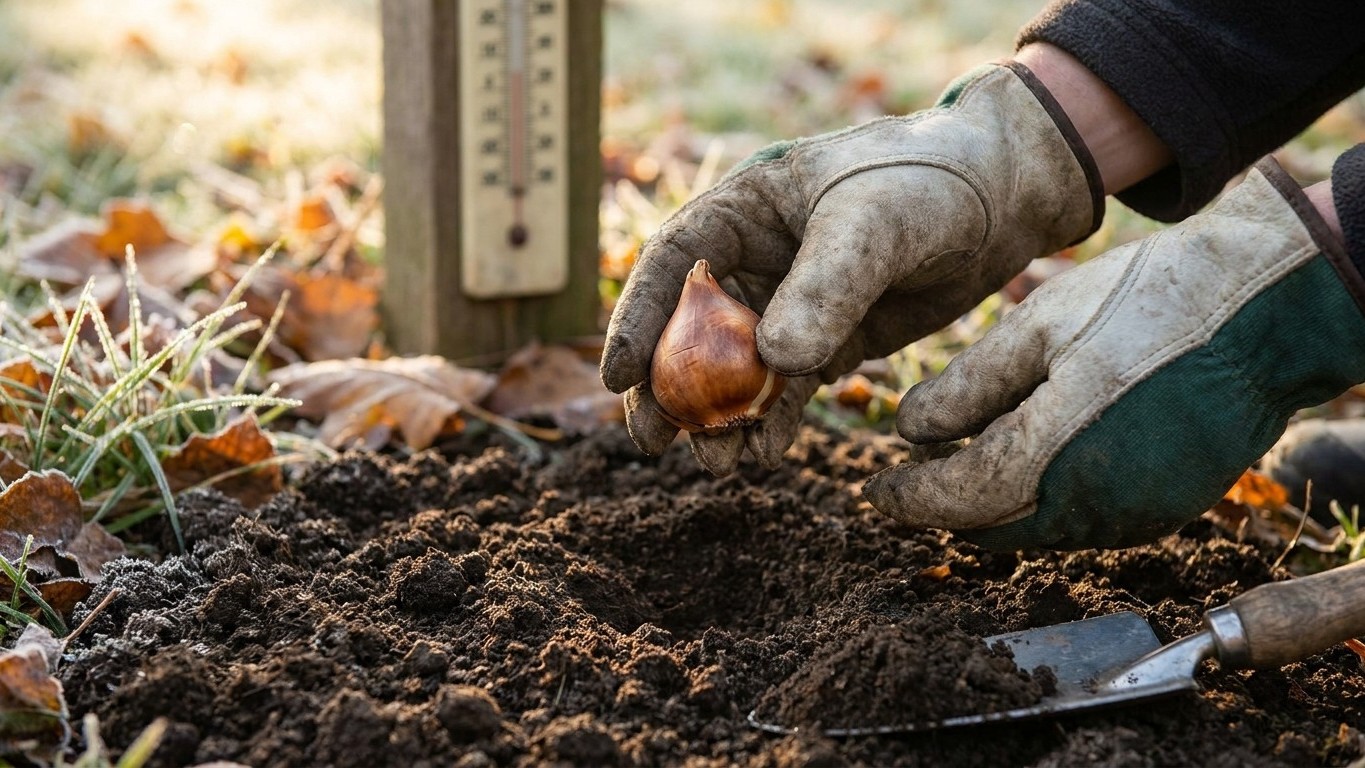

Six weeks before the ground freezes solid is the planting window that works, because it gives roots time to establish while the soil is still workable. The flower itself isn’t something you’re building this fall. It’s already there, folded inside the bulb, waiting on two things only a gardener can supply: enough cold, and enough time to root before the soil locks up for the season.
The short answer
Plant spring bulbs about six weeks before the ground freezes in your area. That’s the figure that matters, and it’s worth sitting with for a second, because it’s not six weeks before the first frost, not six weeks before Thanksgiving, not a date on a calendar at all. It’s tied to the ground itself, to the point where soil Temperature drops low enough that a shovel won’t go in anymore.
That distinction changes everything about how you plan. Frost kills tender leaves and tomato vines long before the ground actually freezes. A light frost can hit while the soil ten inches down is still soft and workable. So if you’re using frost as your marker, you’re likely to plant too early or, more often, panic and plant too late. The ground-freeze date is later than the first frost date in almost every region, sometimes by several weeks, which is why so many bulbs go into the ground later than gardeners expect and still turn out fine.
Why six weeks, specifically
Six weeks is the buffer that lets roots get established before the cold shuts things down. A bulb planted into workable soil doesn’t need warmth to grow roots, it needs the soil to still be loose enough for roots to push through and make contact. Once that root system is in place, the bulb can sit through winter drawing in the cold it needs, and the roots keep functioning even after the top of the soil has firmed up, as long as they got a head start.
Plant too close to the freeze date and the roots don’t have that runway. The bulb still survives, in most cases, because bulbs are built to tolerate a fair amount of neglect. But a bulb that goes in with only a week or two of workable soil left behind it is starting the cold season less anchored, less able to draw moisture, and more exposed to the kind of frost heaving that pushes shallow-rooted bulbs up and out of the ground over winter. The six-week window isn’t a magic number so much as a practical margin, the amount of time root establishment typically takes before hard freeze makes the question moot.
What actually decides it
Here’s the part that surprises people: the flower for next spring is already formed inside the bulb when you buy it. Whatever species you’re holding, whatever color it’s going to be, that’s already decided. You’re not growing a flower from scratch over the winter. You’re storing and chilling something that’s already complete, and your job is to keep it alive and cold enough until it’s ready to send that pre-formed flower up through the soil in spring.
That reframes what “planting” is actually accomplishing. It isn’t feeding growth. It’s positioning a dormant structure somewhere it can take up moisture through its roots and, more importantly, experience a sustained period of cold. Most spring-flowering bulbs need about 13 weeks below 45 F to complete that internal process. Below that threshold of cold exposure, something specific and unforgiving happens: the bulb produces leaves and no flower. Not a weak flower, not a late flower. No flower at all.
This is worth sitting with, because it’s the same kind of hard cutoff you see in other biological triggers, like day length switching on bulb formation in onions. It isn’t a sliding scale where a little more cold gives you a little more bloom. It’s a threshold. Either the bulb accumulates its 13 weeks below 45 F, or it doesn’t, and if it doesn’t, no amount of fertilizer, sun, or tender care the following spring will produce a flower. The leaves will come up right on schedule, green and healthy-looking, and then nothing more will happen. That gap between leaf and flower is the single most diagnostic sign in spring bulb growing, and it always traces back to insufficient cold, not insufficient nutrition.
So the planting date is really doing double duty. It has to happen early enough that roots take hold before the ground freezes solid, and it has to happen early enough that the bulb accumulates its full quota of cold weeks before spring warmth arrives and triggers growth. Two clocks, both running from the planting date, both needing to finish before the bulb starts pushing upward. If you understand that mechanism, you can reason through timing for practically any spring bulb species, just by asking two questions: how much cold does it need, and how much rooting time does it need before the ground shuts the door.
How to do it
- Find your ground-freeze date. This isn’t the same as your first frost date. It’s the point in fall when soil temperature drops enough that digging becomes difficult or impossible. It’s typically later than the first light frost, sometimes considerably later.
- Count back six weeks from that date. That’s your planting window. Mark it on a calendar rather than relying on memory, since the date shifts a little from year to year depending on how the season runs.
- Choose a site with workable soil. The soil needs to be loose enough for roots to spread, and it needs to drain, since bulbs sitting in standing water over winter are prone to rot regardless of how well the cold requirement is met.
- Get bulbs into the ground within that window, not right at the edge of it. Planting at the very start of the six-week window gives roots more runway than planting on the last workable day, and there’s little downside to going a bit early within reason.
- Water after planting. Moisture at planting time signals the bulb to start root growth immediately rather than sitting inert, which matters when the clock on root establishment is already running.
- Leave the bulbs alone through winter. No feeding, no digging to check on them. The cold accumulation happens on its own schedule underground, and disturbing the site risks damaging roots that are still forming.
What goes wrong
- Leaves come up in spring but no flower ever appears. This is the cold-requirement failure, and it’s the one that matters most. If the bulb didn’t get its roughly 13 weeks below 45 F, whether because it was planted too late, stored somewhere too warm, or planted in a mild-winter spot without enough cold days, the flower simply doesn’t form. There’s no fix once this has happened for the season. Feeding won’t help, extra sun won’t help. The only remedy is planting on time next fall, or in warmer climates, artificially chilling the bulbs before planting.
- Bulbs planted too close to the freeze date never root properly. Without six weeks of workable soil ahead of them, roots stay shallow and weak. The fix is prevention: track your ground-freeze date and work backward, rather than planting whenever the mood strikes in late fall.
- Bulbs heave up out of the soil over winter. This usually traces back to shallow or incomplete rooting, often a downstream effect of planting too late. Firming the soil well at planting time and mulching after the ground begins to cool can help hold bulbs in place while roots finish establishing.
- Rot sets in before spring. Poor drainage is almost always the cause, not the cold itself. A site that holds water through winter will rot bulbs regardless of how correctly the timing was handled. The remedy is choosing a different site or amending drainage before the next planting season, not adjusting the planting date.
- Bulbs planted too early sprout before winter sets in. Unseasonably warm spells after an early planting can occasionally push premature top growth. It’s not usually fatal, but it does mean rethinking the planting date within the six-week window rather than at its outer edge.
Common questions
Does it matter if I plant a little earlier than six weeks before the ground freezes?
Not much. Extra rooting time before freeze-up is rarely a problem, since the risk runs almost entirely in the other direction, planting too close to the freeze date rather than too far ahead of it.
Can I still plant if I miss the six-week window?
It depends on how much workable soil time is left. If the ground can still be dug, bulbs can still go in, just with less root establishment time and a somewhat higher risk of heaving or weak spring performance.
Why do the leaves come up fine but no flower ever shows?
That’s the cold-requirement threshold at work. The bulb needs about 13 weeks below 45 F to complete flower development internally, and if it didn’t get that, leaves still emerge but the flower structure was never triggered. It isn’t a feeding or care issue.
Is the ground-freeze date the same as the first frost date?
No, and confusing the two is one of the most common timing mistakes. First frost affects tender foliage above ground; ground freeze is about soil temperature reaching the point where digging is no longer possible, and it typically comes later.
The Moon calendar is a separate, older custom: see when to plant flower bulbs by the moon, written as tradition rather than fact.