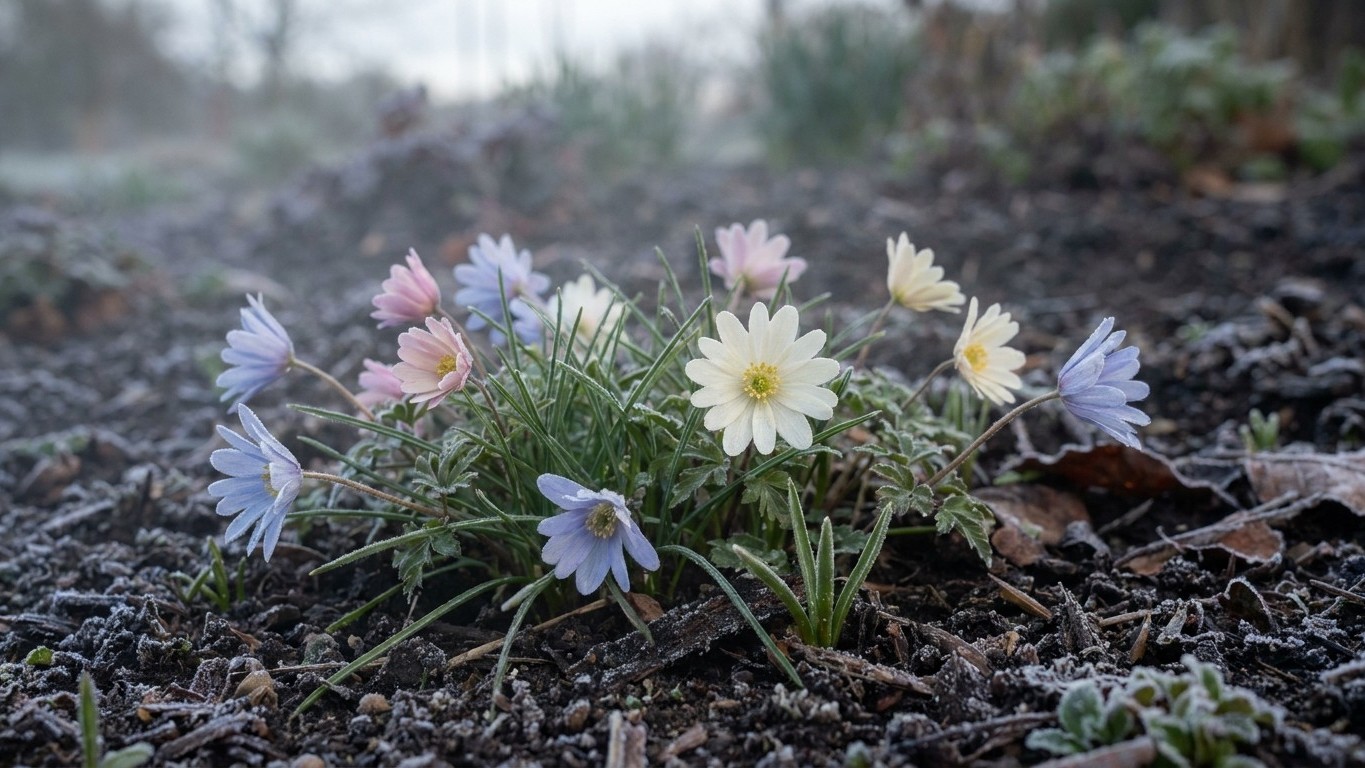

Grecian Windflower needs 12 to 14 weeks of temperatures below 45F to bloom at all, and it’s hardy in USDA zones 5-9. Skip either requirement and you get leaves with no flower, or a bloom too short to see above the mulch. Here’s what a buyer needs to know before the tubers go in the ground.
What Grecian Windflower actually is

Grecian Windflower is a member of the anemone group, and its two defining figures are the ones most catalogs bury on page three: a cold requirement of 12 to 14 weeks below 45F, and a hardiness range of USDA zones 5 to 9. That cold window is the single fact that decides whether you get flowers or just foliage. A bulb that gets close to 12 weeks but not quite there often flowers poorly rather than not flowering at all, so gardeners near the edge of zone 5 or in a mild pocket of zone 9 should treat their results as uncertain rather than guaranteed.
It blooms in early spring, ahead of tulips and most daffodils, in shades of blue, pink, and white. The flowers open low to the ground, close to the still-cold soil, which is part of why the bloom window reads earlier than most people expect from a spring bulb.
A habit worth knowing before you plant
One quirk catches gardeners off guard: the foliage doesn’t wait for a warm season to appear. Leaves emerge in autumn and stay through the winter, low and grassy, well before any flower is visible. Then the plant goes dormant by early summer, foliage and all, and disappears from the bed until the following fall. If you’re used to spring bulbs that leave a visible clump of leaves well into June, this one will surprise you by vanishing weeks earlier.
How deep and how far apart
The depth and spacing are fixed numbers, not a range to eyeball. Plant too shallow and freeze-thaw cycles will heave the tuber right out of the soil over winter; plant at the correct depth and the soil above acts as a buffer against that cycling.
- Depth: 2 to 3 inches
- Spacing: 4 inches apart
Spacing at 4 inches is what turns a planting into a drift rather than a scattering of isolated dots. Anemone blanda reads best in gardens as a loose sheet of color, so resist the urge to space the tubers further apart to “save” bulbs for another bed. Closer spacing within that 4-inch guideline gives a denser, more convincing carpet by the second season.
Orientation and the soak that makes or breaks establishment
Grecian Windflower tubers arrive as small, hard, irregular knots with no obvious top or bottom, and orientation genuinely does not matter here. Plant one sideways or upside down and it still finds its way toward the surface. Don’t waste time hunting for eyes or a growing point the way you might with a dahlia tuber.
What does matter, and what gets skipped more often than it should, is soaking the tubers overnight before planting. These bulbs arrive bone-dry and shrunken, and a dry tuber dropped straight into the ground can simply fail to take up water fast enough to establish before the soil cools further. An overnight soak rehydrates the tuber and is, by a wide margin, the difference between a planting that establishes and one that rots or never sprouts.
Will it come back next year
This is the honest question, and the answer for Grecian Windflower is yes, reliably, within its zone range and cold requirement. Unlike some spring bulbs sold as perennials that quietly fade after two or three seasons, Anemone blanda tends to persist and slowly spread once established, given the right winter chill and a spot that isn’t waterlogged through the dormant months.
The mechanism is straightforward biology rather than marketing. After the flowers fade, the foliage keeps photosynthesizing, and that energy gets stored back into the tuber to build next year’s flower before the plant goes dormant by early summer. Cut the leaves back while they’re still green, or rake them away because they look untidy, and you cut off that energy supply mid-build. The tuber survives, usually, but it flowers weaker the following spring, or skips a year entirely. This is by far the most common reason a planting of spring bulbs “stops working” after a strong first year: it isn’t the cold, it isn’t the soil, it’s a gardener who tidied up too early.
Leave the foliage alone until it yellows and pulls away on its own, however unkempt that looks in a tidy bed for a few weeks in late spring. That patience is what separates a planting that returns and thickens for years from one that quietly disappears after its debut season.
What eats it, and what leaves it alone
Squirrels and other rodents will dig up and eat Grecian Windflower tubers, particularly right after planting when the soil is freshly disturbed and the scent of a buried tuber is easiest to find. This is a plain fact worth stating rather than hedging, because a gardener who loses a fresh planting to squirrels within days of putting it in the ground usually assumes something else went wrong, when the real problem was never given a chance to establish.
The measure that actually works is unglamorous but effective: lay wire mesh flat over the planting area right after you water it in, and leave it there until the ground freezes hard for the season. Rodents dig by scent and disturbed soil texture, and a mesh barrier removes both cues long enough for the tuber to settle in and lose that fresh-dug smell. Pull the mesh once the ground is frozen solid, since by then digging is no longer practical for the animals anyway, and the tubers are past their most vulnerable window.
Repellent sprays and predator urine granules are sold widely for this exact problem, but they wash off with the first rain or snowmelt and need constant reapplication through the fall, which is more effort for less reliability than a single sheet of wire mesh set down once.